The Thing Was Not Rejected in 1982. It Was Mis-Sold.
John Carpenter's The Thing earned back its budget and was savaged anyway. The record says the film was not the problem. The poster, the tagline and the weekend it opened were.
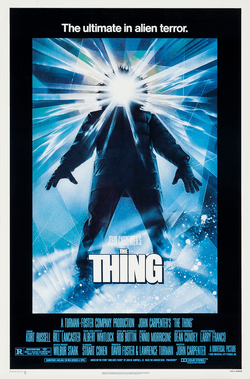
Poster via Wikipedia, The Thing (1982 film). Used under fair use for criticism and review.
Let me get one thing out of the way. The Thing was not a flop. Universal spent a reported $15 million, the film took $19.6 million in American cinemas, and a few later re-releases pushed the worldwide figure to roughly $20.9 million. That is not a hit. It is also not the catastrophe of the legend, in which John Carpenter’s film is thrown out of cinemas by a horrified public and spends a decade in exile before video rescues it.
The truth is more annoying. The film did a business that a modest studio picture can live with, in the worst possible month, under advertising that told audiences it was something else.
June 1982
The Thing opened on 25 June 1982. Three weeks earlier, Poltergeist and Star Trek II: The Wrath of Khan had arrived. Two weeks earlier, E.T. the Extra-Terrestrial had opened, and by the end of that month it was the only thing anyone in America wanted to talk about. The same day as Carpenter’s film, Blade Runner opened across the road. The paying public was being asked to choose between a gentle alien who wants to go home, a cop who hunts replicants and an Antarctic parasite that wants to be you.
It opened to $3.1 million from 840 theatres, a per-screen average of $3,699, and finished eighth for the weekend, behind a Poltergeist in its fourth week. It was out of the top ten within three. This is a small number, and the reason for it is not a mystery. It is the same reason a studio does not open a bleak R-rated horror film into a summer that had just been handed a friendly alien.
Universal knew. Producer David Foster is reported to have said “We’re dead” after the audience at a screening of E.T. went silent for the Thing trailer. The studio had also commissioned a demographic study showing that the audience for horror films had fallen by seventy per cent over the previous six months, and it sent the study to Carpenter. He took it, not unreasonably, as a hint to lower his expectations.
What they sold instead
Here is the part I will not let go. Carpenter’s film has one great idea, and it is not the monster. It is that nobody in the room can be trusted, and the audience cannot be sure either. That idea had a tagline: “Man is the warmest place to hide.” It was written by Stephen Frankfort, the man who wrote “In space, no one can hear you scream” for Alien, and it told the whole story in seven words.
After public pre-screenings, Universal dropped it. The sombre black-and-white artwork the producers had approved was replaced with a colour image of a person with a glowing face, and the tagline became “The ultimate in alien terror.” Carpenter even made a last-minute attempt to retitle the picture Who Goes There?, after John W. Campbell’s 1938 novella, and lost. Universal removed the one line that explained why you should be afraid and replaced it with a line that promised you would see something.
That is a choice about what the picture is for. A film about paranoia was sold as a film about effects, and Rob Bottin’s effects were precisely what many reviewers could not forgive. If you sell a thing on how gruesome it is, you do not get to be shocked when people tell you how gruesome it is.
The reviews, in fairness
The notices were bad, and some of them were bad in ways that deserve attention. Starlog called it “cold and sterile.” The Los Angeles Times’ Linda Gross wrote that it was “bereft, despairing, and nihilistic” and that nobody’s death mattered. Newsweek’s David Ansen felt that it confused effects with suspense and was “sacrificing everything at the altar of gore.” The New York Times’ Vincent Canby said it was entertaining only if you needed to see spider-legged heads and dog autopsies.
I do not think those critics were stupid. I suspect a good number of them walked in expecting the film Universal had advertised. Gross is right that the film is despairing; she is wrong that nobody’s death matters, and the evidence is on screen: Dean Cundey’s anamorphic compositions leave negative space around each man precisely so you register who is no longer in the frame. Carpenter had rehearsed the cast for two weeks before shooting, an expense that was unusual at the time, because he wanted to see how the scenes would play before the cameras ran, and what he got is a room in which every look between Kurt Russell’s MacReady and Wilford Brimley’s Blair carries a threat. Keith David, in his first significant film role, learned on the job to hold back what his character knew. None of that is “sacrificed at the altar of gore.”
Who was right
The record settles it. The film that was thrown out in June 1982 is now ranked among the best horror films and science-fiction films ever made, in poll after poll, and Ennio Morricone’s score, much of it bent towards Carpenter’s own synthesiser style and laced with the electronic pieces Carpenter and Alan Howarth added, now sounds like the only music the story could have had.
The correct lesson is not that audiences were wrong. They were being asked to buy something else, and in June 1982 most of them declined. The film, given time, found the audience it should have been sold to in the first place. That is a more damning verdict on the campaign than on the public’s taste.
I would rather be clear about who failed whom. The film did the job. The campaign lost its nerve, and a nervous campaign is how you end up with a nightmare about trust and a poster with a glowing face on it.
Marcus believes good criticism is an argument. He is almost always angry about something, usually for good reason. Horror is his first language.
MORE BY MARCUS VELL →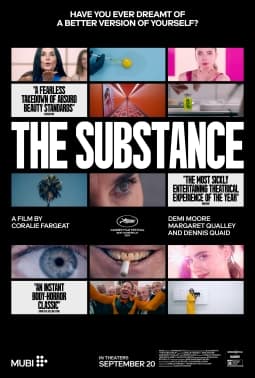
The Substance and the Body Horror Renaissance
Eighteen months after Coralie Fargeat's prosthetic-heavy fable drew both Oscar nominations and walkouts, the strange alchemy of The Substance has only clarified. The film is less about Hollywood than it looks, and more about what we're allowed to say with bodies on screen.
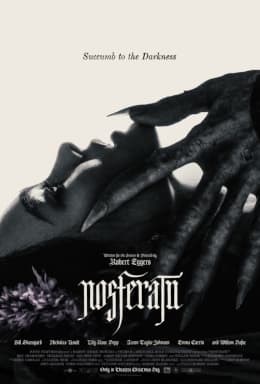
Nosferatu: Eggers' Gothic Masterwork
Eggers' remake was received with admiration rather than fervour, a proper film from a proper filmmaker. Sixteen months later, it looks like the serious piece the year needed, and the one we were too cool to love properly at the time.
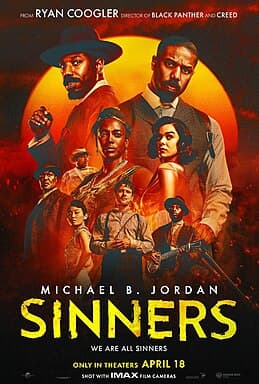
Sinners: Coogler's Vampire Western and the Return of the Studio Auteur Movie
Ten months on, Ryan Coogler's 1930s Mississippi vampire film doesn't just still hold up, it looks like the clearest sign in years that the studio auteur movie is not dead. A field report from inside the juke joint.