Nosferatu: Eggers' Gothic Masterwork
Eggers' remake was received with admiration rather than fervour, a proper film from a proper filmmaker. Sixteen months later, it looks like the serious piece the year needed, and the one we were too cool to love properly at the time.
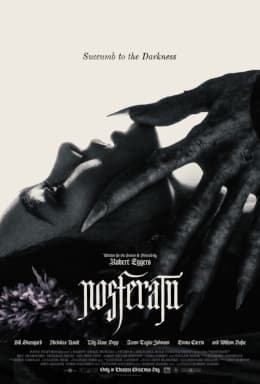
Poster / promotional material via Wikipedia, Nosferatu (2024 film). Used under fair use for criticism and review.
The critical reception of Robert Eggers’ Nosferatu in December 2024 was, in retrospect, unfair in a specific way: it was unfair by being too respectful. Reviews tended to describe the film as handsome, scholarly, period-accurate, meticulous, all of which it is. What nobody quite said, at the time, was that it was also lovestruck.
Sixteen months later, re-watching the film in a smaller cinema, what I noticed first was not the production design (which everyone has already praised), nor the Jarin Blaschke cinematography (ditto), nor Lily-Rose Depp’s performance (the best in a film of very fine performances). What I noticed was the camera’s willingness to hold on the ugly. The long shots of Bill Skarsgård’s Count Orlok, the sinews, the nails, the raised veins under vellum skin, are not horror shots in the modern sense. They are reverent shots. Eggers loves this creature. The film’s argument, for anyone patient enough to sit in its tempo, is that the tradition Orlok represents, the Eastern European folk-horror of earth and rot and unholy pacts, is worthy of love, even when it’s repulsive.
A remake of a remake of a not-quite-adaptation
It’s worth remembering how improbable this film was. F.W. Murnau’s 1922 Nosferatu was itself a plagiarised adaptation of Dracula, made without permission from Bram Stoker’s widow, who sued. Werner Herzog’s 1979 version, the other pillar of the Nosferatu tradition, was itself partly a meditation on Murnau. To make a Nosferatu in 2024 was to step into a line of inheritance so specific that missteps would have been immediate.
Eggers did not misstep. What he did was quieter and more surprising: he made the film explicitly about the characters’ faith in their own stories. The Transylvanian villagers in his film are not credulous peasants. They are expert practitioners of a folk religion that turns out, in this world, to be correct. Ellen Hutter’s sensitivity is not a Gothic-novel cliché, it’s a vocation. She is the only person in the film who can do the thing the film requires, and she knows it, and the film is about her gathering the nerve to do it.
This is the part of Nosferatu that I don’t think was sufficiently appreciated at release. The film is a horror film, and an excellent one, and it will reward every viewer who comes to it for the horror. But the engine underneath is a theological engine. Orlok exists because a certain kind of belief exists. He is not in the film to haunt Wisborg, he is in the film because Ellen needs him, in a way that is never quite articulated and never quite denied. Lily-Rose Depp plays her as a woman who understands the transaction and is horrified that she understands it.
On the length
There was grumbling about the runtime. Two hours, twelve minutes. This is not actually long for a Gothic, but it felt long because Eggers refuses to accelerate into his horror beats. He makes the viewer wait. Scenes breathe in a way that is out of step with the contemporary American genre film, which tends to edit for momentum. Nosferatu edits for dread.
Dread, as a mood, is more fragile than scare. A well-staged jump scare is hard to ruin, the viewer’s body responds whether or not they believe in it. Dread requires the viewer’s imagination to cooperate. It requires time. The long sections of Nosferatu set in Orlok’s castle, the meals, the corridors, the sequence with the books, are dread that will not survive shortening. If you cut those scenes in half, the film is sharper and worse.
The Skarsgård question
The most divisive element of the film, in its first release, was Bill Skarsgård’s performance. Some reviewers loved it. Some thought it was too physicalised, too prosthetic-dependent, a creature performance rather than a character performance. I was, at the time, mildly on the second side of that argument.
I was wrong. The performance works, and it works because Skarsgård made a specific decision that I missed on first viewing: Orlok is tired. The voice, the movement, the slow terrible patience of him, it’s all coloured by exhaustion. This is not Dracula the charismatic seducer. This is a creature that has been dragging itself across centuries to accomplish one particular thing, and the weight of those centuries is in every syllable. The exhaustion is what makes him frightening. A monster who is bored of being a monster is more frightening than one who enjoys it.
What it set up
Nosferatu made money. Not blockbuster money, but enough, north of $180 million worldwide on a reported $50 million budget, to keep Eggers in the director chair for whatever he wants next. That is meaningful. It is also a reminder that the serious film, made by a distinctive filmmaker with an unfashionable commitment to the slow accumulation of atmosphere, still has a market. Not every year. Not every film. But it exists, and it found this one.
I also think, and this is harder to quantify, that Nosferatu recalibrated what a “prestige horror” release could look like in the post-Hereditary era. The A24 wave had been running for long enough that its grammar had started to feel template-ish: slow zooms, brown palettes, a final revelation that is often more idea than image. Nosferatu is in some ways continuous with that tradition, but it is doing something the A24 films were too cool to do. It is being romantic. It believes in its monster, it believes in its heroine, it believes in the myth, and it wants you to believe too. The film is not ironic about its own Gothic. There is no knowing wink.
That lack of irony is, sixteen months later, the thing I keep coming back to. We have been over-trained by the last decade of American genre filmmaking to read every frame for its distancing moves. Eggers gives us none. He makes his film in earnest. It is a remake of a remake, yes. It is also one of the most wholehearted horror films of the decade.
Go see it again. Preferably in the dark. Preferably on a bad-weather night. You’ll know what I mean by the second reel.
Lena writes long-form essays on the films that will still be talked about in a decade. Previously at a defunct monthly whose name we do not speak.
MORE BY LENA ASHWORTH →
The Crow: How Not to Remake a Movie
The Crow remake, after two decades of failed attempts, finally arrived in August and confirmed every reason the attempts should have stayed failed.
The Substance and the Body Horror Renaissance
Eighteen months after Coralie Fargeat's prosthetic-heavy fable drew both Oscar nominations and walkouts, the strange alchemy of The Substance has only clarified. The film is less about Hollywood than it looks, and more about what we're allowed to say with bodies on screen.
Sinners: Coogler's Vampire Western and the Return of the Studio Auteur Movie
Ten months on, Ryan Coogler's 1930s Mississippi vampire film doesn't just still hold up, it looks like the clearest sign in years that the studio auteur movie is not dead. A field report from inside the juke joint.