Companion and the Case for the Small Sci-Fi Thriller
Drew Hancock's debut strips its premise to a weekend-house structure and one central idea. The discipline is the film's argument, and the argument lands cleanly.

Poster / promotional material via Wikipedia, Companion (film). Used under fair use for criticism and review.
Drew Hancock’s Companion, released by New Line and Warner Bros in January 2025, is a ninety-seven-minute genre exercise that does two things well. It gets to its premise early, within the first fifteen minutes, and it trusts the specific premise to carry the rest of the running time without pretending to be larger than it is. This is the specific register of small sci-fi thriller the American studio system has largely stopped making, and the fact that it exists inside a Warner Bros release window is the first thing worth noting.
I will not spoil the premise in detail. What I can say, and what the trailers and marketing materials disclosed, is that Sophie Thatcher plays Iris, a young woman on a weekend lake-house trip with her boyfriend Josh (Jack Quaid) and two other couples (Megan Suri and Lukas Gage, Harvey Guillen and Rupert Friend). The film reveals, about a reel in, that Iris is not what she appears to be, and the remainder of the running time is the specific cascading fallout of that reveal.
What Hancock does with the reveal
A lesser version of this film would treat the reveal as a third-act rug-pull, a Knock at the Cabin-style delayed disclosure that forces the preceding material to be recontextualised. Hancock, writing and directing his feature debut, makes the opposite decision. The reveal happens early. The characters have to deal with it. The viewer gets to watch the characters deal with it. The specific tension across the remaining eighty minutes is produced by the specific ethical questions the reveal creates, not by waiting for the reveal to arrive.
This is a sharper structural decision than it sounds. Most premise-driven horror and sci-fi of the past decade has leaned on the delayed reveal because the delayed reveal is a specifically efficient way to generate tension without having to engineer tension from character. What Hancock has understood is that character-generated tension can sustain a feature if the characters are written sharply enough, and that the reveal is worth more as a first-act structural pivot than as a third-act payoff.
Sophie Thatcher carries the film
Thatcher, coming off Heretic and the Yellowjackets seasons, has been accumulating a specific kind of leading-role credibility across the last eighteen months. Companion is the first film to build a feature entirely around her lead performance, and the performance is the film’s central asset. The role requires Thatcher to play a specific kind of emotional register that modulates across the running time: opening with a specific uncomplicated sweetness, then collapsing into a specific kind of rage-inflected clarity, then resolving into something colder and more self-possessed. The transitions are managed across the performance, not signposted with dialogue. Thatcher is doing the work with her face.
Jack Quaid, as the boyfriend, is the film’s second structural bet. Quaid has, across The Boys and the Scream reboot, been accumulating a specific comic-register leading-man credibility, and Companion uses that register against him. His Josh is charming for the first reel and becomes, across the middle and back halves, a specifically horrifying character. The horror is not located in violence. It is located in the small ordinary entitlements Quaid makes visible in the role, the specific unexamined assumptions a certain kind of contemporary man carries into a relationship without ever articulating them. The performance is the most morally serious thing Quaid has done, and the film’s argument depends on him playing it at this register.
The supporting cast
Rupert Friend, as the older friend hosting the weekend, does the specific quiet weight the film needs from a secondary role. Harvey Guillen, who audiences will know from What We Do in the Shadows, gets a small number of specific beats that the script uses to build a secondary thematic layer alongside the primary premise. Megan Suri and Lukas Gage round out the weekend party with the specific kind of contemporary-couple texture that makes the opening material feel observed rather than constructed.
The ensemble is small. The film does not pretend otherwise. This is one location, one weekend, six characters, and one premise. The containment is the discipline.
The technical work
Cinematographer Eli Born shot the film in a specific naturalistic register, with the lake-house interiors lit with practical sources and the exteriors caught across a specific weekend-afternoon window that gives the film its consistent warm-to-cold visual transition. The lighting degrades across the running time, in a specific way that mirrors the film’s narrative arc. By the third act, the film has moved into night exteriors lit with a specific blue key that the opening material has not prepared us for, and the transition is emotionally legible without being signposted.
Editor Sofia Subercaseaux does the specific structural work the film’s pacing requires. The first fifteen minutes establish the weekend dynamic at a deliberately slow pace. Then the reveal arrives, and the editing tightens. The final act runs at a specific high-tempo rhythm that is pure genre mechanics, and the mechanics are handled without the film losing its specific observational quality.
The AI conversation the film is having
Companion is, among other things, a film about a specific contemporary anxiety. I will not describe the specific technology the film is engaging with, because the specific engagement is the film’s argument and the specifics are worth encountering without preparation. What I can say is that the film is taking the anxiety seriously without resorting to the specifically overwrought register that recent AI-adjacent genre cinema (M3GAN 2.0, the remake of The Creator) has mostly defaulted to. The anxiety is processed through character and situation, not through declamation.
What Hancock has done, at a thematic level, is to locate the specific question of AI-assisted relationships inside the specific existing question of coercive relationships. The film is not making a point about machines. It is using machines to clarify a point about people. This is the correct register.
The commercial numbers
Companion grossed approximately $36 million worldwide on a reported production budget of around $10 million. The opening weekend was $9.3 million, a specifically strong result for an original R-rated sci-fi thriller with no franchise attachment. The word-of-mouth legs across the second and third weekends were stronger than the opening indicated, which is the specific pattern small-budget genre films have historically produced when the film is substantively better than its marketing campaign has suggested.
For New Line, the result is confirmation of a specific operational theory. Sub-$15-million original genre films, packaged and released carefully, can still produce the kind of 3x theatrical multiple the studio system is increasingly reluctant to bet on. The Barbarian commercial result in 2022 was the same theory. Companion is the second proof of the theory.
What the film is
Companion is the kind of film I want more of. It is small. It has one idea, handled with discipline. It trusts its actors. It trusts its audience to follow the premise without being told. It does not stretch to a two-hour runtime when ninety-seven minutes is what the premise supports. It resolves cleanly. The ending does what the film has been building toward, and it does not hedge.
Drew Hancock has not previously directed a feature. On the evidence of Companion, he understands a specific thing about how genre material works at this budget level, and the specific thing is that containment is an asset rather than a limitation. His next project will be watched, correctly, with significant expectation.
Watch Companion in a single sitting, without having read any summary beyond the logline. The specific reveal is worth encountering inside the specific pace Hancock has designed for it. The discipline of the film is the pleasure of the film.
Marcus believes good criticism is an argument. He is almost always angry about something, usually for good reason. Horror is his first language.
MORE BY MARCUS VELL →
The Substance and the Body Horror Renaissance
Eighteen months after Coralie Fargeat's prosthetic-heavy fable drew both Oscar nominations and walkouts, the strange alchemy of The Substance has only clarified. The film is less about Hollywood than it looks, and more about what we're allowed to say with bodies on screen.
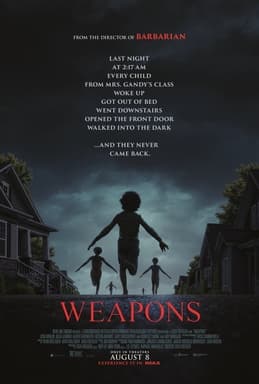
Weapons Is a Comedy Structure With the Laughs Taken Out
Zach Cregger spent a decade writing sketch comedy and then applied the sketch runner's structure to a film about seventeen missing children. It made $270 million on $38 million.

Nosferatu: Eggers' Gothic Masterwork
Eggers' remake was received with admiration rather than fervour, a proper film from a proper filmmaker. Sixteen months later, it looks like the serious piece the year needed, and the one we were too cool to love properly at the time.