The Outrun and the Recovery Film Told in Weather
Nora Fingscheidt's adaptation of Amy Liptrot's memoir arrived in autumn through Sony Pictures Classics. It is a recovery film that keeps reaching past the recovery, out into the weather on the islands.
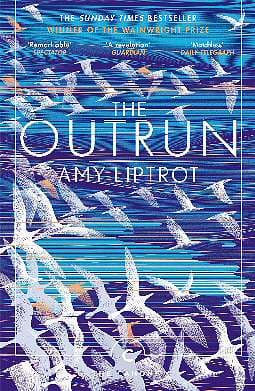
Poster / promotional material via Wikipedia, The Outrun. Used under fair use for criticism and review.
Nora Fingscheidt’s The Outrun, adapted from Amy Liptrot’s 2016 memoir, opened in the UK on 27 September 2024 through StudioCanal and in the United States the following week through Sony Pictures Classics. Saoirse Ronan plays Rona, the book’s Amy-proxy, a thirty-year-old biologist returning to Orkney after a collapse in London. Ronan also produced the film. The project has been hers, in the structural sense, since she optioned the book in 2020. The film took a small theatrical and then settled into the place recovery films tend to settle, which is the attention of people who have a specific reason to seek them out.
I want to argue that The Outrun is one of the year’s more formally interesting British films, and that the thing it gets right is not the recovery material, which has been done well and badly many times, but the weather. The weather is the film’s argument. The weather is where Fingscheidt is working.
The adaptation and its refusal
Liptrot’s memoir is structured as a braided essay. The chapters alternate between the London collapse, the Orkney childhood, and the present-tense fieldwork the writer is doing for the RSPB, counting corncrakes on the archipelago’s smaller islands. The braiding is the book’s formal commitment.
Fingscheidt, who directed System Crasher in 2019, keeps the braid. The film cuts, often mid-scene, between Ronan in a London bar in the second year of a relationship that is about to end, Ronan on the coast of Papa Westray counting birds, Ronan as a teenager listening to her father’s manic speech in the family farmhouse. The cuts are not flashbacks in the conventional sense. They are weather systems moving across the same person.
This is a more demanding formal choice than the recovery-drama genre usually permits. Most sobriety films are structured as linear descent and ascent. Fingscheidt refuses the shape. The film is asking the viewer to hold three time-registers at once and let them accumulate rather than resolve.
Ronan, doing the interior work
Saoirse Ronan is one of the most precise screen actors working in English, and The Outrun asks her to play a character across at least five distinct temporal and emotional registers within the same runtime. She plays Rona in active addiction, Rona in early dry months on the mainland, Rona at the Papa Westray field station, Rona as a teenager, Rona at the island pub in the specific register of a returnee navigating a small community that remembers her. The performance sits inside Ronan’s body before it sits inside the script.
What Ronan is doing at the line level is keeping the voice consistent while the body shifts. Rona’s speech is clipped, specific, sometimes funny, across every timeline. The body is where the histories live. In the London sequences Ronan carries her shoulders differently, her hands move faster, her gaze does not settle. On Papa Westray she is stiller. The stillness is not peace. It is the stillness of someone who has worked out what her body does and is now tolerating it. The shift between the registers is the acting. Ronan makes it look small because she has earned the right to.
The accent is Orkney-specific and she does it properly. Liptrot has said in press that she worked with Ronan on vowel placements and the specific island rhythm. The work is audible. The accent does not slip across the runtime, which on a film that moves between islands, mainland Scotland, and London is a sustained technical achievement.
The weather as argument
Here is where the film is working hardest. Fingscheidt and her DP Yunus Roy Imer built the film’s Orkney sequences around actual weather rather than around simulated weather. The film was shot across a long schedule on the islands, in winter and spring, and the storms, the specific quality of the grey sea, the way the light changes across a single afternoon in late February, these are documentary textures embedded in a fiction film. The weather is not a backdrop. It is a character, and the film respects it as one.
The sequences on Papa Westray, in particular, are built around letting the weather determine the pacing of the scenes. A conversation between Rona and her supervisor is interrupted, mid-line, by a gust that forces them to turn. The film holds the turn. The dialogue resumes when the wind permits it. This is the kind of on-location discipline that most studio productions would never accept. Fingscheidt accepted it, and the result is that the Orkney sequences have a texture no soundstage work could reproduce.
The specific scene I keep returning to is Rona alone on a cliff, mid-second-act, after a phone call we do not hear from her mother. The scene is almost wordless. Ronan sits. The wind moves her hair. The sea works below her in a specific grey. Imer’s camera holds the shot at a distance that respects Rona’s space. The weather is doing the emotional work the script is declining to do. The scene is the film’s clearest statement of method.
The parents, and the island as family
Stephen Dillane plays Rona’s father. Saskia Reeves plays her mother. Both performances are calibrated to specific emotional registers the film does not over-explain. Dillane’s father is bipolar, living alone on the island, mostly in manic phases across the film’s present tense. Dillane plays him without external indication; the illness is in the rhythm of his speech and in the specific way he does not complete his sentences. The father-daughter scenes are the most difficult material in the film. Dillane plays them as a man who loves his daughter and cannot, structurally, hold the form of the relationship she needs from him.
Reeves’s mother is the evangelical Christian the memoir describes. Reeves plays her as a woman whose faith is not performative and not available for the film to treat as a plot device. The relationship between Rona and her mother is one the film lets sit in its specific awkwardness, and Reeves honours the sitting. The scene between mother and daughter at the film’s midpoint, a conversation about a prayer Rona cannot bring herself to join, is the film’s most emotionally exact piece of writing.
The birds, and the labour
The RSPB sequences, in which Rona is counting corncrakes at night on the islands, are the film’s most specific formal pleasure. The corncrake is a small bird whose call is easier to register than its body. The fieldwork involves walking specific transects at specific hours, recording each call, logging the coordinates. The film takes the labour seriously. Fingscheidt shoots the night counts in long, patient takes with minimal score. The viewer learns, across the sequences, what the bird sounds like. The work becomes audible as work.
This is also where the film makes its quietest argument about recovery. The fieldwork is repetitive, solitary, weather-dependent, and rewarded only by small satisfactions of having done the count properly. It is not a metaphor the film underlines. The film trusts the viewer to register what the labour is teaching Rona. The labour is the recovery.
The London register
The London sequences are shot differently. The camera is handheld, the light artificial, the scenes structured around the claustrophobia of a bar, a bedsit, a cab ride. Fingscheidt is deliberately giving the London material a register that reads as worse. Paapa Essiedu plays Daynin, the London boyfriend, in careful work across a limited role. The break-up sequence, staged late in the second act, is handled without melodrama. Two adults end a relationship that has been failing for specific reasons. The film moves on.
What the film refuses
The Outrun refuses the addiction-film redemption arc in its conventional form. There is no rock-bottom scene in the structural sense. There is no moment of clarity. There is a long, specific, patient series of days in which Rona does the small work of staying on the island, counting the birds, calling her sponsor, writing in her notebook, walking. The film’s ending is not an ending. It is a continuing. Rona is not recovered. She is working at it.
This is the correct structural choice for the material and the reason the film will last. Recovery is not narratively satisfying in the conventional sense. The films that have dealt with it best, and The Outrun belongs in this short list, have refused the satisfying shape. Fingscheidt has refused it. Ronan has refused it. The book refused it first.
What stays
The Outrun did modest theatrical numbers. It is now available to rent. Watch it on a large screen if you can, with the volume set high enough to register the wind. The weather is the film. The weather is Ronan. The weather is the argument. Take the two hours. Let the pacing do what it does. Fingscheidt has earned it.
Lena writes long-form essays on the films that will still be talked about in a decade. Previously at a defunct monthly whose name we do not speak.
MORE BY LENA ASHWORTH →
Nickel Boys: Ross's First-Person Adaptation
RaMell Ross adapted Colson Whitehead's Pulitzer-winning novel through a first-person camera almost continuously across two hours. The argument is that the formal gamble is the adaptation, and the adaptation is, so far, the film of the awards year.

Wicked: What Jon M. Chu's Part One Gets Right About Musicals
Jon M. Chu's Wicked was the studio musical that worked, and the reasons it worked are specific to the form. A year on, its choices look like a template.

Blitz: Steve McQueen's Crowded Home Front
Steve McQueen's first feature since Small Axe attempts a sprawling wartime mural of London. The mural mostly works. The boy at its centre is the reason it sometimes does not.