The Monkey: Osgood Perkins' Stephen King Mechanism
Osgood Perkins' follow-up to Longlegs is a better film than the hype-fatigue has let on. An argument for the adaptation that does not care about the source material.
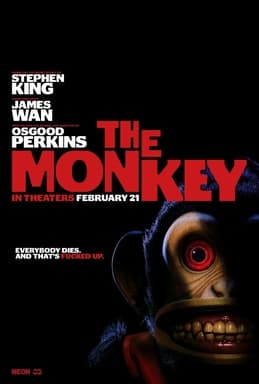
Poster / promotional material via Wikipedia, The Monkey (film). Used under fair use for criticism and review.
Osgood Perkins’ The Monkey, released in February 2025 on the back of Longlegs’ commercial surprise, was the second Perkins-Stephen-King adaptation the culture was asked to process in a year. The film landed in a specific hype-fatigue environment. The Longlegs discourse had barely cooled. The marketing, which returned Perkins to the Neon-distributor playbook, attempted to recreate the Longlegs cryptic-campaign energy on a story that was fundamentally different.
The Monkey is not a better film than Longlegs. It is, I want to argue, a more successful one, specifically because Perkins made it on his own terms without the weight of audience expectation shaping the result.
What the film is
Adapting Stephen King’s 1980 short story “The Monkey,” Perkins has restructured the material into a feature-length horror comedy. A cursed wind-up toy monkey, whenever it plays its cymbals, causes someone nearby to die. Twin brothers Hal and Bill, played in adulthood by Theo James, grow up with the toy in their childhood home. Their mother (Tatiana Maslany) dies under its influence. The brothers get rid of the monkey. Years later, as adults, the monkey returns, and the deaths begin again.
The film is structured as three partial films stacked on top of each other: a childhood-flashback horror piece; a present-day estranged-brother drama; and a splatter comedy about the specific escalating absurdity of the monkey’s kills. Perkins commits to each of these modes without forcing them to resolve into a single tone.
What Perkins got right
The single most interesting choice The Monkey makes, and the choice that separates it from most contemporary horror, is its tonal commitment to comedy. Perkins has said in interviews that he approached the material as a deadpan comedy with horror set pieces rather than as a horror film with occasional black humour. The distinction matters. The deaths in The Monkey are staged for absurdist comic effect, not for traditional horror shock. The viewer is, mostly, asked to laugh at them.
This works because the specific mechanism of the monkey, a wind-up toy that kills an arbitrary person whenever it plays, is absurd by construction. Perkins does not try to make the mechanism scary. He makes it darkly funny. The deaths are imaginative in a specifically over-the-top direction (a kitchen fire, a hibachi-grill accident, a drowning-in-soup) that emphasises their randomness rather than their horror.
This is a bold tonal move. It also happens to be the move that Longlegs audiences, expecting another atmospheric procedural, were least prepared for. The reception was divided.
Theo James, carrying two brothers
Theo James plays both adult Hal and adult Bill, and the performance is his best screen work to date. The brothers are not interchangeable. Hal is a specific kind of damaged: mild, withdrawn, recovering, deliberately avoiding the aspects of his own life that the monkey’s presence would activate. Bill is a different kind of damaged: resentful, performatively-competent, smaller than he pretends to be. James plays each brother at a different register of posture, speech rhythm, and specific physical tension.
The scenes in which both brothers share the screen (via split-screen and over-the-shoulder technique) are the film’s most formally impressive sequences. James is not simply doing two different characters; he is doing two different rhythms of speech and two different body-language vocabularies, and the film uses the difference as narrative content.
Tatiana Maslany, briefly but importantly
Tatiana Maslany as the brothers’ mother, who appears in the film’s first third and in flashbacks throughout, is doing the smaller-but-more-important performance. Her character dies relatively early, but her presence in the film retroactively colours everything about how Hal and Bill grow up. Maslany plays her as a specific kind of American-suburban mother in the 1980s whose surface-competence has been hollowed out by something she cannot articulate.
The scene in which she tries to explain the monkey to her young sons, without fully explaining that she knows what it does, is the film’s single most emotionally loaded sequence. Maslany plays it with specific tired affection that informs the rest of the film.
Where the film falters
The Monkey is not a perfect film. Its second act, which follows adult Hal’s attempt to reconnect with his estranged son after the monkey returns, has pacing issues that the film does not fully solve. The film’s final set piece, an extended confrontation at a town parade, is staged with a specific glee that some viewers will find exhilarating and others will find too arch.
I was, on first viewing, slightly put off by the third-act gear change. On second viewing, I think the gear change is the point. Perkins is, across the film, deliberately breaking his own tonal commitments at specific intervals. The unevenness is not a bug. It is an editorial decision.
What the film signals for Perkins
With The Blackcoat’s Daughter, I Am the Pretty Thing That Lives in the House, Gretel & Hansel, Longlegs, and now The Monkey, Osgood Perkins has produced a body of work that is unmistakably his own. His films have a specific tonal signature, slow-dread, deadpan-comic, atmospheric, formally patient, that very few American horror directors are currently matching.
The commercial reception of The Monkey was modest compared to Longlegs (about $70 million worldwide on a $10 million budget, which is healthy but not a sequel-producing smash). I do not think Perkins needs or wants the Longlegs numbers to make another film. What he needs is the continued critical attention, and the space to work at his current budget tier.
Watch The Monkey with the expectation of a deadpan horror comedy, not a Longlegs successor. The film is better on those terms, and Perkins is a director worth watching closely.
Marcus believes good criticism is an argument. He is almost always angry about something, usually for good reason. Horror is his first language.
MORE BY MARCUS VELL →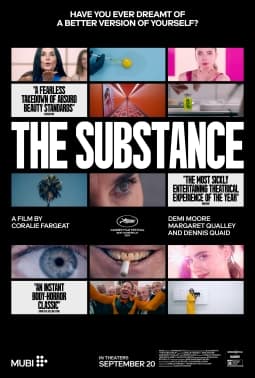
The Substance and the Body Horror Renaissance
Eighteen months after Coralie Fargeat's prosthetic-heavy fable drew both Oscar nominations and walkouts, the strange alchemy of The Substance has only clarified. The film is less about Hollywood than it looks, and more about what we're allowed to say with bodies on screen.
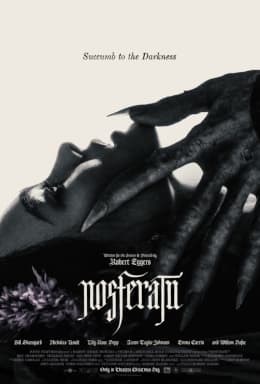
Nosferatu: Eggers' Gothic Masterwork
Eggers' remake was received with admiration rather than fervour, a proper film from a proper filmmaker. Sixteen months later, it looks like the serious piece the year needed, and the one we were too cool to love properly at the time.
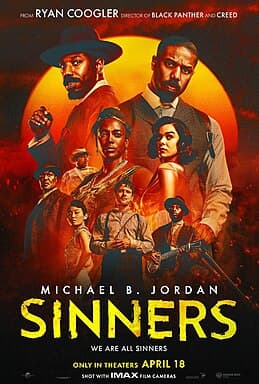
Sinners: Coogler's Vampire Western and the Return of the Studio Auteur Movie
Ten months on, Ryan Coogler's 1930s Mississippi vampire film doesn't just still hold up, it looks like the clearest sign in years that the studio auteur movie is not dead. A field report from inside the juke joint.