Smile 2 and the Sequel That Actually Sharpens
Parker Finn's follow-up to his 2022 hit arrived through Paramount in October. It takes the original's thin premise and pushes it into something stranger, harder, and more formally specific.
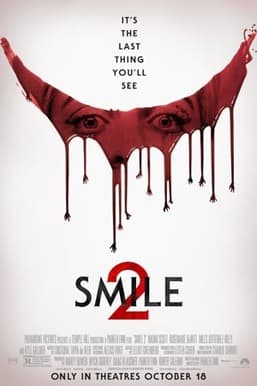
Poster / promotional material via Wikipedia, Smile 2. Used under fair use for criticism and review.
Parker Finn’s Smile 2, released through Paramount on 18 October 2024, is the horror sequel of the last twelve months, and it has not been discussed that way. The film took about $138 million worldwide against a reported $28 million production budget, a clean commercial result but nowhere near the original Smile’s 2022 run of roughly $217 million on a $17 million budget. The reviews were warm. The discourse moved on quickly. I want to argue that the discourse moved on too fast, and that the actual film is a considerably sharper object than the one the culture decided to remember.
Here is my position. Smile 2 is better than Smile. It is a more formally disciplined piece of horror filmmaking, it commits harder to its central conceit, and the performance at its centre, Naomi Scott as a pop star on the edge of collapse, is the best single piece of horror-lead work by a studio star in at least three years.
What the original was
The 2022 Smile was a competent, scary, high-concept horror film about a curse that passes between victims through witnessed trauma. The witness sees a person commit suicide while smiling. The witness then has roughly a week of escalating supernatural harassment before passing the curse along through their own death. The concept was legible in a poster. The film delivered the jumps.
What Smile did not do, and what many studio horror films do not do, was commit to the psychological register the material implied. The curse was a mechanism. The film treated the mechanism functionally. Sosie Bacon’s lead performance was strong. The structure around her was a jump-scare delivery system with a mental-health-adjacent theme bolted on. The film worked. It did not sing.
What the sequel does differently
Smile 2 takes the same curse and applies it to a different protagonist: Skye Riley, a twenty-something pop star played by Naomi Scott, one week before the launch of her comeback arena tour after a year away from the public following a serious car accident and substance-abuse episode. The curse lands on her. The film spends its two hours watching her break.
The structural shift is that the protagonist this time is a person whose public-facing life requires specific, sustained performative labour. Skye cannot go to the police. She cannot go to a doctor. She cannot take a week off to recover. She has a press day, a dance rehearsal, a stadium crowd, a mother-manager, an assistant, a physio, a label. Every scene she is in is a scene she is performing through. The curse, which externalises hallucination, arrives in a life that is already organised around the suppression of internal experience.
This is a smarter conceit than the original film had. Finn has figured out what his franchise is for. Smile is a pop-horror vehicle about the specific horror of living inside a persona that a curse is trying to tear. The sequel’s Skye is the ideal vessel for the conceit. The first film’s Rose, a therapist, was structurally the wrong protagonist for the material. Smile 2 corrects the problem.
Naomi Scott, carrying the film
Scott’s performance is the load-bearing element of the film. She is in essentially every scene. She sings. She dances. She performs on stage while hallucinating. She plays an interview while the curse is working on her. She plays a recovery meeting while the ceiling is doing something unspeakable above her head. She plays a physio appointment where she does not know if the physio is real.
What Scott is doing at the technical level is playing two performances simultaneously: the public-facing Skye who is holding it together for her label and her fans, and the interior Skye who is coming apart. The film keeps both tracks visible. You can see the second track bleeding through the first, and you can see Scott fight to get the first back. The acting choice that makes the film work is Scott’s commitment to keeping the public-facing Skye legible right up to the end. She does not abandon the performance when the interior collapses. The persona is the last thing to go.
Finn made the bet that she could carry a two-hour studio horror film by herself. She carried it. Her physical commitment in the dance-rehearsal sequences, the choreography is real and sustained, is part of what the film is earning. She is not a pop-star body-double surrounded by cutaways. She is a lead doing a specific physical job.
The pop-star register, done right
The film’s arena-pop mise en scène is built with a care most horror films do not bother with. The concert-tour iconography is specific. The choreography, by Celia Rowlson-Hall, is legible as the actual choreography of a working pop act rather than as an idea of pop choreography. The songs, written for the film by a team including Cristóbal Tapia de Veer, who also wrote the score, are functional pop songs that could plausibly appear on a real tour. The specific pop-industry details, the tour rider, the physical-therapist relationship, the fan-meet-and-greet register, the relationship between a star and her manager-mother, are all rendered with the care of a film that has done its research.
This matters because the genre material lives inside the pop-industry material. The film’s scares do not work unless the pop-star register is plausible. Finn understood this. He spent the production budget on the specifics. The arena sequences, which are the film’s structural setpiece, are shot with the proper equipment and the proper crowd scale. The film is not borrowing the iconography. It is building it.
The scares, and the discipline
The actual scares in Smile 2 are better than in Smile. They are less reliant on false-start jump-scare rhythm and more reliant on the specific horror of seeing something that should not be there stay in the frame for longer than the viewer’s comfort permits. Finn has learned, across the two films, what to do with his camera in the quieter horror register. A long, slow push-in on a background extra whose smile has been wrong for forty seconds is a more effective horror beat than a cymbal crash, and the film knows it.
The choreographed-background-extra gag, which Smile 2 turns into a sustained formal device, is the film’s single best visual joke. In a pop choreography rehearsal sequence, mid-film, the dancers around Skye begin to drop out of the choreography, one at a time, and fix her with the specific smile the curse produces. The sequence is staged as a long take. It is played straight. It is scarier than any of the jumps. It is also a specific commentary on what the curse is doing: isolating the performer inside a performance that no longer recognises her.
Where the film is honest about its limits
Smile 2 is not a perfect film. The second act sags in the specific place horror second acts often sag, where the protagonist is doing exposition that the audience has already figured out. The subplot involving Skye’s mother, played by Rosemarie DeWitt in a limited arc, is not fully integrated. These are the limits of a commercial horror sequel working inside a studio envelope.
The commercial framing
The $138 million against the original’s $217 million has been read, in some trade coverage, as a franchise cooling. The cooling reading misses the point. The first film benefited from a specific post-pandemic horror market and an audience who had not yet seen the gag. The drop is not a verdict on the film. The drop is a verdict on the market.
What Finn does next
Parker Finn is attached to direct a new original horror feature for Paramount, alongside continued producing commitments. Smile 2 is his argument for being permitted to make more original work at studio scale. The argument is strong.
Rent it. Watch it on a loud system. Pay attention to what Finn is doing with extras in the backgrounds of scenes, particularly in the rehearsal sequence. The sequel took a mechanical conceit and made a film out of it. That is a harder job than the original had. Finn did it.
Marcus believes good criticism is an argument. He is almost always angry about something, usually for good reason. Horror is his first language.
MORE BY MARCUS VELL →
A Quiet Place: Day One, and the Discipline of a Small Apocalypse
Michael Sarnoski's Quiet Place prequel is a studio horror release built to break the franchise's scale rules, and the smaller it stays, the better it works.

Gladiator II: Ridley Scott's Sequel Problem
Ridley Scott made Gladiator II twenty-four years after the original and repeated most of the first film's beats without any of its conviction. The problem is not age. The problem is a director who no longer believes the genre.
The Substance and the Body Horror Renaissance
Eighteen months after Coralie Fargeat's prosthetic-heavy fable drew both Oscar nominations and walkouts, the strange alchemy of The Substance has only clarified. The film is less about Hollywood than it looks, and more about what we're allowed to say with bodies on screen.