Gladiator II: Ridley Scott's Sequel Problem
Ridley Scott made Gladiator II twenty-four years after the original and repeated most of the first film's beats without any of its conviction. The problem is not age. The problem is a director who no longer believes the genre.
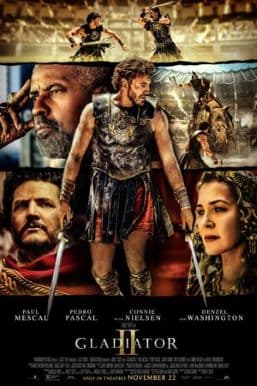
Poster / promotional material via Wikipedia, Gladiator II. Used under fair use for criticism and review.
Let me start with the number. Gladiator II cost a reported $310 million to produce, making it one of the five most expensive films ever made. It grossed approximately $462 million worldwide, which on a standard studio multiplier (2.5x production cost to break even before ancillary) means Paramount took a loss in the order of $100 million before home video and streaming. This is not a disaster on the scale of recent tentpole flops, but it is, in the specific context of a legacy sequel to a Best Picture winner, a failure.
A year on, the commercial failure is the least interesting thing about the film. The interesting thing is why Ridley Scott, a filmmaker who was sixty-three when he directed the first Gladiator and is now in his late eighties, made a film that so obviously does not believe in its own genre.
The reception
Gladiator II opened in November 2024 to mixed reviews, a B+ CinemaScore, and a specific internet conversation about whether Denzel Washington’s Macrinus performance was “saving” the film or simply surviving it. The film was not universally hated. It was, at best, patiently tolerated.
The comparisons to the 2000 original were everywhere and they were unhelpful. Gladiator, released when Scott was in his first full directorial return after the 1492 and White Squall years, was a genuinely strange film: a swords-and-sandals epic made with a post-Seven bleakness, shot by John Mathieson in a muted palette that looked nothing like the Technicolor lineage of Ben-Hur or Spartacus. The film’s success was not inevitable. It was the product of a specific directorial conviction about what the genre could be made to mean in 2000.
Gladiator II does not have that conviction. That is the problem.
What the film is
Lucius (Paul Mescal), the grown-up son of Lucilla (Connie Nielsen) from the first film, has been living in Numidia under an assumed name. Rome invades. His wife is killed. He is captured, enslaved, and sold to Macrinus (Washington), a gladiator-stable owner with political ambitions. Lucius fights his way up through the arena while Macrinus manoeuvres against the twin emperors Geta (Joseph Quinn) and Caracalla (Fred Hechinger), and Marcus Acacius (Pedro Pascal), the Roman general who killed his wife, becomes the target of his personal revenge.
This is, structurally, the plot of the first Gladiator with the names changed. A man is enslaved, a man becomes a gladiator, a man plots revenge against a corrupt Rome, a man dies in the arena having made Rome briefly better. Scott has essentially reshot his own film at three times the budget and with none of the specific anger that made the first one work.
The Denzel problem
Denzel Washington’s Macrinus is the thing most 2024 reviews fixated on, and the praise was deserved in one sense and misplaced in another. Washington is doing genuine work. His Macrinus is a specific character: a former slave who has bought his freedom and is now using the political chaos of Rome to position himself for the throne. Washington plays him with a specific mixture of camp and menace that is a pleasure to watch.
The problem is not that Washington is overshadowing Mescal. The problem is that Macrinus is interesting in a film whose protagonist is not. Paul Mescal, who has been, in Aftersun and All of Us Strangers, one of the most specifically compelling young leading men in recent cinema, has been given nothing to play. Lucius is a figure without interiority. He has a dead wife, a political pedigree, and a slow arc toward acknowledging his parentage. That is the character. Scott and writer David Scarpa give him no specific contradictions, no specific temptations, no specific moral failures to overcome. He is pointed at revenge and pointed at redemption and pointed at the throne, and Mescal does not have the material to make the pointing interesting.
Compare to Russell Crowe’s Maximus, who was given a dead child, a violated farmstead, a crisis of faith in the Senate he was supposed to restore, and a specific physical trauma (the infected shoulder wound) that shadowed the second half of the film. The first Gladiator gave its lead a body, a history, and a slow decay. Gladiator II gives Mescal a grievance and expects the grievance to carry him.
The set pieces
The action sequences, which are the whole commercial point of a legacy sequel to Gladiator, are the single place the film is worst. The naval battle in the Colosseum, which features CGI sharks, has been widely ridiculed, and the ridicule is deserved. The sequence is tonally incoherent: neither the historical fantasia of the first film’s tiger-arena battle nor the camp spectacle of, say, Russell Crowe’s 2014 Noah flood. It is simply an ugly fifteen-minute interruption in a film that did not need it.
The one-on-one combat sequences are competent. Scott, even at eighty-six, knows how to block a sword fight. The coverage is clear, the geography of the arena is established, and the hits land with the specific crunch that the first film established as a genre signature. But the fights have no stakes beyond Lucius surviving, because the film has not given us anyone in the stands we want him to survive for. Maximus was fighting for a vision of Rome that included specific people (Lucilla, young Lucius, the Senate). This Lucius is fighting for himself, and the film’s attempt to elevate the fight to political significance lands without weight.
Pascal, miscast
Pedro Pascal’s Marcus Acacius should have been the film’s emotional centre. The character, a Roman general who has fought for Rome honestly and now sees the empire collapsing into chaos, is the closest thing the film has to a Maximus figure. Pascal is a specifically capable actor. He is, on paper, perfect casting.
The film does not use him. Acacius is offscreen for stretches of the second act. His relationship with Lucilla, which the film hints is the emotional ground of his moral crisis, is handled in roughly three scenes that do not adequately establish what the ground actually is. By the time Acacius faces Lucius in the arena, the confrontation has the shape of a significant moment without the underlying weight, because the film has not bothered to build the weight.
What went wrong
Gladiator II was in development for nearly two decades. Scott shot it in his usual rapid mode (primary photography wrapped in five months) with a specific budget profile that required the tentpole to hit every four-quadrant target simultaneously. The script passed through David Franzoni (who wrote the original) and landed with Scarpa, whose work with Scott on All the Money in the World and Napoleon has been, at best, functional.
The deeper problem is that Scott, across his recent filmography, has lost interest in the specific emotional machinery that makes his best films work. Napoleon (2023) had the same issue: a historical epic stripped of the specific interiority that made Gladiator or Kingdom of Heaven or The Duellists cohere. Scott at eighty-six makes films with the physical craft of his prime and none of the specific emotional investment.
Where it sits
Gladiator II will be remembered as a legacy sequel that no one actually needed, a vehicle for Denzel Washington to do a specific kind of late-career camp, and a commercial near-miss for Paramount during a period when the studio could not afford the miss. It will not be remembered as a Scott film of any particular consequence.
The lesson, if there is one, is about the specific cost of making a sequel to a film you no longer believe in. The first Gladiator was a risk, and the risk was what made it good. The second Gladiator was an inheritance, and the inheritance is what made it hollow. Watch it for the Colosseum set and for whatever Washington is doing in the second act. Skip the rest.
Marcus believes good criticism is an argument. He is almost always angry about something, usually for good reason. Horror is his first language.
MORE BY MARCUS VELL →
Smile 2 and the Sequel That Actually Sharpens
Parker Finn's follow-up to his 2022 hit arrived through Paramount in October. It takes the original's thin premise and pushes it into something stranger, harder, and more formally specific.
September 5 and the Control Room Film
Tim Fehlbaum's procedural about the ABC Sports team covering the 1972 Munich hostage crisis narrows its field of vision to a single control room. The narrowing is the film's argument, and it holds.
A Quiet Place: Day One, and the Discipline of a Small Apocalypse
Michael Sarnoski's Quiet Place prequel is a studio horror release built to break the franchise's scale rules, and the smaller it stays, the better it works.