A Quiet Place: Day One, and the Discipline of a Small Apocalypse
Michael Sarnoski's Quiet Place prequel is a studio horror release built to break the franchise's scale rules, and the smaller it stays, the better it works.
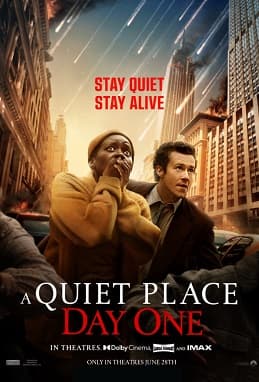
Poster / promotional material via Wikipedia, A Quiet Place: Day One. Used under fair use for criticism and review.
Studio horror franchises do not usually send a prequel to the quiet, patient indie director of a film about a truffle hunter and a pig. Paramount did. The result, A Quiet Place: Day One, was released in late June 2024, grossed around $261 million worldwide on a production budget in the mid $60 million range, and is, to my mind, the best film in the franchise so far, which is a sentence I did not expect to write in 2020.
Michael Sarnoski, whose only previous feature was 2021’s Pig, was an unusual hire for the third entry in a studio horror franchise. John Krasinski, who directed the first two films, was on board as producer. The casting of Lupita Nyong’o in the lead, with Joseph Quinn as her secondary, was a choice that told you, on paper, that Paramount was willing to let the prequel be a different animal.
What the film actually is
Sam (Lupita Nyong’o) is a terminally ill poet in a Manhattan hospice. The film opens with her being driven from the hospice to a day trip in the city, against her specific wishes, by a nurse who wants her to get out. The day trip becomes the arrival of the alien invasion that the franchise has been pointing back to from the first film.
The bulk of the ninety-nine minute running time is Sam, her cat Frodo, and eventually Eric (Joseph Quinn), a young British law student who attaches himself to Sam as the city collapses, trying to get across Manhattan and down to the East River during the first twenty-four hours of the invasion. That is the whole plot. The monsters hunt by sound. The characters try not to make sound. The city is destroyed in the background of the first act and through it for the rest.
What the film refuses, and refuses in the first ten minutes, is the scope expansion that a studio prequel would ordinarily be required to deliver. There is no global cutaway. There is no military montage. There is no scientific explanation sequence. The film stays on Sam. The film stays on the cat. The film stays in Manhattan.
The Sarnoski hire
This is where Pig becomes relevant. Sarnoski’s previous film was, at its core, a story about grief worn in public, about a man whose inner life had been forced out into the open by loss and who had no interest in the performance of recovery. Nicolas Cage played the lead without the eccentric register that most of his 2010s casting relied on. The film was slow, strange, specific, and emotionally precise.
A Quiet Place: Day One is, at its core, a film about a dying woman spending what she correctly understands to be her last day on earth. Sarnoski brings the same register he brought to Pig. Sam is not trying to survive. She is trying to get across the city for a specific, small, personal reason that the film saves for its second half. The alien invasion is, for Sam, not the main event. It is the specific condition inside which her actual final day is occurring.
This reframing is the single smartest structural move the film makes. A survival horror in which the protagonist is indifferent to survival cannot rely on conventional stakes, and Sarnoski has built a film that knows it. The suspense in A Quiet Place: Day One is not about whether Sam will live. The suspense is about whether she will be allowed to do the specific thing she is trying to do before she dies.
Lupita Nyong’o’s work
Nyong’o gives a performance that is specifically contained, specifically patient, and specifically uninterested in the heroic register that franchise horror leads usually get handed. Sam is tired. Sam is in pain. Sam is medicated for most of the running time. Nyong’o plays the medication as a real physical condition rather than a narrative convenience, which means Sam moves through the film at the specific tempo of a person who is already past the point of urgency about herself.
The performance’s best scenes are the ones in which Sam is simply waiting. A long sequence in a flooded subway tunnel, holding absolutely still while a monster moves through the water above her, is the film’s formal centrepiece. Nyong’o plays stillness as a full performance register. You can watch her breathing at two different tempos depending on whether the creature is in the frame. The precision is extraordinary.
There is a later scene, in a jazz club in the second half, where Sam is finally able to speak aloud for approximately ninety seconds under the cover of a recording. Nyong’o plays the sequence as a person finally allowed to say the things a dying woman would say if she had the chance, and the scene is devastating because it is staged at a volume that no one can hear.
Joseph Quinn and the cat
Joseph Quinn, best known before this for his Stranger Things turn, is playing a considerably harder role than it first appears. Eric is the film’s audience surrogate: a terrified young man whose specific role is to attach himself to Sam and to the cat, and to keep Sam alive long enough for her to reach her destination, even though she has told him repeatedly that she has no interest in his project of keeping her alive.
Quinn plays Eric as a specific type of young British anxiety that the film uses structurally. He is not heroic. He is not resourceful. He is terrified and polite, and what he is good at is the specific task of being present to another person without asking anything back. The friendship that develops across the running time is earned at the tempo of the film, and it is doing real emotional work by the final act.
Frodo the cat, for what it is worth, is played by two cats (Nico and Schnitzel, according to Paramount’s press materials). The cat is doing genuine performance work. The cat’s stillness during the long quiet sequences is not the product of training anyone would reasonably expect from a feature production. It is, from all reports, the product of specific animal-wrangler patience and specific editing. The animal is a character, not a prop.
The cinematography and sound
Pat Scola, who shot Pig, returns as director of photography. The film is shot in a specifically desaturated palette that distinguishes it visually from the pastoral register of the first two films. Manhattan is rendered in a specifically greyed-out register that makes the occasional colour incursion (a red cardigan, a yellow subway light, a pink sky at dusk) land harder than it would in a conventionally colourful frame.
The sound design, credited to Erik Aadahl and Ethan Van der Ryn, who worked on the previous two films, is doing the franchise’s specific load-bearing work. The creature-hunting mechanic means that every audible element of the soundtrack is narratively consequential, and the film uses this discipline continuously. A water drip matters. A distant car alarm matters. The cat’s collar matters. Alexis Grapsas’s score is used sparingly, often at the threshold of audibility, and when it arrives it is doing specific emotional rather than suspense work.
Where it leaves the franchise
Paramount has announced A Quiet Place Part III for 2025 as a Krasinski-directed return to the primary family timeline. Whether Day One’s specific formal discipline will carry over is uncertain. My suspicion is that it will not. The prequel’s particular success depended on a specific director with a specific interest in grief rather than survival, working at a specific scale that the franchise’s next instalment is likely to exceed.
What Day One has done, whether or not the franchise absorbs the lesson, is demonstrate that a studio horror prequel can be a small, patient, formally specific film when the hire is right and the studio holds its nerve. Watch it on a weeknight, with the volume up and the lights off. Stay for the final shot. The film’s specific argument is made by its refusal to do what the franchise would have predicted, and the refusal is the thing.
Marcus believes good criticism is an argument. He is almost always angry about something, usually for good reason. Horror is his first language.
MORE BY MARCUS VELL →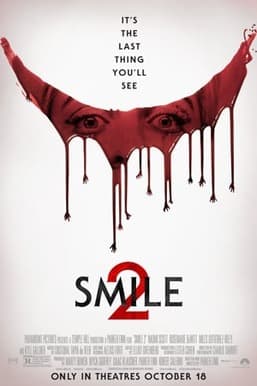
Smile 2 and the Sequel That Actually Sharpens
Parker Finn's follow-up to his 2022 hit arrived through Paramount in October. It takes the original's thin premise and pushes it into something stranger, harder, and more formally specific.
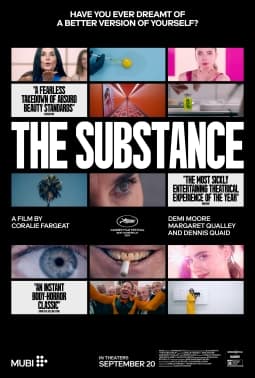
The Substance and the Body Horror Renaissance
Eighteen months after Coralie Fargeat's prosthetic-heavy fable drew both Oscar nominations and walkouts, the strange alchemy of The Substance has only clarified. The film is less about Hollywood than it looks, and more about what we're allowed to say with bodies on screen.
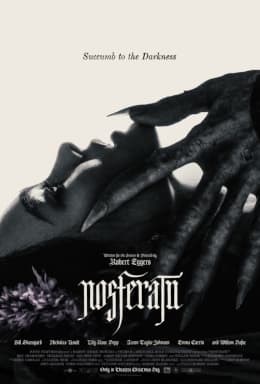
Nosferatu: Eggers' Gothic Masterwork
Eggers' remake was received with admiration rather than fervour, a proper film from a proper filmmaker. Sixteen months later, it looks like the serious piece the year needed, and the one we were too cool to love properly at the time.