September 5 and the Control Room Film
Tim Fehlbaum's procedural about the ABC Sports team covering the 1972 Munich hostage crisis narrows its field of vision to a single control room. The narrowing is the film's argument, and it holds.
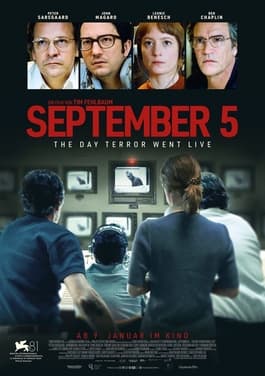
Poster / promotional material via Wikipedia, September 5 (film). Used under fair use for criticism and review.
There is a small sub-genre of cinema that locks its camera inside a single room for most of its running time and derives its dramatic force from what the characters in that room can and cannot see of the events they are processing. Sidney Lumet’s 12 Angry Men is the foundational text. Costa-Gavras’s Z uses the form in specific courtroom sequences. More recent examples include Margin Call (2011) and the Danish The Guilty (2018). Tim Fehlbaum’s September 5, released in December 2024, belongs to this lineage, and it uses the lineage with specific discipline.
A year on, the film’s formal choices have clarified. What looked, to some reviewers at the time, like a limitation now reads as the film’s deliberate argument.
What the film is
September 5, 1972. ABC Sports is broadcasting the Munich Olympics from a temporary studio near the Olympic Village. At roughly four in the morning local time, a Palestinian militant group, Black September, takes eleven Israeli athletes and coaches hostage in the Israeli delegation’s apartment. The event is happening approximately one kilometre from the ABC studio. Roone Arledge (Peter Sarsgaard), the head of ABC Sports, faces a specific journalistic question: should a sports broadcast team pivot to covering an active terrorist incident, and if so, how.
The film runs for approximately ninety-five minutes. It stays in the ABC studio for essentially the entire running time. The hostage crisis is covered through what the studio team can see on their monitors, hear through their communications equipment, and deduce from the footage their camera operators are sending back. The audience of the film sees what the ABC team sees.
The formal discipline
This choice is the film. It is also the film’s most frequently misunderstood feature. Some of the 2024 reviews framed the confinement as a limitation, a way for a lower-budget production to avoid the costs of recreating the historical event at scale. This framing misses the argument.
The confinement is not a constraint. It is a claim about how broadcast journalism actually works. The people producing the news are not at the scene. They are in a control room, looking at monitors, making decisions under time pressure with incomplete information. The film is about the specific mediation of historical events through broadcast infrastructure, and the only way to make the film about that mediation is to place the viewer inside the same mediated frame the producers are working in.
Fehlbaum, a Swiss director whose previous feature (Tides, 2021) was a post-apocalyptic science fiction film, has the specific discipline to hold this premise for the entire running time. The camera rarely leaves the studio. When it does, it briefly shows the outside world through windows or hallways, but never enters the external locations the team is covering. The viewer cannot know more than the team knows. The viewer is forced into the same epistemic position.
The performances, under constraint
Peter Sarsgaard’s Roone Arledge, the ABC Sports executive whose decision-making structures the film, is the performance the film hinges on. Sarsgaard plays Arledge as a specifically competent American broadcast-television operator who is, across the film’s running time, working out in real time what kind of journalism he is capable of producing. The performance is built out of specific small moments: Arledge deciding to keep the satellite feed live, Arledge deciding to let Peter Jennings anchor despite his lack of news experience, Arledge deciding how to describe what has happened when the first confirmed reports of the athletes’ deaths come in.
Sarsgaard plays these decisions without showy dramatisation. Arledge is not working through a moral crisis in the film’s foreground. He is doing his job, and the film is about the specific nature of the job.
John Magaro, as the newsroom producer Geoffrey Mason, gets the second-largest role, and gives a more visibly stressed performance. Mason is the specific technical professional whose competence holds the broadcast together. Magaro plays him as a particular kind of American mid-level media worker, the kind of person whose specific professional identity is entirely bound up in the quality of the work, and whose specific stress is the stress of needing the work to be good under conditions where it cannot possibly be fully adequate to the event.
Ben Chaplin, as the sportscaster Marvin Bader, gives the film’s most specifically journalistic performance: a man whose professional training is in sports reporting, who is now trying to cover an active hostage crisis, and who is specifically alert to the professional limits of his own training.
The Leonie Benesch thread
Leonie Benesch, playing a German interpreter named Marianne Gebhardt who is assisting the ABC team, is the film’s specific access point for the question of what the event looks like from inside German national memory. Her presence in the control room allows the film to address, without over-addressing, the specific political weight of a terrorist incident happening on German soil at the Olympics intended to rehabilitate the post-war German image.
Benesch plays this without thematic insistence. Marianne is a translator, doing her job, registering the specific national weight of what is happening without needing to articulate it. One specific moment deserves flagging: when Marianne, asked to translate a statement from the West German police spokesperson, pauses on the word “again,” the pause carries the specific historical weight the film otherwise declines to underline.
The ethics, undramatic
One of the film’s most disciplined choices is its refusal to dramatise its own ethical subject. The Munich broadcast is, as a piece of journalism history, a specific inflection point: the moment at which live television news coverage of a terrorist incident in progress became a global viewing event, with all the specific subsequent consequences (the hostage-takers watching themselves on television, the broadcast providing tactical information to both sides, the later debates about whether live coverage of terrorism serves the public or amplifies the attack).
Fehlbaum addresses these questions across the film but does not stage a formal debate about them. Instead, he lets the specific operational decisions of the ABC team carry the ethical content. When Mason has to decide whether to show a camera operator’s footage that may include dead bodies, the decision is made in roughly thirty seconds of screen time, and the weight of the decision is carried by the specific posture of the actor rather than by dialogue. The film trusts the viewer to recognise the ethical stakes without announcement.
Where it sits
September 5 grossed approximately $14 million on a reported $15 million budget, which makes it commercially modest. It received a Best Original Screenplay nomination at the 2025 Academy Awards and did not win. Critical reception was specifically respectful without being rapturous.
The film will, I suspect, age better than its release-window reception suggested. It is a specifically mature piece of historical drama, and the specifically mature pleasure it provides (the pleasure of watching competent adults do a difficult professional job under time pressure) is the kind of cinematic pleasure that has become rarer in contemporary American filmmaking. Fehlbaum will be worth watching.
Watch the film on a weekday evening with the phone in another room. The specific formal patience it rewards is the patience it demands, and the patience is where the film’s argument lives.
Priya came to criticism sideways from theatre. She is patient with slow shows, short with bloated ones, and cheerfully vicious about lazy writing.
MORE BY PRIYA NAIR →
A Quiet Place: Day One, and the Discipline of a Small Apocalypse
Michael Sarnoski's Quiet Place prequel is a studio horror release built to break the franchise's scale rules, and the smaller it stays, the better it works.

Gladiator II: Ridley Scott's Sequel Problem
Ridley Scott made Gladiator II twenty-four years after the original and repeated most of the first film's beats without any of its conviction. The problem is not age. The problem is a director who no longer believes the genre.
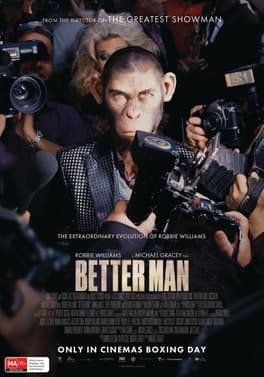
Better Man and the CGI Monkey Problem
Michael Gracey's Robbie Williams biopic cast its subject as a CGI chimpanzee and posted one of the worst wide-opening results of the year. The film is still better than its box office.