Better Man and the CGI Monkey Problem
Michael Gracey's Robbie Williams biopic cast its subject as a CGI chimpanzee and posted one of the worst wide-opening results of the year. The film is still better than its box office.
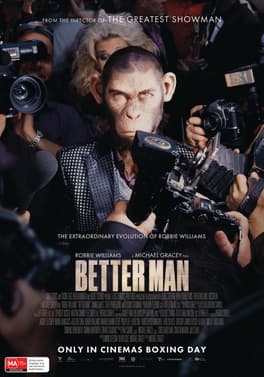
Poster / promotional material via Wikipedia, Better Man (film). Used under fair use for criticism and review.
Better Man opened wide in the United States on 10 January 2025 and did approximately 1.1 million dollars in its first weekend across 1,291 screens. The production budget, according to reporting by Deadline and Variety, sat around 110 million. Paramount, which had picked up US distribution from the Australian production, took a multi-million-dollar write-down within a month of release. The headline, written in the first forty-eight hours after the opening, was already locked in: the Robbie Williams biopic with the CGI monkey had failed.
What the headline did not have room for was the film itself, which is one of the stranger objects any major studio released last year, and which is considerably better than the number of people who saw it.
What the film actually is
Michael Gracey, who made The Greatest Showman, spent the better part of five years building Better Man as a musical biopic of Robbie Williams, the English pop star whose career with Take That and subsequently as a solo artist has made him one of the biggest-selling UK acts of the last thirty years. The film tracks Williams from his Stoke-on-Trent childhood, through his Take That years, through the solo imperial phase of the late nineties, through cocaine, through his nervous breakdown at Leeds, through rehab, and through his reconciliation with his father. It is a standard biopic arc.
The non-standard element is that Williams is played, in every frame, by a motion-capture chimpanzee. The performance-capture was done by Jonno Davies. The visual effects work was led by Weta FX, with Luke Millar as VFX supervisor. Williams himself provides the voice and sings all the songs.
The conceit, which Gracey and Williams developed together in interviews and on the film’s promotional circuit, is that Williams has always felt like a performing monkey. The film renders the feeling as visual fact. Every other character is a human. Williams is a primate. No one in the world of the film comments on this.
Why the conceit works more than it should
The first half-hour is where the film has to either sell the device or lose you. Gracey, working with cinematographer Erik Wilson, shoots the early childhood sequences with enough specific naturalistic detail that the monkey becomes, within about ten minutes, the least strange thing on screen. The Stoke council estates, the working men’s club where his father performs, the specific mid-eighties British texture of wallpaper and pub carpet: the film is so committed to the physical reality of the world around the chimpanzee that the chimpanzee is permitted to become the emotional centre by default.
The moment the device clicked for me was in the first Take That rehearsal sequence. The five members of the band, four humans and a chimp, are being walked through a dance routine by a choreographer who is not treating the chimp as a chimp. The chimp is just the youngest member. He is bad at the choreography. He is also, you realise, better at it than the others, because the motion-capture lets him move in ways a human body cannot. The film has made a formal argument for why Williams needed to be a monkey without underlining it.
The musical numbers
Gracey, whose Greatest Showman instincts are populist and maximalist, stages roughly seven major musical sequences. The standout, by broad critical consensus and my own sense, is a recreation of Williams’s 2003 Knebworth concert performed as a single long take through the crowd, which Gracey and Wilson shot as a combination of practical crowd work and digital extension. The sequence runs around nine minutes. It contains real euphoria. It is also, structurally, the film’s peak, which presents the problem of what to do with the remaining forty-five minutes.
The sequence I keep thinking about is the earlier “Rock DJ” number, staged along Regent Street in London as a single fluid camera move with approximately five hundred dancers. This was shot practically over multiple nights in January 2024 with real street closures, which is the kind of production-scale detail that explains where the 110 million went. You cannot fake a hundred-metre-long dance number with real scale, and the film does not try to. It is a sequence that would have been the main marketing asset if the marketing had known how to sell a chimpanzee.
The marketing problem
Paramount inherited the film. The original production was financed by VVS Films and Rocket Science, with Australian government rebates, and Paramount picked up domestic distribution late. The marketing campaign that resulted tried to solve three problems at once. It had to explain that the film was a musical. It had to explain who Robbie Williams was, because outside the United Kingdom he is a considerably smaller figure. And it had to explain the monkey without making the monkey sound like a gimmick.
The campaign failed at the third problem, which made failing at the first two inevitable. The American trailers leaned into the musical numbers but obscured the primate lead, which meant the audience that showed up on opening weekend was surprised by the central conceit. Surprise, for a mainstream audience in January, is not a selling feature. The word of mouth that might have saved the film, and which the film does have in its second and third weeks, never had a chance to compound.
What the film is about
I want to be clear that Better Man is a biopic. It has the biopic structure. It does the biopic moves. Williams’s addiction, his ego, his insecurity, his father: these arrive on the schedule you expect.
What the chimpanzee conceit does is save the film from its own genre. The biopic is fundamentally an exercise in flattery, because the living subject has final approval. Williams the monkey, because the visual register does not permit straightforward flattery, becomes a character rather than a brand extension. The cocaine scenes are grotesque in a way cocaine scenes involving a recognisable actor rarely are. The breakdown at Leeds, where the monkey is literally being pelted with bottles by a hostile crowd, reads as a panic attack rendered as physical attack, which is the figurative move that biopics usually fumble into a montage. Better Man lets the figurative be literal. It is, weirdly, the most honest biopic of the last few years, and the honesty is the monkey.
The afterlife
Better Man will not clear its budget at the box office. It finished its global theatrical run around 20 million dollars worldwide, which against a 110 million production is catastrophic. The film moved to PVOD within six weeks and to streaming inside three months. Its critical reception, as measured on aggregators, held steady in the high seventies across the first six months, which is the kind of score that indicates a film people liked once they saw it.
What will happen to the film, I suspect, is what happens to many expensive commercial failures with a distinct idea. It will find its audience slowly, on home release, as a thing people are told about rather than a thing that is marketed to them. The monkey is the hook in conversation, the musical numbers are the reason to stay. Williams himself, who took the reputational and financial risk of being the subject rendered as a chimpanzee, gets the benefit of a film that is about him in a way biopics almost never are.
Gracey’s next project, as of reporting from late 2024, is a Naughty or Nice film with Universal. It will probably not have a CGI primate lead. The version of Gracey that made Better Man is a more interesting filmmaker than the version that made The Greatest Showman, and I hope he stays closer to the former. The studio system is not currently structured to encourage it.
Watch it on streaming. Pay attention to the Regent Street number. Stay for the Knebworth one. The film will reward the time you give it more reliably than its box office suggests.
Marcus believes good criticism is an argument. He is almost always angry about something, usually for good reason. Horror is his first language.
MORE BY MARCUS VELL →
Anatomy of a $200M Musical Flop: What Killed Folie à Deux
Eighteen months after Todd Phillips' much-hated sequel opened to a $37 million weekend and a 30% audience score, it is time to autopsy the corpse. The film isn't good. It also isn't quite what you've been told.
A Complete Unknown: Why the Dylan Biopic Works When Most Don't
A year after James Mangold's Dylan biopic arrived in the middle of a tired genre, the film's decisions keep looking smarter. An argument for the underrated music biopic of the decade.
September 5 and the Control Room Film
Tim Fehlbaum's procedural about the ABC Sports team covering the 1972 Munich hostage crisis narrows its field of vision to a single control room. The narrowing is the film's argument, and it holds.