The Secret Agent and the Leg in the Shark
Kleber Mendonça Filho's Recife thriller left the Academy Awards with nothing from four nominations. Its subject was never the chase. It was who gets to keep the record of a city.
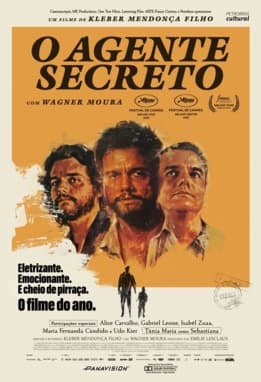
Poster via Wikipedia, The Secret Agent. Used under fair use for criticism and review.
The most important body in The Secret Agent is not a body. It is a severed human leg, found inside a captured shark in Recife during Carnival in 1977, and the question of whose leg it was is not one that anybody in authority is eager to answer. The police would prefer it belonged to no one. The newspapers would prefer it belonged to a monster. Kleber Mendonça Filho treats it as the first item in an archive, and the picture spends its 161 minutes assembling that archive, corrupting it, and finally handing it to people who were not born when the leg was found.
The first reception was generous, and precise about the wrong things. The film premiered in competition at Cannes on 18 May 2025 and left with Best Director, Best Actor for Wagner Moura, the FIPRESCI Prize and the Art House Cinema Award. It opened in Brazil on 6 November and through Neon in the United States on 26 November. Moura won the Golden Globe for Best Actor in a drama, the film won the Globe for Foreign Language Film, and it arrived at the 98th Academy Awards with four nominations: Picture, Actor, Casting and International Feature. It won none of them. The international award went to Joachim Trier’s Sentimental Value.
The consensus account (a political thriller set under the military dictatorship, carried by a great central performance) is accurate. It is also the least interesting description of what Mendonça Filho built, which is a film about record-keeping in which the thriller is the delivery mechanism.
Three ways of keeping a record
The film is organised around a single question, who holds the record of what happened, and it answers with three competing systems.
The first belongs to the state. Armando, a former researcher who comes to Recife to be near his young son Fernando and lives under the name Marcelo, is placed by a dissident network in a job at the city’s identity card office. The arrangement is a joke with teeth. A man the regime wants dead hides inside the bureaucracy that decides who people officially are, and he spends his working hours going through its files for traces of his own dead mother. The dictatorship does not appear in this film as tanks. It appears as paperwork. It is a counter, a filing system, and a corrupt police chief named Euclides.
The second belongs to the press and to the street. The leg becomes a newspaper sensation, and the film folds in the Recife urban legend of the hairy leg, staging its attacks along the Capibaribe as grotesque, absurd horror sequences that seem at first to have wandered in from a cheaper film. They have not wandered in. They are the film’s proposal for how a city under a dictatorship processes violence it cannot name aloud: it turns the violence into folklore and gives it hair.
The third belongs to the resistance, and it is the one the film trusts. In a present-day frame, a history student named Flavia works through audio recordings and newspaper archives connected to Elza, a figure in the resistance network played by Maria Fernanda Cândido. What Flavia learns from those materials is that Armando was murdered, and that afterwards he was framed as a corrupt professor. The regime kills him twice, and the second time it only needs a typewriter.
The face on the recordings
Moura plays Armando. Moura also plays Fernando as an adult in the present day, now a doctor, and this is the casting decision the whole structure depends on. It is more exact than a gimmick. The student has spent the frame listening to voices from 1977, and the man she goes to interview wears the face of the father whose fate is in those recordings. What survives the archive is not a document. It is a resemblance.
In the 1977 sections the performance is built on a particular kind of watchfulness: a man who has learned that pleasantness is a security measure, and who keeps being pleasant a beat after it has stopped working. It is a quiet lead performance, and the prizes it collected were for exactly that quality.
Around Moura, the ensemble keeps the film from narrowing into a portrait. Tânia Maria’s Dona Sebastiana runs the refuge where Armando lodges, a building of dissidents and Angolan refugees, and plays a former anarcho-communist with the ease of somebody who has outlasted several governments. Udo Kier turns up as Hans. Gabriel Leone’s Bobbi is one half of a pair of hitmen hired in São Paulo by Henrique Ghirotti, a former Eletrobras executive with a political and personal grievance against Armando, and the detail matters. The violence in this film is contracted, invoiced and outsourced. The dictatorship supplies the climate; a businessman supplies the order.
Alexandrova’s seventies
Evgenia Alexandrova shot the picture on Panavision anamorphic lenses with vintage camera equipment, aiming for the look of 1970s cinema, over ten weeks on location in Recife in 2024. Many scenes were filmed in the city’s historical buildings, among them the Cinema São Luiz, and the Carnival sequences were restaged near Rua da Aurora, along the route of the city’s main parade. Eduardo Serrano and Matheus Farias edited; Tomaz Alves Souza and Mateus Alves wrote the score.
It would be easy to call the look period dressing. It is closer to forgery, in the useful sense. The anamorphic frame is the grammar of the era’s genre cinema, and by photographing 1977 in the visual language that 1977 used for its thrillers, the film manufactures a document of its own: an image that looks as though it could have been pulled from the same boxes Flavia is working through. The Secret Agent is the fourth record-keeping system in The Secret Agent, and the only one honest about having been made up.
The documentary underneath
Mendonça Filho wrote the script over three years, partly overlapping with the production of Pictures of Ghosts (2023), his documentary about Recife and its cinemas. The two films should be read together. The documentary goes looking for the city’s memory in the rooms where the city used to watch films. The fiction takes the city’s worst decade, stages it on the same streets and in some of the same buildings, and then, in the present-day frame, lets the audience watch somebody else go looking for that memory in a set of recordings.
That second search is deliberately partial. Flavia does not recover Armando. She recovers what was said about him, what was kept of his associates’ voices, and the name of a son. The film’s discipline is in refusing to let the present-day frame become a reckoning. It stays an inquiry.
Where it sits now
The awards season asked the film to be a statement about Brazil, and it obliged well enough to collect four nominations without winning anything. Read instead as a film about inheritance under censorship, it is the most rigorously constructed picture Mendonça Filho has made, and the rigour is structural: a state archive that erases, a folk archive that disguises, a resistance archive that survives in fragments, and a casting decision that lets the fragments arrive wearing a face.
What reaches the present is a voice on a recording, a false story in a newspaper, and a doctor with his father’s face. The film does not pretend that adds up to a man. It argues, with some force, that it is still enough to inherit.
Lena writes long-form essays on the films that will still be talked about in a decade. Previously at a defunct monthly whose name we do not speak.
MORE BY LENA ASHWORTH →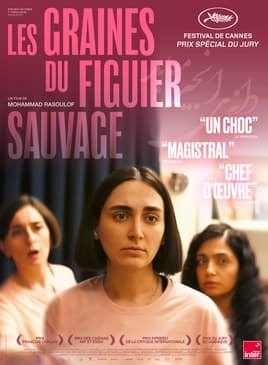
The Seed of the Sacred Fig: Rasoulof's House Film
Mohammad Rasoulof shot the film in secret, fled Iran during post-production, and arrived at Cannes with a three-hour domestic thriller about a judiciary father and his protesting daughters. The retrospective argument is that the long cut is the cut.
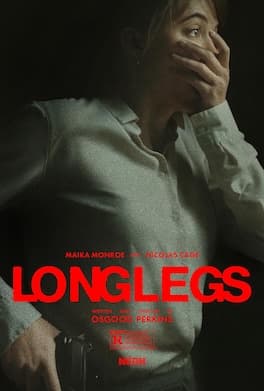
Longlegs: What Perkins Was Really Doing
A year after Longlegs' extraordinary marketing run turned into an extraordinary opening weekend, the film looks smaller than the hype suggested and stranger than the backlash allowed.
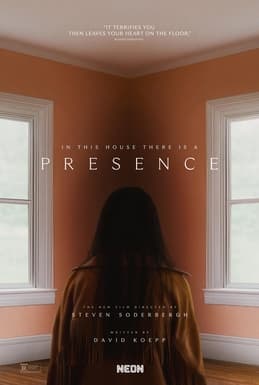
Presence and the Ghost POV Soderbergh Trusted
Steven Soderbergh shot a haunted house film entirely from the ghost's point of view. The formal constraint should not work. It does, and the reasons are technical.