Presence and the Ghost POV Soderbergh Trusted
Steven Soderbergh shot a haunted house film entirely from the ghost's point of view. The formal constraint should not work. It does, and the reasons are technical.
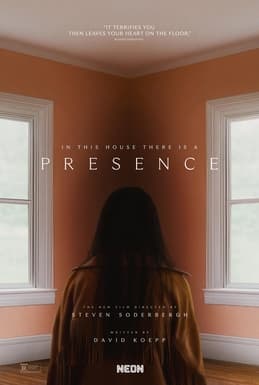
Poster / promotional material via Wikipedia, Presence (2024 film). Used under fair use for criticism and review.
Steven Soderbergh’s Presence, released by Neon in January 2025 after a Sundance premiere the previous year, is a ninety-two-minute haunted house film shot entirely from the point of view of the ghost. The camera is the ghost. The ghost moves around a suburban American house. The family who have just moved into the house are the subjects of the camera’s observation. The ghost cannot speak. The ghost can, in certain specific sequences, move objects. The family cannot see the ghost, though they begin, across the film’s running time, to sense the ghost’s presence.
The premise is the kind of formal constraint that a specific type of festival-film premise deck promises more than it delivers. Soderbergh, here, delivers. A year on, the film is one of the most specifically disciplined recent examples of what a formal constraint can actually do when it is taken seriously.
What the film is
The Payne family (parents Rebecca, played by Lucy Liu, and Chris, played by Chris Sullivan, along with their two teenage children, Chloe and Tyler, played by Callina Liang and Eddy Maday) move into a suburban American house. The house has a ghost. The ghost, whose identity is gradually specified across the film, is drawn particularly to Chloe, whose best friend died under specific unexplained circumstances some months before the film begins.
The plot, such as it is, operates on two specific levels. On the domestic level, the Payne family is working through specific contemporary family pressures (a parental affair, a strained sibling relationship, a teenage daughter’s specific ongoing grief). On the ghost-story level, something specific is going on in the house that will resolve into a specific supernatural confrontation in the final act.
David Koepp wrote the script. Soderbergh directed, shot, and edited. The budget was reportedly around $2 million, making this the most specifically compressed mid-budget horror of 2025.
The ghost camera, technically
The specific formal constraint of the film is that every shot is from the ghost’s point of view. This is not accomplished through a static POV or through a handheld simulation. Soderbergh, who has always had a specific interest in the specific affordances of small cameras, uses a gimbal-stabilised rig that floats through the house at a specific height and with a specific physical fluidity that is neither fully handheld nor fully Steadicam. The camera moves through doorways, floats up and down staircases, drifts through rooms. It is, in its specific physical behaviour, doing a reasonable approximation of what a ghost would do if ghosts were trying to be attentive to the specific activities of the living people they are sharing space with.
The specific technical achievement is that the camera does not call attention to itself as a specific formal conceit. The viewer, within about fifteen minutes of running time, stops registering the constraint and begins watching the film as if the ghost’s point of view is simply the natural camera position for a film of this kind. This is the constraint working. Soderbergh has placed the viewer in the specific position the film requires.
What the ghost can and cannot do
The specific rules of the ghost-camera are important to the film. The ghost can observe. The ghost can, in specific emotionally charged moments, exert minor physical force on objects (shifting furniture, rattling doors, producing specific cold spots that characters register). The ghost cannot communicate directly with the living. The ghost cannot leave the house. The ghost cannot enter rooms where the door is closed (the camera, respecting this, pauses at closed doors and waits for them to open).
These rules are specifically disciplined across the running time. Soderbergh does not violate them. The specific discipline is what allows the film’s specific set pieces to generate tension, because the viewer has learned what the ghost can and cannot do, and the tension is produced by the specific gap between what the ghost wants to do and what the ghost is permitted to do.
This is, at a structural level, very similar to the specific formal discipline of the better first-person video games (Amnesia, SOMA, Observer). The camera has rules. The rules are consistent. The consistency is what generates meaning.
The domestic scenes
One specific thing worth noting: the non-supernatural content of the film is, on its own, specifically well-observed contemporary family drama. The Payne family has specific contemporary American problems (a corporate financial misstep that has hurt Rebecca professionally, a specific extramarital relationship Chris is managing, a specific long-running grief that Chloe has not fully processed), and the ghost’s observation of these problems is the specific mechanism by which the film presents them to the viewer.
The film, if you stripped away the ghost premise, would still be a specifically functional family drama. The ghost is not a gimmick imposed on otherwise weaker material. The ghost is the specific observational consciousness the film uses to access the material, and the material is good enough to justify the access.
Callina Liang, in particular, gives a specifically sharp performance as Chloe. Her scenes with her boyfriend Ryan (West Mulholland), who turns out to have a specifically important role in the film’s supernatural resolution, are played with a specific adolescent emotional transparency that the ghost-camera captures in specific lingering held observations. Liang is an actress worth watching. Her next project will be worth attending to.
The Koepp script
David Koepp’s screenplay deserves specific attention. Koepp, whose long career has included Jurassic Park, Mission: Impossible, and Spider-Man, has in the later stretch of his career moved toward specifically compressed formal exercises (his collaborations with Soderbergh on Kimi, Presence, and Black Bag constitute a specific late-career project). The Presence script is the most formally daring of the three.
The specific challenge of writing a script for a ghost-POV film is that the ghost cannot deliver dialogue, cannot directly articulate thoughts, and cannot stage-manage the scenes the viewer is watching. The dramatic burden falls entirely on the living characters, who must, in every scene, produce specific dramatic content that the ghost is observing. Koepp’s script manages this by giving the family members specific overlapping ongoing storylines that produce dramatic material across the entire running time. There is no scene in which nothing interesting is happening, because the family is always doing at least three things simultaneously.
The reveal, handled
The film’s final act, which I will not spoil, resolves the ghost’s identity and the specific plot mechanism that has been accumulating under the observational surface. The reveal works. It works partly because the film has been honest about the rules of the ghost-camera across the preceding hour, and the specific payoff involves the ghost doing something the viewer has been shown the ghost can do. There is no cheat in the mechanism.
The specific thematic weight of the reveal, which ties the ghost’s identity to the Payne family’s specific contemporary problems in a way that is both narratively satisfying and emotionally earned, is the thing that elevates the film from formal exercise to completed dramatic work.
Where it sits
Presence grossed approximately $12 million on its $2 million production budget, which is a specifically strong commercial result for a formally experimental horror film. Neon’s marketing was specifically careful to avoid spoiling the ghost-POV premise in the trailers, and the specific word-of-mouth that the film accumulated across its theatrical run was the specific thing that sustained the commercial performance.
The film will, I think, become a specific reference point for how to use formal constraint productively in low-budget American horror. Soderbergh’s two 2025 releases (Presence in January, Black Bag in March) together constitute one of the most specifically productive years in his late career, and both films are the kind of specifically disciplined adult genre filmmaking that the American industry has mostly stopped supporting at this budget level.
Watch Presence in a dark room with the lights off. The specific formal constraint is the specific gift, and the specific gift is one that reveals itself gradually across the running time.
Marcus believes good criticism is an argument. He is almost always angry about something, usually for good reason. Horror is his first language.
MORE BY MARCUS VELL →
Longlegs: What Perkins Was Really Doing
A year after Longlegs' extraordinary marketing run turned into an extraordinary opening weekend, the film looks smaller than the hype suggested and stranger than the backlash allowed.
The Substance and the Body Horror Renaissance
Eighteen months after Coralie Fargeat's prosthetic-heavy fable drew both Oscar nominations and walkouts, the strange alchemy of The Substance has only clarified. The film is less about Hollywood than it looks, and more about what we're allowed to say with bodies on screen.
Nosferatu: Eggers' Gothic Masterwork
Eggers' remake was received with admiration rather than fervour, a proper film from a proper filmmaker. Sixteen months later, it looks like the serious piece the year needed, and the one we were too cool to love properly at the time.