Sentimental Value and the House Joachim Trier Won't Leave
Joachim Trier's Sentimental Value gives a family house more screen time than most films give their leads, and that decision is the whole argument of the picture.
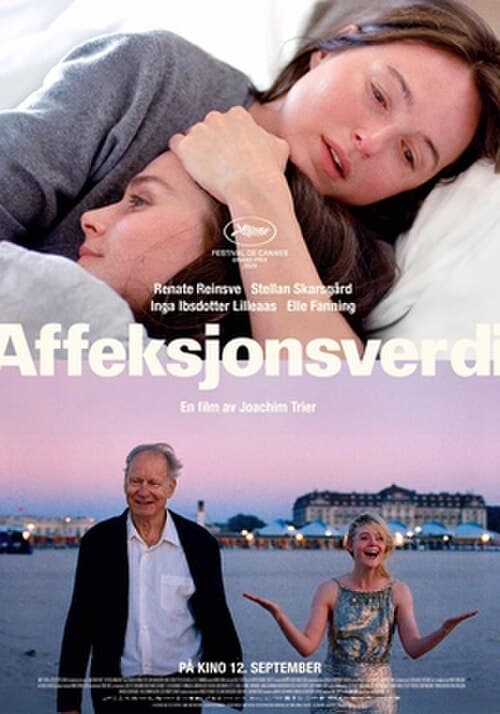
Poster via Wikipedia, Sentimental Value. Used under fair use for criticism and review.
The first thing Sentimental Value does is teach you to look at a house. Before any of its people arrive, Joachim Trier and his cinematographer Kasper Tuxen give us the building itself, an old timber house in Oslo, and a voiceover that hands the place a memory of its own. By the time the family walks in, the house has been established as something closer to a character than a set, and everything the film does afterwards depends on our having taken that lesson. This is a picture that gives more sustained attention to a flight of stairs and a particular doorway than most films give their leads, and the choice is not decoration. It is the argument.
Trier premiered the film in competition at Cannes in May 2025, where it took the Grand Prix, the festival’s second prize. It runs 133 minutes, it reunites him with Renate Reinsve four years after The Worst Person in the World, and it was written, as his films almost always are, with Eskil Vogt. Knowing the collaborators matters here, because Sentimental Value is partly a film about what it means to make things with the same people across a lifetime, and Trier has been making things with Vogt and with his regular crew for the better part of two decades.
The house as inheritance
Reinsve plays Nora, a stage actress whose career is the kind that looks successful from outside and feels like a series of near-collapses from within. Her sister is played by Inga Ibsdotter Lilleaas, and the two of them have inherited, on their mother’s death, the house they grew up in, along with the more difficult inheritance of their father. Gustav, played by Stellan Skarsgård, is a film director of some reputation who walked out of the family years earlier and has been, by his own admission, a better artist than parent. He comes back not quite to apologise. He comes back with a script.
What he wants is to make a film in the house, about the house, about his own mother, and he wants Nora to play the central part. She refuses. He casts an American star instead, a young actress played by Elle Fanning, and installs her in the family home to perform a version of the family’s grief. The premise sounds like a cruelty, and in lesser hands it would play as one. Trier is after something stranger: the way a parent who cannot say the direct thing will build an elaborate machine to say it sideways, and call the machine art.
What the camera knows
Tuxen shoots the house the way a portraitist shoots a face, returning to the same angles until they accumulate weight. There is a staircase the film climbs and descends so often that by the third act a simple cut to it carries information no line of dialogue could. Trier has always been a director of interiors in both senses, the rooms people live in and the rooms they cannot get out of, and Sentimental Value is the fullest expression of that instinct he has managed. The editing, by Olivier Bugge Coutté, holds shots a beat past comfort, so that we are made to wait inside scenes the way the characters are made to wait inside the house.
Hania Rani’s score works the same seam. It does not swell to tell us how to feel; it sits under the image like the hum of a building’s heating, present, almost ignorable, until a scene needs it to rise. The restraint is the point. A film this attentive to a physical place cannot afford a score that overrides the place, and Rani understands the assignment, which is to be one more thing the house contains.
The risk of the conceit
A film built on a metaphor as legible as this one, the house as the family, the family as the unfinished film, can curdle into a diagram. Sentimental Value mostly avoids the trap, and where it does not, the lapses are forgivable, because Trier keeps undercutting his own neatness with behaviour that refuses to resolve. Skarsgård gives Gustav a courtliness that keeps sliding into evasion; he is charming in exactly the way that has cost his daughters the most. Reinsve plays Nora as someone performing competence over a fault line, and the film’s best scenes are the ones where the performance slips for half a second and she has to rebuild it in real time.
The American actress could have been a joke, the vain Hollywood import dropped into a Scandinavian chamber drama. Fanning declines to play her that way. She plays a young woman who senses she has been cast as a proxy in a family argument she does not understand, and who tries, with real decency, to do the job well anyway. That generosity is what keeps the film from becoming a closed loop of Norwegian self-regard. The outsider is treated as a person, not a device.
What it leaves standing
By the end, Trier has done something I did not expect from the premise, which is to argue that the sideways machine, the film-within-the-film, the whole elaborate apparatus of displacement, might actually work. Not as therapy, and not as forgiveness, but as a way for people who cannot speak plainly to each other to stand in the same room and make one true thing together. The house is still standing. The family is not repaired. But a film got made inside it, and the film, the real one, the one we are watching, treats that as enough.
Sentimental Value is the work of a director who has spent his career learning that the largest emotions are best approached through the smallest details, a doorway, a staircase, a score that refuses to insist. Trier will not leave the house because the house is where the feeling lives. He is right to stay.
Lena writes long-form essays on the films that will still be talked about in a decade. Previously at a defunct monthly whose name we do not speak.
MORE BY LENA ASHWORTH →
Dream Scenario: Borgli's Cage Vehicle as Media Critique
Kristoffer Borgli's A24 feature used Nicolas Cage as the vehicle for a media satire that landed in late 2023 and has aged, through 2024 and into 2025, into a specifically sharper object than the reviews initially registered.

The Running Man Spent Like a Star Vehicle Without a Star
Edgar Wright's Stephen King adaptation took $69 million worldwide on a $110 million budget. The film was fine. The price tag assumed a star Paramount had never actually tested.

The Secret Agent and the Leg in the Shark
Kleber Mendonça Filho's Recife thriller left the Academy Awards with nothing from four nominations. Its subject was never the chase. It was who gets to keep the record of a city.