Saturday Night and Jason Reitman's Real-Time Origin Story
Jason Reitman's compressed account of the ninety minutes before the first SNL broadcast is the rare backstage film that trusts the chaos to be its own argument.
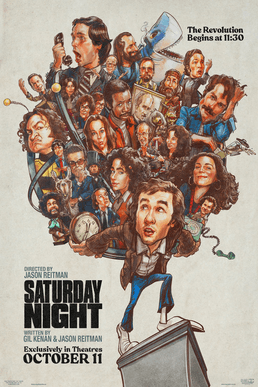
Poster / promotional material via Wikipedia, Saturday Night (2024 film). Used under fair use for criticism and review.
Jason Reitman’s Saturday Night, released through Sony in October 2024 after a Telluride premiere a month earlier, makes one large structural bet and rides it for the full hundred and nine minutes. The bet is that the ninety minutes immediately preceding the first broadcast of NBC’s Saturday Night on 11 October 1975, presented in something close to real time, will produce enough dramatic content to sustain a feature-length film. The bet pays, with reservations, and the reservations are worth describing because they are the same reservations that make the film interesting.
Reitman wrote the script with Gil Kenan, his frequent collaborator on the Ghostbusters sequels, and the writing partnership matters. Kenan, whose sensibility tends genre, pulls the script away from the kind of reverent prestige register that backstage-of-an-institution films routinely default to. The script is propulsive, often chaotic, occasionally too pleased with its own ensemble density. It is also continuously alert to the specific historical fact that the people inside the building did not know, at 11:20 PM, whether the show they were assembling would air.
The casting bet
Gabriel LaBelle plays Lorne Michaels. The casting is the film’s first major decision, and it works because LaBelle, who came up through The Fabelmans, plays Michaels not as the cultural institution he later became but as the specific twenty-nine-year-old Canadian producer who had pitched a sketch show to NBC, talked his way into ninety minutes of network airtime, and was now responsible for filling those ninety minutes with material the network had not seen. The performance avoids the trap of inhabiting a known voice. LaBelle plays a young man under operational pressure, and the inhabitation is patient.
The Not Ready for Primetime Players are cast across a register that the film keeps deliberately uneven. Cory Michael Smith’s Chevy Chase is the most full-throated impression, and the performance leans into the specific abrasive vanity that Chase’s reputation has long carried. Dylan O’Brien plays Dan Aykroyd with a younger actor’s specific physical commitment to a specific physical character. Matt Wood plays John Belushi as a chaotic operational variable rather than a cultural artefact. Ella Hunt’s Gilda Radner is the performance most willing to be small, and the smallness is the performance’s argument.
Lamorne Morris, as Garrett Morris, is given the script’s quietest stretches. The film does not pretend the racial politics of 1975 American sketch comedy were anything other than what they were, and Morris’s specific late-arriving moments inside the script are calibrated as a kind of structural correction rather than a redemption. The choice is honest.
What the film is doing with time
The compressed real-time conceit is the film’s central formal commitment. Reitman, working with cinematographer Eric Steelberg and editor Nathan Orloff, shoots the film as a series of overlapping continuous walks through the 30 Rockefeller Plaza building. Cameras follow characters into corridors, dressing rooms, the studio floor, the control room, the rooftop where Michaels has a specific conversation with NBC executive Dick Ebersol (Cooper Hoffman). The transitions between sequences are constructed so that the film’s geography of the building begins to feel familiar across the running time, which is the specific thing the formal conceit needs to accomplish.
The temporal compression is not perfect. Reitman cheats, productively, in two specific places. The cold opening flashes back to a few earlier production meetings. A sequence in the third act collapses two events that historically occurred in different orders into a single dramatic beat. Both cheats serve the film, and both are visible enough to readers familiar with the SNL prehistory that the film cannot be accused of falsifying the record. It is doing what dramatised history is supposed to do.
The production department
The film’s production design, by Jess Gonchor, is the unsung architectural choice. The 30 Rock interiors have been reconstructed at a scale and with a specific period accuracy that allows the camera to move continuously through real spatial relationships. Doors lead to corridors that lead to the studio floor that leads to the control room. The production design is doing the same kind of structural work that a real building does. You stop registering it as design.
Jon Batiste’s score is the second piece worth crediting. Batiste, who has been moving across film, television, and his own recording career, supplies a specific kind of jazz-inflected motif that establishes the period without lapsing into nostalgia. The score is most active in the film’s quieter stretches and pulls back almost completely in the louder ensemble scenes, allowing the dialogue overlaps to do their own work.
The ninety-minute argument
What the film is finally about, beneath the casting and the architecture and the temporal cleverness, is the specific question of what it costs to launch something that has not existed before. The 1975 SNL launch was the result of a specific institutional gamble by a specific group of people, most of them young, most of them under-credentialed for what they were attempting, all of them aware that the network had given them ninety minutes and would not give them ninety more if the first broadcast did not work.
Reitman’s film registers this without sentimentalising it. The Lorne Michaels of Saturday Night is not a visionary. He is an organiser under operational pressure, and the film’s most consistently observed beats are the moments when the organisational pressure converts into specific small decisions about which sketch goes first, which guest host needs reassurance, which performer is too high to perform. The film respects the specific texture of this kind of work.
The supporting cast keeps producing small surprises. Rachel Sennott plays Rosie Shuster, Michaels’s wife and a writer on the show, with a specific clear-eyed register that the film uses to externalise some of Michaels’s internal calculations. Nicholas Braun does double duty as Andy Kaufman and Jim Henson, and the second performance is the more interesting one. Naomi McPherson’s Janis Ian is a small, sharp musical interlude that the film uses as a structural breath. Willem Dafoe arrives as NBC executive David Tebet and does, in three scenes, what he has been doing across his late career, which is to play institutional menace with a specific degree of warmth that complicates the menace.
The Belushi moment
The film’s strongest five minutes belong to Matt Wood’s Belushi. The specific sequence involves Belushi refusing to sign his contract, with the broadcast clock approaching the hour, and Michaels having to negotiate the signing in real time on the studio floor. The sequence is played with the specific stakes-uncertainty that the larger film has been accumulating, and Wood’s specific physical performance, with his body language continuously communicating the gap between Belushi’s professional-acquisition value and his personal-operational difficulty, is the film’s most concentrated dramatic asset.
What the film leaves
Saturday Night did approximately $9.4 million domestically against a reported $25 million production budget. The commercial result was modest. The critical reception was warmer than the commercial result suggested, and the film entered awards-season conversation in the specific second tier of films that critics liked and Academy voters did not quite reward. It received no major Oscar nominations.
The film will, I suspect, age into something more durable than its theatrical run indicates. It is the kind of dramatised institutional history that benefits from the specific repeat viewing the streaming window allows. People will watch it on planes, on living-room televisions, on laptops. The architecture of the building, the density of the ensemble, the specific ninety-minute clock, are all things that reward a second viewing, when the viewer has stopped trying to keep up with the cast list and can begin attending to the specific things the film is doing with its formal conceit.
Reitman has, with this film, completed a specific kind of mid-career project. The Tully and Up in the Air observational mode is here, slightly displaced into ensemble. The Ghostbusters franchise work is here, in the comfort with chaotic genre operation. Saturday Night is the synthesis of those two registers, and the synthesis is the most interesting thing he has made since Up in the Air. Worth your evening, particularly if you are watching it with somebody who remembers, or thinks they remember, watching the original broadcast.
Lena writes long-form essays on the films that will still be talked about in a decade. Previously at a defunct monthly whose name we do not speak.
MORE BY LENA ASHWORTH →
Warfare: Mendoza and Garland's Real-Time Iraq
Ray Mendoza and Alex Garland's second collaboration rebuilds a 2006 Ramadi engagement from the memories of the men who survived it, and the film's claim on attention is its specific refusal to shape.

Frankenstein Cost $120 Million and Played Like a Secret
Del Toro's Frankenstein is built in two halves that only work if you sit through both in one go. Netflix released it as something you can pause.

The Electric State and What $320 Million Cannot Buy
Netflix reportedly spent around $320 million on The Electric State. The film that came out the other end is the clearest argument yet against frictionless money.