Perfect Days: Wenders, Tokyo, and the Discipline of Noticing
Wim Wenders' film about a Tokyo toilet cleaner is the quietest great film of the year. An argument for the discipline of the ordinary.
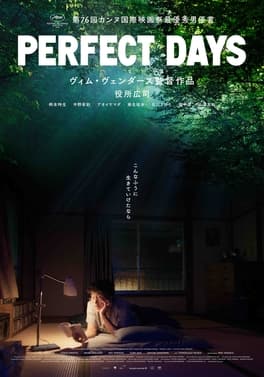
Poster / promotional material via Wikipedia, Perfect Days. Used under fair use for criticism and review.
I want to write about Wim Wenders’ Perfect Days before the Oscar-season heat around it cools. The film, which was Japan’s submission for Best International Feature this year, is the kind of work that tends to slip out of the cultural centre quickly, not because it is not well-loved, but because its virtues do not produce headlines.
What the film is
Hirayama, played by Koji Yakusho, is a middle-aged man who cleans public toilets in central Tokyo for a living. The film follows him across several weeks of his life. He wakes before dawn, folds his futon, brushes his teeth, trims his moustache, drives to work in a Daihatsu van listening to cassettes (Lou Reed, Patti Smith, The Rolling Stones, Van Morrison). He cleans toilets carefully, with invented tools and a practitioner’s focus. He reads in the evenings, Faulkner, Patricia Highsmith, Aya Koda. He goes to the same bathhouse, eats at the same counter restaurant, photographs the same trees in the same park with the same disposable camera.
The narrative engine, such as it is, consists of mild incursions from outside: a runaway niece who arrives and stays for a few days, a co-worker who needs a favour, a chance meeting with the former husband of a woman Hirayama is quietly attached to. None of these incursions resolve into plot in the conventional sense. They pass through the film like weather passing through a garden.
The discipline argument
What Wenders is doing, and what Yakusho is doing, and what the film is doing, is making an argument for the moral value of attention.
Hirayama is not happy in any simple sense. He has a past the film only gestures at (a family wealth he has walked away from, a sister who appears briefly in a scene that suggests a rift). He is not pursuing anything. He is not escaping anything. He is conducting, day by day, a set of practices that add up to a life, and the film’s argument is that such a life, undertaken with enough care, is not a lesser thing than the lives we are told to admire.
This is a difficult argument to make on screen, because screen drama traditionally works by introducing stakes and resolving them. Perfect Days has almost no stakes and almost no resolutions. Its dramatic rhythm is daily. You wake up, you do your work, you notice things, you go to sleep. The next day, you do it again.
The Koji Yakusho performance
Yakusho won Best Actor at Cannes for this film and the win was, to my mind, beyond correct. What he does across the running time is something almost no leading actor gets to do: he plays a man who does not speak for long stretches, and whose inner life is communicated almost entirely through the specific quality of his attention to his surroundings.
Watch him light a cigarette at his morning wake-up. Watch him smile at the same tree he photographs every week. Watch him read a book. These are the dramatic beats. There is no other drama. Yakusho makes them enough.
The tree photographs
A motif that runs through the film: Hirayama photographs the same stand of trees on his lunch break every day, using disposable cameras. He develops the film weekly, keeps the good images in a file, discards the rest.
The film understands, and wants us to understand, that this practice is the specific shape of Hirayama’s spiritual life. He is not photographing for social media. He is not photographing to be someone. He is photographing because he has decided that the way light falls through these specific leaves is a thing worth noticing, and he is going to keep noticing it until he cannot anymore. That is, in the film’s worldview, a discipline. It is also, in a way I do not think the film is embarrassed to suggest, a prayer.
Where the film wobbles
I will register one complaint. The sequence with the dying cancer patient, a former husband of a woman Hirayama is close to, is the film’s only overt plot-intrusion, and it sits slightly heavily against the film’s otherwise minor-key pattern. The two men play shadow-tag on a riverbank. It is a beautiful scene. It is also a more conventional piece of film grammar than the surrounding material, and you can feel the script reaching, for a moment, into a less patient register.
This is a small complaint. The film recovers in its final scene, a long-held close-up on Yakusho’s face while Nina Simone’s “Feeling Good” plays, which is the single most sustained piece of screen acting of the year so far.
Where I think it fits
Perfect Days sits in a specific late-Wenders mode. The 1984 Paris, Texas was a film about a man trying to reconstitute a life he had destroyed. The 2011 Pina was a film about a director honouring a collaborator by documenting her work. Perfect Days is a film about the possibility of a life constructed entirely out of small reliable things, refusing the large dramatic moves that Wenders’ earlier filmography took for granted.
Wenders, it is worth saying, is now in his late 70s. The film has the specific patience of a director who has nothing left to prove and a lot of life left to observe. It is an old director’s film in the best sense.
Watch it when you have time, and when you can watch it without your phone. The film will reward both. Nothing else this year has.
Lena writes long-form essays on the films that will still be talked about in a decade. Previously at a defunct monthly whose name we do not speak.
MORE BY LENA ASHWORTH →
Megalopolis: Coppola's $120 Million Argument With Himself
Francis Ford Coppola self-funded his first film in thirteen years. It is nearly unwatchable in specific places and almost-great in others. The project is the point.

The Bikeriders: Jeff Nichols' Slow Elegy
Jeff Nichols' motorcycle-club drama was held up by distribution chaos for a year, then released in a summer that did not know what to do with it. A case for the slower film.
Evil Does Not Exist: Hamaguchi's Quietest Provocation
Ryusuke Hamaguchi's follow-up to Drive My Car is the quietest major film of the year. An argument for the patience the film requires and rewards.