The Bikeriders: Jeff Nichols' Slow Elegy
Jeff Nichols' motorcycle-club drama was held up by distribution chaos for a year, then released in a summer that did not know what to do with it. A case for the slower film.
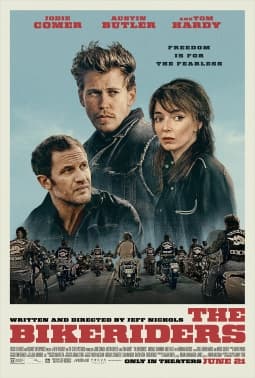
Poster / promotional material via Wikipedia, The Bikeriders. Used under fair use for criticism and review.
The Bikeriders, Jeff Nichols’ adaptation of Danny Lyon’s 1967 photo book about a fictional Chicago motorcycle club, was shot in late 2022, premiered at Telluride in September 2023, and then disappeared into a distribution limbo when 20th Century Studios (under new Disney ownership) backed out of the planned theatrical release. Focus Features picked up the film and eventually released it in June. By that point, the film had been discussed more than seen, and the eventual release was mostly a quiet one.
A month on, this is the 2024 film I most want to defend. The Bikeriders is a better film than its commercial reception suggests, and it is specifically better in the way Jeff Nichols’ films have always been better: slower, quieter, more attentive to character than to plot, committed to a specifically American regional specificity that most contemporary commercial cinema has abandoned.
What the film is
Inspired by but not directly adapting Lyon’s photo book, the film is a fictional account of the rise and fall of the Vandals, a Chicago-area motorcycle club, across roughly a decade from the mid-1960s to the mid-1970s. The film is structured as a series of interviews Lyon (Mike Faist) conducts with Kathy, played by Jodie Comer, the wife of a Vandal named Benny, played by Austin Butler. Around Kathy’s narration, the film reconstructs the specific arc by which an informal regional club of motorcycle enthusiasts gradually transforms into an organised-crime-adjacent outfit.
The central figure, arguably, is not Kathy, Benny, or Johnny (Tom Hardy, the club’s founder), but the club itself, a specific kind of postwar American male institution whose trajectory from subcultural brotherhood to proto-criminal hierarchy the film documents with care.
What Nichols is doing
Jeff Nichols has, across his career, been one of the most consistent chroniclers of specifically American regional life (Take Shelter, Mud, Midnight Special, Loving). The Bikeriders is Nichols applying his specific methodology to a genre-coded subject. The film has the surface features of a motorcycle-gang picture (violence, leather, motors, specific male-homoerotic undercurrents), but the dramatic register is closer to a regional character study than to an action film.
This is the right approach for the material. Lyon’s original photo book was not, finally, about motorcycle gang glamour. It was about the specific texture of a specific American subculture at a specific historical moment. Nichols’ film preserves that documentary impulse.
The Jodie Comer performance
Jodie Comer’s Kathy is, by some margin, the film’s best performance and the specific element that should have driven the film’s awards conversation. Comer, whose Killing Eve work demonstrated her range with accents, here commits to a specific Chicago working-class register that most contemporary actors would not even attempt. The accent is precise. The physicality is specific. Kathy, as she narrates, is a woman who has thought carefully about what she lost to the club and about what she chose to lose.
The specific thing Comer is doing, across the interview segments in particular, is playing Kathy as a woman who is telling the story of her own life with a slight time-delay, hearing each sentence as she speaks it and recognising, in real time, what it means. The performance is built out of those micro-recognitions. It is an extraordinary piece of screen acting that deserved a much larger cultural platform than the film’s distribution mess allowed.
The Austin Butler question
Austin Butler’s Benny is the film’s specific puzzle. Benny is written, deliberately, as an opaque figure: a young man whose beauty and magnetic passivity make him the film’s focal point without ever actually giving him a dramatic interior. Butler plays this opacity without flinching, and the choice divided critics at the time of release.
I was, initially, unsure about what Butler was doing. On reflection, I think the opacity is the right choice. Benny is not, structurally, the protagonist. He is the object around which Kathy and Johnny each construct their separate versions of the club’s meaning. Butler’s refusal to give Benny a clear interior is, in the film’s grammar, a specific acting decision that serves the film’s broader argument.
The Tom Hardy contribution
Tom Hardy’s Johnny, the club’s founder, is a specific kind of quiet charismatic performance that Hardy has been quietly perfecting for the last decade. Johnny is not theatrical. He is authoritative in a specifically low-key way. Hardy plays the quiet authority with the kind of craft that makes all of Johnny’s decisions across the film feel specifically earned.
The scene in which Johnny watches Benny and has to decide whether to endorse him as a successor is the film’s dramatic centre, and Hardy plays it almost entirely with his face across a three-minute held shot. The performance is a reminder that Hardy, when the material permits, is one of the best silent actors in contemporary cinema.
What the film is really about
The Bikeriders is, finally, a film about the way subcultural institutions age into organisational failure. The club starts as a brotherhood of specific men with specific shared desires. It ends as a proto-criminal bureaucracy that has lost most of what originally bound it. The transition is gradual, non-melodramatic, and historically legible.
This is the specifically American subject Nichols has been drawn to across his filmography: the slow way that the institutions Americans build (families, communities, churches, workplaces, motorcycle clubs) gradually lose their original purposes and become something else. The film treats this drift with a specific sadness that is the emotional register of all of Nichols’ work.
What the film deserves
The Bikeriders did modest commercial business and has, a month on, begun to find its audience on streaming platforms. The film is likely to age into a specific cult respect that its theatrical window did not provide.
Nichols is a director whose commercial profile has always been smaller than his critical reputation. The Bikeriders will not change that. What it will do is confirm, for anyone paying attention, that he is one of the most consistent serious filmmakers working in the American register.
Watch it when you have time. Pay attention to Kathy’s interview scenes. Let the specific silence of Johnny and Benny build. The film is doing what good regional cinema does, which is nothing dramatic, patiently.
Marcus believes good criticism is an argument. He is almost always angry about something, usually for good reason. Horror is his first language.
MORE BY MARCUS VELL →
Megalopolis: Coppola's $120 Million Argument With Himself
Francis Ford Coppola self-funded his first film in thirteen years. It is nearly unwatchable in specific places and almost-great in others. The project is the point.

Perfect Days: Wenders, Tokyo, and the Discipline of Noticing
Wim Wenders' film about a Tokyo toilet cleaner is the quietest great film of the year. An argument for the discipline of the ordinary.
Evil Does Not Exist: Hamaguchi's Quietest Provocation
Ryusuke Hamaguchi's follow-up to Drive My Car is the quietest major film of the year. An argument for the patience the film requires and rewards.