Mufasa and the Disney Prequel Machine
Disney hired Barry Jenkins to direct a photoreal prequel to a remake of an animated film. The economic logic is intelligible. The artistic logic is not. A year on, the question is what Jenkins was doing there.
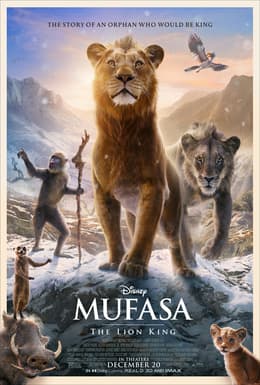
Poster / promotional material via Wikipedia, Mufasa: The Lion King. Used under fair use for criticism and review.
Disney’s Mufasa: The Lion King, released in December 2024, was directed by Barry Jenkins. This is the sentence I keep coming back to, because on any reasonable reading it does not make sense.
Barry Jenkins directed Moonlight (2016), which won the Academy Award for Best Picture. He directed If Beale Street Could Talk (2018), one of the most specifically beautiful American films of the last decade. He directed The Underground Railroad (2021), a ten-episode television adaptation of Colson Whitehead’s novel that is one of the specifically towering achievements of prestige-era streaming. His specific filmography is organised around the intimate emotional interiority of Black American characters, rendered through specific patient photographic attention and specific restrained editorial pacing.
He also directed Mufasa, a photorealistic animated musical prequel to the 2019 remake of Disney’s 1994 animated film. The prequel is an IMAX-formatted family entertainment with a reported $200 million production budget, a two-hour running time, and a soundtrack of new songs by Lin-Manuel Miranda.
I am still trying to work out what happened.
What the film is
Mufasa, the future father of Simba, begins his life in the film as a young orphaned lion cub named something not-Mufasa (the name Mufasa is given to him later). He is adopted by a separate pride whose young prince, Taka, becomes his adopted brother. Taka will grow up to become Scar. The film is the specific origin story of both lions, staged as a specific journey across various computer-generated African landscapes, punctuated by musical numbers in which photo-realistic lions sing at the camera.
The framing device involves Rafiki (John Kani) telling the story of Mufasa to Kiara, Simba’s daughter, with interjections from Timon (Billy Eichner) and Pumbaa (Seth Rogen). The framing is as annoying as it sounds. The inner story is, in places, more interesting than the framing allows.
The commercial arithmetic
Mufasa grossed approximately $720 million worldwide on its $200 million production budget. This is, on a conventional studio multiplier, a specifically modest success: not a disaster, not a hit, something like a break-even at best once marketing costs are factored. For a Disney tentpole with Lion King IP attached, this is a specific underperformance.
The 2019 Lion King remake, for comparison, grossed approximately $1.66 billion. Mufasa is, relative to the previous entry in its specific franchise chain, a halving of commercial performance. The prequel machine is running into the specific diminishing-returns problem that the Disney live-action-remake strategy has been approaching for several years.
The Jenkins question
The specific artistic question is what Barry Jenkins is doing in this film at all. I do not mean this dismissively. I mean it as a genuine inquiry. Mufasa has visual and rhythmic signatures that are specifically Jenkins’s, and the presence of these signatures inside a corporate prequel is one of the more interesting film-criticism puzzles of 2024.
Several specific examples. The opening sequence, which introduces the young Mufasa in a specific savannah storm, is shot with a specific attention to reflection and water that is recognisable from Moonlight’s Miami sequences. The scene in which Mufasa and Taka first bond across a specific night watch is composed with the same specific slow camera movement and held reaction-shot pattern that characterises the Beale Street apartment scenes. The specific song that functions as Mufasa and Sarabi’s romantic theme is scored with specific string arrangements that recall Nicholas Britell’s work on Jenkins’s earlier films (Britell does not score Mufasa; Dave Metzger does, in what reads like a deliberate stylistic imitation).
The question is why Jenkins is deploying his specific directorial signature in this commercial context. One reading: he is quietly subverting the Disney machine by smuggling his aesthetic into it. Another reading: he is taking the paycheck and doing the work at the quality level his professional standards require. A third reading: the Jenkins signature is the specific creative contribution Disney hired him to provide, and the corporate machinery is perfectly happy to have it sitting inside the product.
The first reading is the one fans of Moonlight want to be true. I do not think it is. The signature, in Mufasa, is aesthetic rather than political. Jenkins is not secretly critiquing the corporate form he is operating inside. He is making the corporate form look more like a Barry Jenkins film than it would otherwise look.
What the photorealistic animation cannot do
The specific technical problem that has dogged every Disney photorealistic-animation project since the 2019 Lion King remake is that photorealistic animal faces cannot perform the specific emotional work that stylised animated animal faces can perform. Lions do not have eyebrows. Lions do not have expressive lips. Lions have specific facial musculature that, when rendered photorealistically, produces a specific affective neutrality regardless of what the animators are trying to communicate.
The 1994 Lion King solved this by using specifically stylised animal faces that departed significantly from real lion anatomy. The 2019 remake and now Mufasa attempt to solve it by adding subtle rigging to photorealistic faces, and the solution does not work. The specific emotional range available to Mufasa and Taka across the film is narrower than the specific emotional range the story requires. The photorealistic rendering is fighting the specific dramatic material.
Jenkins, to his credit, compensates for this with specific directorial choices. He stages key emotional beats in specific lighting conditions that let the lighting carry the affective weight the faces cannot. He uses specific body-language direction (the specific way a lion turns its head, the specific way a lion lowers its chest) to communicate emotional content. He uses specific musical scoring in specific sparse arrangements to underline emotional beats the faces cannot produce.
These compensations are, formally speaking, Jenkins’s most specific contribution to the film. They are the reason the film achieves any emotional coherence at all. They are also, structurally, workarounds for a fundamental problem that the specific animation technology cannot solve.
The Lin-Manuel Miranda songs
The specific songs Lin-Manuel Miranda has written for Mufasa are, collectively, not among his best work. They have the specific Miranda signatures (internal rhyme, rhythmic density, thematic callbacks) that his Broadway output is known for, but they are written to a specific Disney-animated-musical template that does not play to his particular strengths. The songs need to be heard in the specific context of the film to work at all, and several of them do not work even there.
This is not entirely Miranda’s fault. The specific musical-number structure of a contemporary Disney animated film is, as a form, in a specifically decayed state. The songs exist less as specific dramatic articulations than as specific commercial events that the film is required to have. Miranda is writing into this decayed form. The results are specifically uninspiring.
Where it sits
Mufasa will, I suspect, be remembered as one of the specific minor entries in Barry Jenkins’s otherwise specifically distinguished filmography, and as another data point in the specific decline of the Disney live-action-adjacent animation strategy. The specific commercial underperformance is the specific number Disney will be looking at in their development meetings, and the specific decision may be to stop making these films altogether.
For Jenkins, the specific question is what he does next. His next project, reportedly a lower-budget original drama, is the one to wait for. Mufasa was, I suspect, a specific financial decision taken at a specific career juncture. The specific hope is that the decision bought him the specific latitude to return to the work he actually wants to be making.
Watch the opening sequence, the specific night watch scene, and the specific final confrontation. Skip Timon and Pumbaa. The Jenkins signature is worth identifying. The rest is the Disney machine.
Marcus believes good criticism is an argument. He is almost always angry about something, usually for good reason. Horror is his first language.
MORE BY MARCUS VELL →
Frankenstein Cost $120 Million and Played Like a Secret
Del Toro's Frankenstein is built in two halves that only work if you sit through both in one go. Netflix released it as something you can pause.
The Electric State and What $320 Million Cannot Buy
Netflix reportedly spent around $320 million on The Electric State. The film that came out the other end is the clearest argument yet against frictionless money.
Caught by the Tides and the Archive of a Face
Jia Zhangke built his new film out of twenty-two years of his own discarded footage. The result is the rare picture whose real subject is the time it took to shoot.