Mickey 17 and the Expensive Satire Bong Joon-ho Made
Bong Joon-ho's first film after Parasite is a $118 million science fiction satire that Warner Bros marketed badly and audiences did not know how to process. A year on, the failure is the studio's, not the director's.
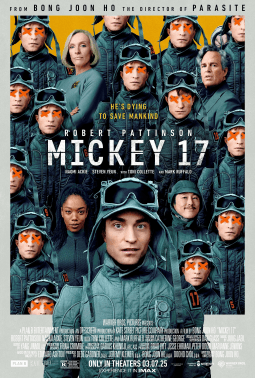
Poster / promotional material via Wikipedia, Mickey 17. Used under fair use for criticism and review.
The commercial record on Mickey 17: a reported $118 million production budget, a March 2025 theatrical release, a worldwide gross of approximately $130 million, a loss of somewhere in the range of $80 to $100 million for Warner Bros once marketing and distribution costs are factored. It is, in the specific accounting of 2025 theatrical cinema, a flop.
It is also, when you actually sit down and watch the thing, a specifically good film that the studio system does not know what to do with. A year on, the gap between the film’s aesthetic achievement and its commercial reception is the specific diagnostic problem worth pulling apart.
The first film after Parasite
Mickey 17 is Bong Joon-ho’s first feature since Parasite (2019), which won the Palme d’Or, the Best Picture Oscar, and became the first non-English-language film to win Best Picture in the Academy’s history. The specific commercial and critical weight that accumulated around Bong in the five years between Parasite and Mickey 17 was enormous, and the specific expectation surrounding his next film was, predictably, unrealistic.
Bong was always going to make a film that did not meet the specific expectation. The question was which direction the disappointment would run in. Mickey 17 ran in the direction of a specifically absurdist English-language studio science fiction comedy adapted from Edward Ashton’s novel Mickey7, and the Warner Bros marketing apparatus had, visibly, no idea what to do with the tonal register.
What the film is
Mickey Barnes (Robert Pattinson) is, in the film’s specific premise, an “Expendable”: a person who has signed away the rights to his body to a deep-space colonisation corporation, on the terms that when he dies (which happens routinely in the specific high-risk jobs Expendables are assigned), a new version of him is printed from a biological template, with his memories uploaded from a backup maintained between bodies. Mickey has died sixteen times by the point the film opens. He is working on a planet called Niflheim, which is being colonised under the specific leadership of a former American politician named Kenneth Marshall (Mark Ruffalo).
A specific accident results in Mickey 17 and Mickey 18 existing simultaneously, which is, in the specific terms of the Expendable contract, forbidden. The film is about what the two Mickeys do about their simultaneous existence, and about what happens as the colonisation project collides with the native inhabitants of Niflheim.
The satire, specifically
Bong’s film is, among other things, a specifically sustained satire of American corporate-colonial logic, and the specific target of the satire is not subtle. Mark Ruffalo’s Kenneth Marshall is a specifically bombastic American leader whose rhetorical style, public-appearance habits, and specific relationship with his wife Ylfa (Toni Collette, giving a specific horror-comic performance) are, on any reasonable reading, a specific caricature of the Trump administration. Ruffalo plays Marshall with a specific orange-tan makeup, a specific rhetorical cadence, a specific relationship with his supporters that is obviously referential.
This is the specific thing that Warner Bros could not market. The film was released in March 2025, two months after the specific American political event it was implicitly commenting on. The studio marketing positioned it as a Pattinson-led science fiction adventure. The film itself is a specifically anti-authoritarian satire whose political framing is, for specific American audiences of specific political dispositions, either directly confrontational or, for the other specific dispositions, not confrontational enough. Neither group got what they were sold.
The specific disposal of the film’s political content in the marketing was, I think, the single largest commercial mistake Warner Bros made. The film is most interesting when you read it as the specifically political text it is.
What Pattinson does
Robert Pattinson, playing both Mickey 17 and Mickey 18, gives a specifically committed dual performance that is worth specifically attending to. The two Mickeys are not identical. Mickey 17 is specifically quieter, specifically beaten-down, specifically the product of seventeen versions’ worth of disposable labour. Mickey 18 is specifically angrier, specifically less worn, specifically a fresher rebellion against the same material conditions. Pattinson plays the distinction through specific physical differences (posture, vocal register, rhythm of speech) that are subtle enough to feel real and consistent enough to work in the split-screen sequences.
Pattinson has, across his post-Twilight career, been one of the specifically committed American leading men working in the mid-to-high budget register. His collaborations with Claire Denis, David Michôd, Robert Eggers, Matt Reeves, and now Bong have established a specific career pattern: he works with specifically demanding directors, he does specifically committed work, he does not condescend to genre material. The Mickey 17 performance extends this pattern. It is the kind of performance that, in a different studio climate, would be being discussed as his best.
The Niflheim creatures
One specific formal achievement worth flagging: the creature design for the native inhabitants of Niflheim, which Bong’s production team has called “Creepers.” The creatures are not humanoid. They are not mammalian. They are, specifically, segmented land-dwelling invertebrate creatures that the film gradually reveals to have social organisation, language, and specific moral agency. The design is committed enough that the specific empathetic weight the film places on the Creepers in its final act lands.
Most American studio science fiction of this budget level renders alien life as a specific variant of familiar biological forms. Mickey 17 refuses the variant. The Creepers are genuinely specifically strange, and the film’s willingness to let them remain strange while also requiring the viewer to recognise their moral agency is the specific formal move the film’s politics rely on.
Where the film wobbles
Mickey 17 is not structurally perfect. The second act, which introduces Nasha (Naomi Ackie, doing strong work with less screen time than the role deserves) and begins to develop the specifically political confrontation with Marshall, has some pacing issues. Specific scenes in the colony base feel like they are being played for comedy that the surrounding dramatic material does not quite support. The tonal register shifts are, in places, rougher than Bong’s previous work.
But the film’s overall argument, about what a specifically American corporate-colonial project does to the labouring body, is carried with specific discipline across the two and a half hour running time, and the final act (in which the two Mickeys have to decide what kind of collective resistance they are willing to organise) earns its specific political weight.
The reception problem
Mickey 17 received specifically mixed reviews on release, with critics generally respecting the ambition and audiences less willing to sit with the tonal register. The specific commercial failure is a warning about what American studios can and cannot release into the current theatrical market. A $118 million science fiction satire that is specifically politically confrontational is, at this moment, a specifically difficult product to place with a general audience.
The question the film raises is whether Warner Bros should have made it at all, given that the specific audience for it was always going to be narrower than the budget required. My reading is that the film is good enough to justify the bet even with the specific loss, but the bet is the kind of bet that the specific current studio climate is moving away from. Mickey 17 may be one of the last mid-to-large-budget auteur science fiction films Warner Bros greenlights for a while.
Where it sits
Bong Joon-ho’s next project has not been announced as of this writing. Whatever he does next will likely be made at a specifically lower budget in a specifically narrower release frame, which, on the evidence of his previous Korean-language work (Memories of Murder, Mother, Okja, Parasite), is the register in which he does his best work.
Mickey 17 is, in my reading, a specifically underrated entry in his filmography, and a specifically early casualty of the changing studio economics. Watch it on streaming when it arrives. The specific satire is the specific thing worth watching for, and the specific disappointment of its commercial reception is the specific story worth remembering.
Marcus believes good criticism is an argument. He is almost always angry about something, usually for good reason. Horror is his first language.
MORE BY MARCUS VELL →
Dream Scenario: Borgli's Cage Vehicle as Media Critique
Kristoffer Borgli's A24 feature used Nicolas Cage as the vehicle for a media satire that landed in late 2023 and has aged, through 2024 and into 2025, into a specifically sharper object than the reviews initially registered.
Juror #2 and Clint Eastwood's Final Courtroom
Clint Eastwood's probable farewell as a director was buried by Warner Bros in a ghost release. The film is better than the release, and the release is part of the story.
A Quiet Place: Day One, and the Discipline of a Small Apocalypse
Michael Sarnoski's Quiet Place prequel is a studio horror release built to break the franchise's scale rules, and the smaller it stays, the better it works.