Juror #2 and Clint Eastwood's Final Courtroom
Clint Eastwood's probable farewell as a director was buried by Warner Bros in a ghost release. The film is better than the release, and the release is part of the story.
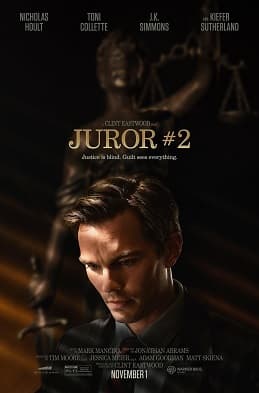
Poster / promotional material via Wikipedia, Juror No. 2. Used under fair use for criticism and review.
Clint Eastwood directed his first feature (Play Misty for Me) in 1971. He is, as of this writing, ninety-five years old. Juror #2, released in a specific ghost-release pattern by Warner Bros in November 2024, is his forty-first feature film as director, and it will, if recent reports are accurate, be his last.
The film has two specific stories attached to it. The first is the story of the film itself: a competent mid-budget courtroom drama, well-directed, tightly scripted, economically shot, and specifically compelling in its final act. The second is the story of how Warner Bros chose to release it: on fewer than fifty American screens, with effectively zero theatrical marketing, in what was widely understood as a specifically deliberate burial.
A year on, both stories are the story. The film is good. The release was a disgrace. Both facts are part of the retrospective.
What the film is
Justin Kemp (Nicholas Hoult) is serving on a Georgia jury in the murder trial of James Sythe (Gabriel Basso), who is charged with killing his girlfriend in a specific roadside incident. Across the opening proceedings of the trial, Justin realises that he was himself at the specific location on the specific night in question, driving home in a rainstorm, and that he may have struck the victim with his car and driven on, believing at the time that he had hit a deer.
This is the premise. The entire film hangs on it. Justin, whose wife (Zoey Deutch) is pregnant with a long-awaited first child, is now the specific juror deciding whether an innocent man goes to prison for a crime Justin may have committed. Faith Killebrew (Toni Collette), the ambitious prosecutor running for district attorney, is the one trying the case against Sythe. Harold (J.K. Simmons), a retired police detective also serving on the jury, begins to suspect that something is off about Justin’s reactions to specific pieces of evidence.
The Eastwood method
Eastwood has, across his career, developed a specifically economical production method. He shoots quickly. He does not indulge in multiple takes unless the material requires it. He works with a specifically loyal crew who have followed him across multiple films. He edits tightly. He scores his own films, often himself (he composed or co-composed scores for several of his recent features). The production philosophy is the inverse of most contemporary Hollywood: fewer takes, faster schedules, no improvisation, no second-guessing.
Juror #2 benefits visibly from this method. The courtroom scenes, which occupy approximately sixty percent of the running time, are shot with a specific procedural clarity that most courtroom dramas no longer bother with. The geography of the courtroom is established in the opening sequence and is never confusing. The specific visual vocabulary of the witness box, the jury box, the prosecution and defence tables, and the judge’s bench is used consistently throughout. The viewer always knows who is looking at whom, and the specific blocking of each cross-examination is legible.
This is not a small thing. Contemporary American courtroom dramas, especially the streaming ones, routinely muddle their own geography in pursuit of specific dramatic flourishes that the older procedural form did not require. Eastwood, operating with a specifically pre-digital grammar, produces a specifically cleaner product.
What Hoult does
Nicholas Hoult, who also stars in The Order (2024) and a specific handful of other 2024 releases, gives a performance as Justin that is the specific opposite of his Order performance. Where Bob Matthews is a specifically charismatic leader, Justin is a specifically ordinary man in extraordinary ethical difficulty. Hoult plays the ordinariness with a specific restraint that is harder than it looks.
Justin’s specific moral calculus across the film is the specific thing the film is about. He could confess and possibly go to prison, losing his family. He could stay silent and let an innocent man (possibly; the film is not entirely clear on Sythe’s character) be convicted. He could attempt to steer the jury toward acquittal without revealing his own involvement. Hoult plays each stage of this calculation across specific small physical reactions (a hesitation before voting, a specific glance at the defendant, a specific rhythm of breathing during witness testimony) that accumulate across the running time into a specific portrait of ethical distress.
Toni Collette’s Faith
Toni Collette, playing the prosecutor Faith Killebrew, gives the film’s second crucial performance. Faith is, in the film’s specific framing, a specifically ambitious American prosecutor whose entire professional trajectory (she is running for district attorney during the trial) depends on the specific conviction of Sythe. The film could easily have rendered her as an antagonist, a careerist willing to convict an innocent man for political advantage.
It does not. Collette plays Faith as a specifically serious professional who, as the trial proceeds, begins to register the possibility that her case may be wrong. The film’s final act hinges on her specific professional and personal decision about what to do with the emerging doubts. Collette plays this without specific melodramatic flourishes. Faith’s moral reckoning is conducted largely in silence, in specific closeups during jury deliberation sequences she is not present for but that the film cuts back to her reaction to.
This is a specifically mature piece of American screen acting, and it is the specific performance the film’s final act earns its weight through.
The ending, disputed
The film’s ending is the specific point on which contemporary viewers have most diverged. I will not spoil the specific resolution. What I will say is that the ending is specifically ambiguous, specifically morally unresolved, specifically refuses to give the viewer a clean catharsis, and specifically trusts the viewer to sit with the ambiguity rather than providing a specific answer to the ethical question the film has raised.
This is, structurally, a specific Eastwood ending. His late films (Gran Torino, American Sniper, Richard Jewell, Cry Macho) have all been willing to end in specific moral ambiguity rather than specific resolution. The ambiguity is the specific form his adult films take. Viewers who want their courtroom dramas to end in a specific reveal or a specific confession will be specifically frustrated. Viewers who understand what Eastwood is doing will be specifically satisfied.
The release, indefensibly
Warner Bros released Juror #2 on approximately forty American screens with essentially no marketing budget. The film did not appear in most major American markets. It did not receive a trailer campaign. It did not receive a press junket. It was effectively dumped into exhibition and then moved to streaming within a matter of weeks.
The specific commercial logic for this release strategy is unintelligible. The film cost approximately $35 million to produce. A conventional limited release followed by expansion, as Warner Bros has used for comparable mid-budget adult dramas in the past, would likely have produced a specific modest theatrical return. The ghost release produced essentially zero theatrical return and effectively guaranteed that the film would be dismissed in critical conversation.
The internal Warner Bros reasoning has not been publicly disclosed. The specific speculation has included: a reluctance to spend on a filmmaker whose commercial prospects the studio views as terminal, a specific conflict over the film’s political content (the film is quietly critical of specific American prosecutorial practice), a specific strategic decision to prioritise other 2024 releases. None of these speculations justify the specific burial.
This is the specific professional disgrace that I think Warner Bros will be remembered for in the Eastwood chapter of their studio history. A 41st film from one of the most consistently successful American directors of the last half-century was treated like an obligation to be disposed of. The disposal is the studio’s specific failure, not the film’s.
Where it sits
Juror #2 will, I think, be rediscovered over the next decade as a specific overlooked late Eastwood feature. The streaming half-life is working to its specific benefit. The film is accumulating specific word-of-mouth that the theatrical release did not allow.
If this is indeed Eastwood’s last film, it is a specifically reasonable place to stop. It is not his best film. It is not a farewell statement. It is, specifically and characteristically, just a competent piece of professional work delivered by a filmmaker who has always understood his job as the production of specifically competent professional work at specifically regular intervals. That is what he has done for fifty-three years. Juror #2 is the last instalment of that career.
Watch it on a Sunday afternoon. It is, against the specific odds of its release, the specific kind of quiet adult drama that still justifies the watching.
Marcus believes good criticism is an argument. He is almost always angry about something, usually for good reason. Horror is his first language.
MORE BY MARCUS VELL →
The Order: Justin Kurzel's Patient Procedural
Justin Kurzel's FBI procedural about white supremacist terrorism in 1980s Idaho was one of the most under-watched American films of 2024. It is also one of the best, and the under-watching is a specific commercial failure worth understanding.
Mickey 17 and the Expensive Satire Bong Joon-ho Made
Bong Joon-ho's first film after Parasite is a $118 million science fiction satire that Warner Bros marketed badly and audiences did not know how to process. A year on, the failure is the studio's, not the director's.

Companion and the Case for the Small Sci-Fi Thriller
Drew Hancock's debut strips its premise to a weekend-house structure and one central idea. The discipline is the film's argument, and the argument lands cleanly.