Materialists Is a Film About Pricing, Not Dating
Celine Song's second feature was sold as a romantic triangle. It is really an argument about what happens to people once you agree to put a number on them.
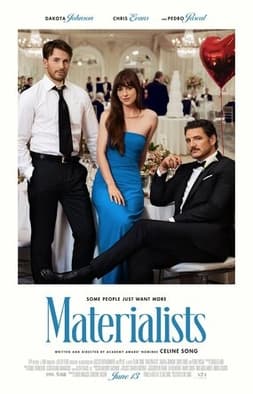
Poster via Wikipedia, Materialists. Used under fair use for criticism and review.
The first thing anyone said about Materialists was that it was a love triangle, and the second thing they said was that the trailer had lied about which film it was. Both are true, and both miss what Celine Song actually made. The triangle is real: Lucy, a matchmaker, courted by a rich client and haunted by a poor ex. The film around it is not about who she picks. It is about the moment she started assigning people a value, and what that habit does to the person doing the assigning.
Song worked as a matchmaker in New York for six months before she wrote Past Lives, and it is the matchmaking, not the romance, that she brought to her second feature. A24 released the film in June 2025 on a reported budget of around twenty million dollars, her most expensive picture by a distance, and it was marketed as the summer’s smart date movie. It is smarter than that and much colder, and the coldness is the argument.
The spreadsheet in the room
Lucy, played by Dakota Johnson, works for a firm called Adore, and she is good at it because she has stopped pretending the work is about feeling. She talks about clients in the vocabulary of assets: height, income, age, the number of previous marriages, the things that move a person up or down a column. Johnson plays her with a flat, professional calm that the film never once punishes for being unromantic. Lucy is right about the market. That is the discomfort Song is after.
Then the market walks in wearing a suit. Harry, played by Pedro Pascal, is the client every matchmaker dreams of, a wealthy man in a Tribeca apartment who scores at the top of every column. Song gives him one detail that turns the whole film: he confesses, late, that he had surgery to add inches to his height, that the number Lucy prized was bought. The perfect asset was manufactured to be an asset. Pascal underplays the reveal, and it lands as shame rather than punchline, which is the correct choice and a harder one.
The ex who won’t price
Across from Harry is John, Chris Evans, Lucy’s former boyfriend, a thirty-seven-year-old actor who caters weddings to pay a rent he splits three ways. Evans has never been used this well as a specifically diminished man; the star wattage is switched almost all the way off, and what is left is someone who cannot compete on any axis Lucy’s job measures. That is the point of him. John is the variable the spreadsheet cannot hold, and the film is honest enough to admit that this does not automatically make him the right answer.
Shabier Kirchner, who shot the Small Axe films for Steve McQueen, photographs all of this in warm, even, slightly airless light, the light of nice restaurants and nicer apartments. Nothing is grimy. Everyone is well dressed. The visual argument matches the verbal one: this is a world where surfaces have been optimised, and the camera declines to editorialise about it. Keith Fraase, who cut Past Lives, keeps the scenes long enough that you feel the transactions happening under the flirting.
Where the argument turns serious
For an hour Materialists could pass as a clever comedy about the economics of dating, and if it stayed there it would be a minor film. Song does not let it. A client Lucy has placed, Sophie, is assaulted by a man Lucy vetted and approved, and the vetting is the horror of it. Lucy did her job. The columns were fine. The man scored well. Song stages the aftermath without sensation and without absolving her heroine, and the film’s whole apparatus of valuation curdles in a single conversation.
This is the hinge, and it is why the ending is not the ending the trailer promised. The question stops being which man Lucy will choose and becomes whether the work she is good at can be done at all without treating people as inventory, and whether the alternative, John, is a rejection of the market or just a worse position in it. Song refuses to make that clean. Lucy ends up with the man who cannot be priced, and the film declines to tell you she has solved anything. She has only decided to stop keeping the column open for herself.
Song’s two films, read together
Past Lives was a film about fate, about the Korean idea of in-yun, the accumulated brushings of two people across lifetimes. Materialists is its opposite number: a film that replaces destiny with a database and then watches the database fail the one test that matters. The pairing is deliberate. Song has now made one film that believes love is written in advance and one that believes it is negotiated at market rate, and the second is braver, because it implicates the audience. Everyone in the cinema has a column. Everyone has, at some point, done the maths on another human being.
That is the film’s quiet accusation, and it is why the warmth of the marketing was a category error rather than a lie. Materialists looks like a romance and behaves like an audit. The love triangle is the shape. The subject is the price tag, and Song’s real achievement is that she makes you feel the cost of having one without ever once telling you to feel bad about it.
Lena writes long-form essays on the films that will still be talked about in a decade. Previously at a defunct monthly whose name we do not speak.
MORE BY LENA ASHWORTH →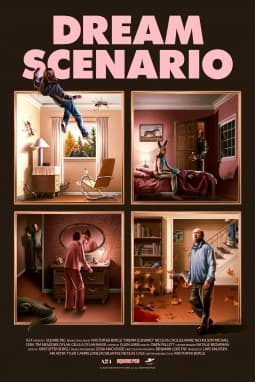
Dream Scenario: Borgli's Cage Vehicle as Media Critique
Kristoffer Borgli's A24 feature used Nicolas Cage as the vehicle for a media satire that landed in late 2023 and has aged, through 2024 and into 2025, into a specifically sharper object than the reviews initially registered.
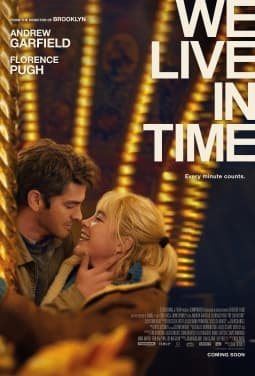
We Live in Time: Crowley's Non-Linear Gamble
John Crowley's third collaboration with A24 runs the ten-year relationship in a non-linear shuffle, and the shuffle is what makes the film survive its cancer-drama premise. Just barely, but it does.

Love Lies Bleeding: Rose Glass Goes Pulp
Rose Glass's second feature dragged the lesbian bodybuilder noir into A24 territory and got reviewed as a tonal mess. The case I want to make is that the tonal mess is the movie, and the movie earns it.