Long Story Short Lights the Same Candle Twice
Raphael Bob-Waksberg's family comedy jumps across six decades in ten half-hours. The jumping is not the design. The design is what gets handed from one pair of hands to the next.
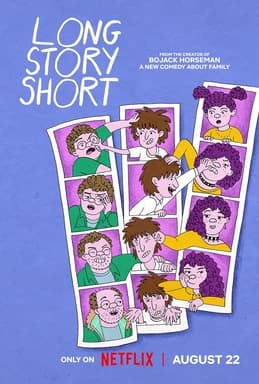
Poster via Wikipedia, Long Story Short. Used under fair use for criticism and review.
The first episode of Long Story Short ends in 2022, with Avi Schwooper sitting alone in his parked car while Paul Simon’s “The Obvious Child” plays. The tenth episode ends in 2022, with Avi sitting alone in his parked car. Between those two shots the season has visited 1959, 1991, 1996, 2002, 2004, 2013 and a dozen other years, and it has arrived back exactly where it started.
That is the obvious structural fact about Raphael Bob-Waksberg’s series, and it is the least interesting one. The circle is a frame. What the frame holds is a set of objects, and the season is organised around who is allowed to hold them.
Netflix released all ten episodes on 22 August 2025, each around twenty-five minutes, and renewed the show before any of them had gone out. The reception settled quickly on “non-linear family comedy from the BoJack Horseman man”, which is accurate as a label. It describes the timeline. It does not describe the architecture.
The prologue and the play
Every episode has the same two-part shape. A short scene from one year, then the main story from another. In the second episode, a 1991 afternoon at the Jersey Shore where Avi abandons his little sister Shira in the water to go and play with older cousins; then 2014, where Shira, trying to have a child with her wife Kendra, asks Avi to be the sperm donor and the two of them argue their way around Hannah’s Christmas pageant until she tells him she nearly drowned that day and a stranger pulled her out.
The prologue is not backstory. It is evidence. The show plants it in front of you, and then lets a character produce it years later as an exhibit in an argument, and you watch the other character discover that the thing they barely remember is the thing their sibling has organised a life around.
Nine of the ten episodes run the prologue earlier than the main story. The ninth reverses it, and the reversal is the most precise piece of writing in the season. It opens in 2014 with Naomi, the mother, at a playground telling Avi she wishes her children were close, like the sisters in HAIM. Then it goes back to 2002, to a community-centre tribute to Naomi, where Avi, Shira and Yoshi write her a Mad Libs speech because it is easier than writing a real one, and end the night looking after each other when eleven-year-old Yoshi is sick on wine. Naomi listens at the door and tells her husband the kids are helping each other.
So the wish she makes in 2014 was granted twelve years earlier, in her hearing, and she seems to have forgotten it. The show does not comment on this. It simply puts the scenes in an order that lets you know something the character no longer does.
Naomi’s recipe
Lisa Edelstein’s Naomi is the season’s centre of gravity and its most careful piece of construction, because the show tells you how her story ends before it has finished introducing her.
In the fourth episode, “Shira Can’t Cook”, it is 2021, Naomi is already dead of COVID, and Shira is trying to make her mother’s knishes to impress a private-school potluck. Her first batch does not taste like Naomi’s, so she bins it, gets the recipe from her father, starts again, and reaches the last line, where Naomi has written to add more garlic because Shira likes them that way.
The eighth and ninth episodes then give Naomi back to you alive, in 2019 and 2002, manipulative, hurt, funny, impossible. You already know the recipe is coming. Every scene of her needling her children plays in front of an audience that has seen the note at the bottom.
The production numbering is worth a glance here. “Shira Can’t Cook” carries the code 102 and airs fourth. “Hannah’s Dance Recital”, code 104, airs second. The running order is a decision somebody made after the episodes existed, and the decision was to let the audience learn of Naomi’s death at the season’s quarter mark and spend the rest of it with her anyway.
The brooch
The prop that carries the most weight is small. In the 1959 prologue to “The Intervention”, seven-year-old Naomi cannot get her parents or older sisters to look at her, so she takes a butterfly brooch and stabs herself in the leg with it. When they finally turn round, she tells them she rode her bike an entire block on her own.
The brooch was her mother’s. In the 2000 prologue to the finale, Naomi finds it while Uncle Barry is clearing out his house before a move to Las Vegas, and Barry keeps it. In 2022, at Barry’s funeral in Las Vegas, it is pinned to Barry’s girlfriend, and Avi, his daughter Hannah and his father Elliot make a bad, doomed attempt to steal it back.
I came to criticism through theatre, and a prop that crosses acts is the oldest structural device a stage has. You watch the object, not the clock. Long Story Short uses the brooch the way a play uses a letter or a gun: it tells you what the family values and who has been refused it.
Two candles
Which brings me to the candles.
In the pilot, at Yoshi’s bar mitzvah in 2004, the candle-lighting ceremony collapses. A candle meant for Uncle Barry goes instead to Jen, Avi’s non-Jewish girlfriend, whom Naomi has spent the weekend needling, because Naomi has rewritten the call sheet, and when Jen goes to light it Naomi cannot stop interfering. A flower arrangement catches fire. Naomi and Barry end up in a physical fight. The candle is an instrument of family politics, and it is given to the outsider to make a point to someone else.
In the finale, after Barry’s funeral, the family track Yoshi to a desert motel. He is Orthodox now, it is Friday, and the sun has already set, so no Jew present can light the Shabbat candles bought from a 7-Eleven. Hannah, raised outside the religion, is the only one who can. Shira shows her how.
Avi does not join in. He sees his mother, at every age, lighting candles beside them.
The two scenes are built from the same parts: an outsider, a flame, a family ceremony, Barry. The first candle is handed to an outsider as a weapon; the last is handed to an outsider because she is the only one allowed to hold it. Eighteen years of family history sit between those two gestures, and the show never once says so out loud.
What the season is
Katie Aldworth, Aaron Brewer, Ben Bjelajac and Katie Rice direct across the season, with Jack Shih co-directing the pilot; Molly Yahr and Brian Swanson cut it; Jesse Novak scores it. Every episode’s credits carry the line “This Program Was Made By Humans”, a note about how the thing was made, from a show that is fundamentally about inherited work.
Because that is what the non-linearity is for. It is not a puzzle and it is not a gimmick borrowed from prestige drama. Long Story Short is structured as an inheritance. A recipe goes from Naomi to Shira. A brooch goes from Naomi’s mother to Barry to a stranger. A candle goes from Jen to Hannah. Avi’s inability to say “I love you”, which he replaces all season with “Hey… y’know?”, goes from somewhere to him, and in the last bus-stop scene Hannah takes it and hands it straight back, which is as close as the Schwoopers get.
The show is told in the order you would find these things in a drawer after someone has died: not by date, but by what your hand touches first.
Priya came to criticism sideways from theatre. She is patient with slow shows, short with bloated ones, and cheerfully vicious about lazy writing.
MORE BY PRIYA NAIR →
The Four Seasons: Tina Fey's Middle-Aged Friendship Show
Tina Fey's adaptation of the 1981 Alan Alda film is a show about three couples, four vacations, and what middle-aged friendship sounds like when nobody is performing for an audience.
The Residence: Uzo Aduba, Shondaland, and the Detective as Structure
Shondaland's White House whodunnit handed Uzo Aduba the role she has been waiting for since Orange is the New Black. The rest of the show is trying to catch up to her.
American Primeval: Peter Berg's Utah and the Cost of a Six-Episode Western
Peter Berg and Mark L. Smith's six-episode Netflix limited western compresses a brutal 1857 Utah into ninety minutes per episode, and the compression is both the method and the mistake.