The Residence: Uzo Aduba, Shondaland, and the Detective as Structure
Shondaland's White House whodunnit handed Uzo Aduba the role she has been waiting for since Orange is the New Black. The rest of the show is trying to catch up to her.
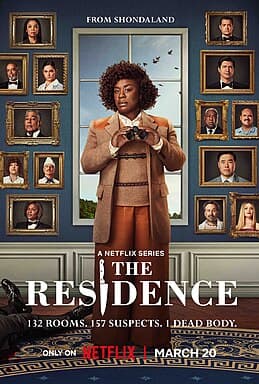
Poster / promotional material via Wikipedia, The Residence (TV series). Used under fair use for criticism and review.
Netflix released The Residence in March 2025 across eight episodes. Paul William Davies, a veteran of Shondaland’s writers rooms (Scandal, For the People), created the show; Shonda Rhimes executive-produced. The premise is straightforward: the White House chief usher is found dead during a state dinner, and an eccentric consulting detective is called in to investigate among the ensemble of official and domestic staff who were in the building that night.
The show is, structurally, a classical country-house whodunnit with the White House as the country house. The innovation is tonal, and the tonal innovation is almost entirely Uzo Aduba’s.
What Aduba does with Cordelia Cupp
Uzo Aduba’s detective, Cordelia Cupp, is the most distinctive detective character in prestige TV in years. She is a birdwatcher. She says so constantly. She carries binoculars. She is interested in the specific patterns of movement and observation that birdwatching has trained her to attend to, and the show’s central formal move is to treat the investigation as a problem of the same order as identifying a specific bird species from intermittent glimpses through dense foliage.
Aduba plays Cordelia at a specific register that I have not quite seen before. The character is arch without being camp. Intellectually confident without being smug. Socially awkward without being ingratiating. What Aduba is doing, to compare it to something, is closer to Peter Falk’s Columbo than to any contemporary TV detective: a person who performs a specific eccentricity that disarms suspects while, underneath, operating at the level of a first-rate investigator. The Columbo comparison is not accidental; the show’s structural debt to the Columbo format is substantial, and Davies has talked openly about it.
What Aduba has that makes the character work is a very specific comic timing. She drops lines late. She lets silences hold for a beat longer than the scripted expectation. She makes minor physical choices (the specific way she adjusts her birdwatching hat, the way she enters a room, the specific cadence of her first exchange with a suspect) that tell us, scene by scene, who the character is. By episode three, the audience has completely absorbed Cordelia’s voice. It is a character-acting achievement.
The whodunnit structure, executed
The whodunnit is a difficult form to execute on television because the weekly structure fights the form’s native rhythm. A classic whodunnit wants a single reading session. A television whodunnit has to maintain weekly interest across multiple episodes while deferring the solution. Davies’s solution is to use the Congressional-hearing framing device: the show is told in flashback as Cordelia testifies before a Congressional committee investigating her handling of the case. The device allows the show to structure its reveals around specific questions the committee puts to her.
The structure works. It gives each episode a specific narrative shape, because each episode corresponds roughly to a specific day of Cordelia’s investigation being retold in testimony. It lets the show control which suspects and which clues are in play at any given moment. It gives Aduba specific scenes with the committee members (a handful of recognisable character actors) that establish Cordelia’s public persona in a different register than her investigative one.
The structure’s weakness is that it slightly flattens suspense. The audience knows Cordelia survived the investigation and is now testifying about it. The jeopardy available to the show is, by design, limited to the mystery itself. This is a fine trade. The show is not trying to be a thriller.
The ensemble, unevenly served
The supporting ensemble is extensive: Randall Park as an FBI agent partner, Giancarlo Esposito as the murdered chief usher in flashback, Jane Curtin as the White House social secretary, Susan Kelechi Watson as the first lady’s chief of staff, Ken Marino as the president’s chief of staff, and a wide range of domestic staff, political appointees, and state-dinner guests among the suspects.
The show’s most consistent supporting performance is Susan Kelechi Watson’s. She plays Chief of Staff Sheila Cannon with a specific professional tightness that does significant dramatic work. The scenes between Watson and Aduba, in which Cordelia is trying to extract information and Sheila is trying to maintain the first lady’s political position, are the show’s most adult scenes. Watson is doing the same thing she did on This Is Us at a completely different register, and the range is impressive.
Randall Park, playing the FBI partner, is the show’s structural weak point. The character is underwritten. Park is a good comic actor, but the role asks him mostly to react to Aduba, and the reaction work does not give him enough to do. A second season could strengthen this, but as written in Season 1, the partnership is uneven.
The White House as country house
One specific thing Davies and his production designer (Emma Fairley) do well is treat the White House as a country house in the Agatha Christie sense: a geographically closed space with specific rooms, specific routes between rooms, and specific patterns of who has access to what. The show has a recurring visual device, an animated transparent floor plan showing where specific characters were at specific times, that is the show’s most successful formal element.
The floor plan does what the best country-house mysteries do on the page: it gives the audience the structural information needed to play along. By episode five, the floor plan has established the White House’s specific domestic geography clearly enough that the audience can track the suspects’ movements as reveals emerge. This is classical whodunnit engineering, updated for a visual medium, and it works.
What the show refuses to do
The White House setting, and the show’s Shondaland pedigree, would have invited a more directly political register. The Residence refuses the invitation, mostly. The president and first lady are not named by party. The political context is deliberately non-specific. The show is interested in the White House as a workplace, not as a political battleground.
This is a specific structural choice and I think the right one. The show’s central subject is the specific labour relation between the permanent domestic staff who run the White House as a residence and the political appointees who pass through it for four or eight years at a time. The murder, when we eventually understand it, is embedded in that labour relation. The political content is the relation, not the policy.
The finale
The finale does what a classical whodunnit finale has to do: it assembles the suspects, has the detective explain the case in specific narrative detail, and produces the revelation. Davies has written the final explanation with the specific discipline that the form requires. The solution is fair: the clues were planted, the motive is coherent, the logic holds. A whodunnit either does this work or does not. The Residence does.
The show has not yet been renewed. Netflix has said the mystery is, in principle, continuing, with Cordelia taking on new cases in future seasons. Aduba has indicated she is willing to return. Whether the show can sustain the specific tonal achievement of Cordelia Cupp across multiple cases is the open question.
What the season leaves
The Residence is the best classical whodunnit American prestige TV has produced in years, and Uzo Aduba’s Cordelia Cupp is a character I expect to become a reference point for the next decade of detective writing. The show’s weaknesses are structural and fixable. The show’s strengths are durable.
Watch it across two long evenings, not eight nights. The form rewards momentum. Pay attention to Aduba’s hands in the second-episode hallway interrogation. She is doing character work that lesser actors would have done with their voices, and it is quietly extraordinary.
Priya came to criticism sideways from theatre. She is patient with slow shows, short with bloated ones, and cheerfully vicious about lazy writing.
MORE BY PRIYA NAIR →
The Four Seasons: Tina Fey's Middle-Aged Friendship Show
Tina Fey's adaptation of the 1981 Alan Alda film is a show about three couples, four vacations, and what middle-aged friendship sounds like when nobody is performing for an audience.

Running Point: Mindy Kaling, Kate Hudson, and the Workplace Comedy Still Works
Mindy Kaling's Netflix NBA comedy is a vehicle for Kate Hudson's return to screen work. The show around her is more conventional than her performance deserves.

A Man on the Inside: Mike Schur, Ted Danson, and the Comedy of Late Life
Mike Schur's Netflix show placed Ted Danson inside a retirement community as an amateur investigator. The premise is a disguise for the comedy Schur has been moving toward for a decade.