Jeanne Dielman and the Arithmetic of a Kitchen
Chantal Akerman's 201-minute film is usually described as an endurance test. It is better understood as a ledger, and the scissors at the end are what happens when the sums stop coming out.
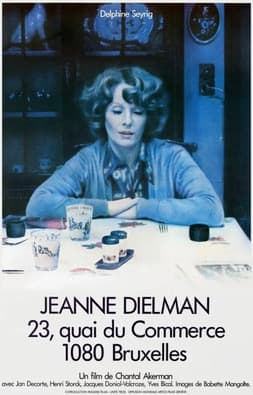
Poster via Wikipedia, Jeanne Dielman, 23 quai du Commerce, 1080 Bruxelles. Used under fair use for criticism and review.
The most discussed thing about Jeanne Dielman, 23 quai du Commerce, 1080 Bruxelles is its length, 201 minutes, and the most discussed thing about its length is that it is hard to sit through. Both statements are true and both miss the film. What Chantal Akerman built, in her mid-twenties, with a cinematographer (Babette Mangolte) and a lead actress (Delphine Seyrig) who each understood the project before the studio-trained world did, is not a test of the viewer’s patience. It is a ledger. Every scene is an entry, and the film’s drama lies in the moment the columns stop adding up.
What the film counts
The setup can be given in a sentence. Over three days, a widow in a Brussels apartment cooks, cleans, shops, takes her teenage son Sylvain his dinner, and, in the afternoons, receives a man for money. Nothing is hidden from the viewer. Nothing is explained to the viewer either.
What the camera does instead is count. It sits square to the room, frontal, and holds. A cutlet is dipped in egg, then in breadcrumbs, then laid in the pan. Potatoes are peeled and dropped into a pot. A light is switched on when Jeanne enters a room and switched off when she leaves it, and the film allows every one of those light switches to take the time a light switch takes. Mangolte’s compositions are not austere for the sake of austerity. They are measurements, set at a distance that lets you see the whole of an action and nothing but that action.
This is why the usual language of boredom is the wrong instrument. Boredom is what you feel when you are waiting for something to happen. Akerman gives you something that is already happening, at the speed at which it happens, and asks whether you have ever looked at it. Most of us have not. Domestic labour has been in cinema for a century, but almost always compressed, a montage of dishes before the real scene begins. Here the dishes are the real scene.
The first day is a rhythm, the second is a fault
On the first day the film establishes a rhythm so exact that you begin to anticipate it. Jeanne’s visitor arrives, the bedroom door closes, the camera stays in the corridor or the dining room, and the transaction takes its place in the day like a trip to the butcher. The money goes into the same tureen on the dining table. The doorbell rings at the hour it rang yesterday.
The tragedy of the second day is not that something terrible happens. It is that a shoe brush and a pot of potatoes begin to go wrong, and the film has taught you to see every one of them. Jeanne drops a shoe brush. She leaves a lid off. Her hair is not quite in order. The potatoes boil past the point she intended. None of these would register in a film built on plot. In this one, after ninety minutes of ritual, they land like a dropped plate in a silent house.
The achievement here is Seyrig’s. She does not play distress. She plays a woman for whom each deviation is information, and she lets the face register it a half-second late, the way a person notices a noise they have been trying to ignore. It is among the great studies of control in the cinema precisely because control is all we are shown, and it is slipping.
Why the ending is not a shock
The third day carries the film’s last entries. The coffee is bad. A pot is wrong again. The afternoon visit goes differently. Then comes the scene in the dining room, where Jeanne sits at the table with her hands in her lap for a long, unbroken stretch, and the film’s meaning arrives in the form of an image rather than an explanation.
I do not think the scissors are a twist. A twist depends on withheld information, and Akerman withholds nothing; the film is, if anything, a refusal to withhold. What the ending does is complete the arithmetic. Jeanne has built a day that has no spare capacity in it, every hour assigned, and a system without slack fails at its weakest joint. The film does not ask us to approve of what she does. It asks us to notice that the conditions for it were visible from the first potato.
What the 2022 vote did and did not mean
In 2022, the Sight and Sound critics’ poll placed the film first, ahead of Vertigo, which had held the top place in the previous poll. The headline version of that story is about canon politics, and it is not wrong. But it flatters the film to treat it as a trophy. A work that was shown at Directors’ Fortnight at Cannes in 1975 and went on to be argued over for decades did not need a poll to become important.
What the result confirms is a change in what viewers are prepared to see as cinema. For a long time the unit of film attention was the event. Akerman’s film makes the unit the hour, and it makes the hour a thing with consequences. Once you can watch a woman peel potatoes for four minutes and feel the stakes rise, you have been taught a different way of watching, and it is difficult to go back.
That is the argument I would make for sitting with the whole 201 minutes. The film does not reward you at the end. It re-calibrates you along the way, and by the final shot, you are not waiting for an act of violence. You are doing the sums with her.
Lena writes long-form essays on the films that will still be talked about in a decade. Previously at a defunct monthly whose name we do not speak.
MORE BY LENA ASHWORTH →
The Warriors Was a Hit That Its Own Studio Treated as a Threat
A $4 million picture grossed about $22.5 million, and Paramount still spent the spring of 1979 pulling its own advertising. The Warriors is a case study in a studio mistaking its audience for the film.
Materialists Is a Film About Pricing, Not Dating
Celine Song's second feature was sold as a romantic triangle. It is really an argument about what happens to people once you agree to put a number on them.

Frankenstein Cost $120 Million and Played Like a Secret
Del Toro's Frankenstein is built in two halves that only work if you sit through both in one go. Netflix released it as something you can pause.