Inside Out 2: Pixar Figures Itself Out Again
Pixar's ninth sequel turns out to be, surprisingly, one of the studio's best films in a decade. An argument for the animation that grew up with its audience.
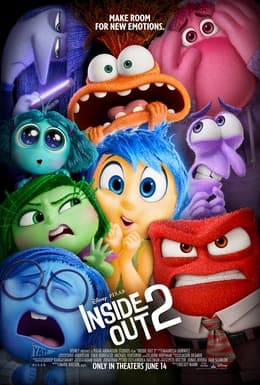
Poster / promotional material via Wikipedia, Inside Out 2. Used under fair use for criticism and review.
Inside Out 2 arrived in June 2024 to reviews that were, on the whole, warmer than I was prepared for. Pixar’s commercial trough across the 2020s had made me wary of any Pixar sequel. Lightyear (2022) had been a misfire. The Cars sequels had progressively thinned the studio’s brand. Onward (2020) had been undone by pandemic release conditions. A sequel to a nine-year-old property felt, on paper, like the safe move a studio in creative decline makes to pay the bills.
The film is better than that. Inside Out 2, now directed by Kelsey Mann rather than Pete Docter (though Docter remains on the producing side), is in fact one of the best things Pixar has released this decade.
What the film is
Riley, the eleven-year-old protagonist of the 2015 original, is now thirteen and in the specific cognitive-emotional turbulence of early adolescence. Her existing internal council of emotions, Joy (Amy Poehler), Sadness (Phyllis Smith), Anger, Fear, Disgust, are joined by a set of new arrivals: Anxiety (Maya Hawke), Envy, Embarrassment, and Ennui. The film’s dramatic engine is the tension between Joy’s longstanding organisational principle for Riley’s self-identity and Anxiety’s specifically overriding new one.
The film unfolds across a weekend hockey camp where Riley is trying to make the high-school team. The external plot is the hockey. The internal plot is the competing models of selfhood that Joy and Anxiety are each trying to build for her.
Why the Anxiety move works
Maya Hawke’s Anxiety is the film’s central inspiration. The character could have been written in one of two bad directions: either as a villain to be defeated, or as a misunderstood emotion whose value the film could, in a therapeutic register, validate.
Hawke and Mann avoid both traps. Anxiety, in the film’s framework, is not evil. Anxiety is, specifically, correct about many of the situations Riley is facing. Riley’s new environment genuinely does contain new social risks. Riley’s old friends genuinely are drifting away from her. The stakes Anxiety is identifying are real stakes. The problem is not that Anxiety is wrong. The problem is that Anxiety’s organisational principle for Riley’s selfhood, the principle that Riley must continuously anticipate and prevent every social misstep, is unsustainable.
This is a legitimate psychological distinction, and the film treats it with a specific maturity that American animated films for children have rarely attempted. Inside Out 2 is genuinely interested in what adolescent anxiety is, how it operates, and how it can become self-reinforcing. The film’s depiction of a full-blown anxiety attack, which Riley experiences in the third act, is the most accurate rendering of the experience I have ever seen in an animated film for children.
Where the film is at its best
The film’s best sequences, by a margin, are the ones that let Anxiety plan. There is an extended montage in which Anxiety takes over Riley’s internal council of emotions and constructs a multi-contingency plan for the weekend’s social challenges, and the sequence is both genuinely funny and genuinely unsettling. Pixar’s animation team has rendered Anxiety’s planning apparatus as a specific visual language of orange-tinged index cards, branching whiteboards, and restless hand gestures. The visual specificity is doing argumentative work.
Similarly, the film’s rendering of Riley’s “sense of self” as a literal internal structure, a tree-like growth made of small flashbulb memories, allows the film’s climactic sequence (in which Joy and Anxiety each try to build a different version of the self) to play as a specific metaphysical drama about competing identity narratives.
Where the film is weakest
The film’s third act, I think, resolves a bit too quickly. Riley’s anxiety-attack sequence is followed by a recovery sequence that the film does not give enough time to. The emotional work required to end the film on a note of integration rather than collapse is compressed into a final ten minutes that, in a slightly longer film, would have had more space.
This is a minor complaint. The film is one hundred minutes long, which is short for a Pixar feature, and the compression reads as a studio-side decision rather than a creative one.
Why the film commercially matters
Inside Out 2 made $1.7 billion globally. It is Pixar’s biggest commercial success ever and the highest-grossing animated film in the history of theatrical release. The specific commercial significance, beyond the numbers, is that the film reversed a five-year decline in Pixar’s relationship with theatrical audiences. The post-pandemic window has been difficult for animation. Disney’s release-to-streaming policy during COVID had, specifically, trained families to wait for new Pixar films at home. Inside Out 2 broke that conditioning.
This matters for the industry. The specific economic model that supports large-scale original animation requires theatrical returns at scale. Pixar, across the last five years, had been looking commercially marginal. Inside Out 2, along with the subsequent success of Wish and the upcoming Elio, has restored Pixar’s theatrical viability.
Where the film leaves the franchise
Inside Out 3 is, as of this writing, not announced but widely rumoured. Mann has said in interviews that he has specific ideas for where the Riley story could go next, particularly into late adolescence or early adulthood.
I am, cautiously, interested. The Inside Out concept has legs. The mid-teen version of Riley in this film is the oldest a Pixar protagonist has ever been. Following her into older age would allow the concept to do the thing animation rarely gets to do, which is actually depict the gradual transformation of a specific human consciousness across years.
Take your children. Pay attention to the anxiety-attack sequence. It will be, for many of them, the first time they see their own actual experience depicted in a medium they are used to consuming as escape.
Lena writes long-form essays on the films that will still be talked about in a decade. Previously at a defunct monthly whose name we do not speak.
MORE BY LENA ASHWORTH →
The Wild Robot: Animation, Still
Chris Sanders' adaptation of Peter Brown's novel is the best animated feature of the year and an argument for DreamWorks doing specifically what Pixar has stopped doing.
Beetlejuice Beetlejuice: The Rare Legacy Sequel That Remembers What the Original Was
Tim Burton returns to Beetlejuice after 36 years and makes a legacy sequel that actually works, mostly because he refused to make a serious one.

American Fiction: Cord Jefferson's Double Movie
Cord Jefferson's debut feature is two films trying to be one. The surprise, two months into its run, is that both films work.