I'm Still Here and the Political Film Brazil Needed Built
Walter Salles's adaptation of Marcelo Rubens Paiva's memoir won Brazil its first Best International Feature Oscar in March 2025. The win matters. The film matters more.
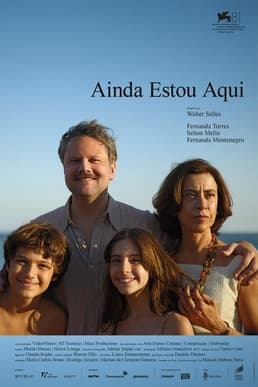
Poster / promotional material via Wikipedia, I'm Still Here (2024 film). Used under fair use for criticism and review.
Walter Salles’s I’m Still Here won Best International Feature at the 97th Academy Awards in March 2025, making it the first Brazilian film to take the prize. Fernanda Torres, who plays Eunice Paiva across the film’s central two hours, was nominated for Best Actress and did not win. The film was also nominated for Best Picture, the first Brazilian feature to land in that category. I want to put a specific position early: the awards attention is not the reason to care about this film. The reason to care is that Salles has made the best Brazilian political film since Pixote, and it is the one that will last.
The film adapts Marcelo Rubens Paiva’s 2015 memoir of the same name, which is structured around the 1971 disappearance of his father Rubens Paiva, a former socialist congressman abducted by agents of the Brazilian military dictatorship. The film covers roughly four decades of the family’s aftermath, from the first hours of the disappearance through the 2014 Truth Commission findings that formally confirmed what the family had known since the first week.
The argument, stated up front
My position is that I’m Still Here is important for three specific reasons, and I want to state them before the craft discussion. First, it is the film that decisively refuses the sentimental-family register that most dictatorship-era Brazilian films have used since the 1980s. Second, it is the film in which Torres, who has been one of the best actors working in Portuguese for thirty years, finally gets a role built at her scale. Third, it is a film made in Brazil, in Portuguese, by a Brazilian director, about a specific Brazilian history, whose Oscar win is a real and rare fact about the contemporary possibility of non-English-language cinema reaching an Academy majority on its own terms.
These are not separate arguments. They are three faces of the same thing, which is that the film did not compromise to be seen.
Torres, and what she is doing
Fernanda Torres is the film’s structural centre, and her performance is the acting achievement of the year. She plays Eunice Paiva across three decades: as the 1971 wife and mother in the hours after Rubens is taken; as the arrested detainee held in the DOI-CODI facility for twelve days; as the widow working through the late 1970s; as the mother of five rebuilding the family in São Paulo; as the working lawyer across the 1980s and 1990s; and, briefly, in a coda sequence set in 2014, as a woman with Alzheimer’s receiving formal confirmation of what she has always known.
What Torres is doing is refusing to play the grief in the external register. Eunice does not weep on camera in any of the scenes where a lesser film would have written tears. She weeps, across the runtime, exactly once, in a scene I will not describe because the restraint is the scene. Torres’s Eunice is a woman who has decided, inside the first week, that her grief is her private property and that the dictatorship is not going to get access to it. The performance is the sustained act of that refusal.
The specific technical fact about Torres’s work here is that she is playing a real woman who was alive during production, who died in December 2018, and whose actual daughter (Fernanda Montenegro, Torres’s mother) appears in the 2014-set coda as the elderly Eunice. Montenegro plays her briefly, mostly without dialogue, and the casting is a structural decision the film has earned the right to make. Montenegro’s appearance is not a stunt. It is a specific formal commitment to the long duration the film is tracking.
Salles, returning to political material
Walter Salles’s career has moved through several specific registers: Central Station (1998) as the breakout; the Che Guevara road movie The Motorcycle Diaries (2004) as the international-prestige phase; the Kerouac adaptation On the Road (2012) as the project that did not quite work; and a long quiet decade before I’m Still Here. The return to Brazilian political material is the return to the register where Salles has always been strongest.
What he does in this film that he has not done since Central Station is trust his actors and his environment to carry the film without the directorial flourishes that marked the international-prestige work. The camera is patient. The staging is disciplined. The period recreation of 1970s Rio is specific without being fussy. Adrian Teijido’s cinematography works in a warm, slightly faded palette that reads as memory without announcing itself as memory.
The scene that demonstrates the method most clearly is the arrival of the military agents at the Paiva house in the opening twenty minutes. Salles stages the sequence across a long, domestic afternoon. The family is at the beach earlier in the day. They return. They have lunch. The agents arrive. The arrival is not dramatised as a break. It is dramatised as an interruption of an ordinary afternoon, and the interruption is what makes the horror work. Salles understands that dictatorship does not announce itself with a dramatic score. It arrives during lunch.
The children, and the long duration
The Paiva children are cast at three distinct age registers across the film. Valentina Herszage plays Vera, the eldest, in the 1970s sequences. The younger children are played by a carefully-picked ensemble of young Brazilian actors. The casting across the ages is careful enough that the family reads as continuous across the decades the film is tracking. This is a practical directorial achievement that deserves specific mention.
What the children give the film, structurally, is the reason Eunice’s refusal to break matters. Torres’s Eunice is not just refusing to give the dictatorship her grief. She is refusing to give her children a mother who has been destroyed. The performance is a thirty-year act of parenting against a state that has tried to erase the family’s structural integrity. This is the specific ethical position the film is building, and it is why the 2014 coda has the weight it does.
The Truth Commission, and what the coda earns
The 2014-set coda is a structural risk the film takes and clears. Brazil’s National Truth Commission, which concluded its work in December 2014, formally documented the circumstances of Rubens Paiva’s death and the identities of the agents responsible. The commission did not produce prosecutions; Brazil’s 1979 amnesty law has held. What the commission produced was official acknowledgement.
The film’s final sequence stages the arrival of the commission’s formal notification at the family home. Eunice is elderly, in the early stages of Alzheimer’s. The scene is brief. Montenegro plays Eunice receiving the document. What the scene does, and what the film has earned across the preceding two hours, is mark the gap between official truth and living knowledge. Eunice has known since 1971. The state has formally confirmed what she has known. The confirmation is not redemption. It is the state, very late, catching up with a widow.
This is the right ending. The film has refused redemption for the whole runtime. It continues to refuse it here. The coda is not catharsis. It is accounting.
What the Oscar win actually signifies
The Oscar is not the reason the film matters, but it is worth marking what the win actually represents. I’m Still Here is the first Portuguese-language Brazilian film to win Best International Feature. It is also the highest-grossing Brazilian film in the domestic market, with box office in Brazil that exceeded the five-million-ticket threshold. The film was made for a reported budget of around R$16 million (approximately US$3 million), a budget that would be considered low-end indie by Hollywood standards.
What the win signifies in industry terms is that a specifically national political film, made at a national-cinema budget, in Portuguese, about a history that is not legible to most Academy voters as a major historical subject, can still reach a majority of international-category voters on the strength of the film itself. This is not the norm. Recent winners in the category (Anatomy of a Fall, All Quiet on the Western Front, Drive My Car) have mostly come from established European or Japanese art-cinema traditions with heavy festival pre-amplification. I’m Still Here arrived with festival recognition but without the same pre-Oscar campaign heft.
The political context
I have resisted making the piece about Bolsonaro’s Brazil versus Lula’s Brazil, because the film is not interested in that framing and nor should this piece be. But the context needs to be marked. The film was made during Lula’s third term, after the 2022 defeat of Bolsonaro. The dictatorship-era reckoning the film depicts is not a settled historical fact in Brazilian politics; the amnesty law continues to hold, and public statements by former president Bolsonaro and members of his circle across 2019-2022 reopened specific questions about the military regime’s legacy. The film arrives in a specific political moment in which its subject is not safely in the past.
What stays
The film will last. I will go further: I think I’m Still Here will be, in ten years, the film most people point to when they want to describe what 2020s Brazilian cinema was capable of. Torres’s performance is of a kind that cinema does not produce often, and certainly does not produce often in the specific register of political refusal that this one works in. Salles has made the film of his career. Watch it in the quiet hour of an evening, and do not watch it distracted. The film deserves the attention, and the attention is the work it is asking for.
Marcus believes good criticism is an argument. He is almost always angry about something, usually for good reason. Horror is his first language.
MORE BY MARCUS VELL →
The Secret Agent and the Leg in the Shark
Kleber Mendonça Filho's Recife thriller left the Academy Awards with nothing from four nominations. Its subject was never the chase. It was who gets to keep the record of a city.

Frankenstein Cost $120 Million and Played Like a Secret
Del Toro's Frankenstein is built in two halves that only work if you sit through both in one go. Netflix released it as something you can pause.

The Electric State and What $320 Million Cannot Buy
Netflix reportedly spent around $320 million on The Electric State. The film that came out the other end is the clearest argument yet against frictionless money.