Flow and the Case Against Animated Dialogue
A Latvian animated feature made on Blender with a team of fifteen people won the Oscar and beat DreamWorks, Pixar, and Netflix. The reason is not budget. It is silence.
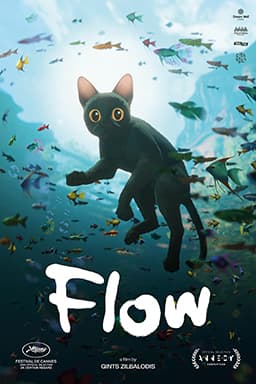
Poster / promotional material via Wikipedia, Flow (2024 film). Used under fair use for criticism and review.
I watched Flow for the first time at a weekday afternoon screening at my local independent cinema, roughly four months after the Oscar ceremony. There were maybe twelve people in the room. Two of us were adults. Nobody said anything afterwards. We filed out, squinted in the light, and went back to our separate lives. That was the experience. The film’s specific power was that it did not require us to do anything with the experience afterwards. It just was the thing it was.
A year on, I have watched the film twice more, and I am still not sure I have words for what it does.
What the film is
Flow is an eighty-five-minute animated feature from Latvia, directed by Gints Zilbalodis, produced on Blender with a core team of roughly fifteen people and a reported budget of approximately $3.7 million. It follows a black cat in a world apparently abandoned by humans, as a slow-rising flood drives it from its home and onto a small wooden boat occupied, over the course of the film, by a capybara, a Labrador, a lemur, and a secretary bird. The animals do not speak. The cat does not speak. There is no narration. The sound design consists of animal vocalisations, ambient water and wind, and a sparse orchestral score (composed by Zilbalodis and Rihards Zaļupe) that tracks the cat’s emotional arc without editorialising it.
The film won the Academy Award for Best Animated Feature in March 2025, beating The Wild Robot, Inside Out 2, Wallace & Gromit: Vengeance Most Fowl, and Memoir of a Snail. It was also the first film from Latvia to be nominated in any Academy Awards category.
The silence
The thing the film does that the other four nominees cannot is shut up.
I do not mean this as a joke. I mean it as a specific formal claim. American theatrical animation has, over roughly the last three decades, built itself around a particular relationship between image and dialogue, in which every significant beat of every scene is either scored or spoken. Pixar’s best work (Up, WALL-E) has specific wordless sequences at its opening, but the films then pivot back to dialogue-driven narrative. Disney’s princess films, the entire DreamWorks catalogue, the Illumination Studios output: all of these share a baseline assumption that animation is a medium for voice performances, and that the voice performances are where the storytelling lives.
Flow does what almost no recent American animated film has attempted. It trusts the image. The cat’s fear, exhaustion, curiosity, affection, grief: all of it is communicated through the specific posture of the body, the specific positioning of the ears, the specific rhythm of the breathing. Zilbalodis and his team have watched actual cats, carefully, and they have built the animation from that watching rather than from the inherited conventions of how animated cats behave. The animation looks, in places, like observational documentary.
What the Blender pipeline enables
The technical story behind the film matters. Blender is a free, open-source 3D software package that has historically been treated as a hobbyist tool rather than a professional production pipeline. Flow was built entirely in Blender. The team used the software’s real-time rendering engine (Eevee) for much of the production work, which allowed the small team to iterate at speeds that a traditional offline-rendered animation pipeline does not permit.
The consequence is visible on screen. The animation has a specific texture that is neither the hyper-polished American theatrical style nor the specific hand-drawn charm of a Studio Ghibli feature. It sits closer, in some specific aesthetic respects, to a video-game cinematic than to a traditional animated film, and Zilbalodis has made specific choices (the camera moves with a particular continuous flow, the lighting has a specifically real-time quality) that lean into the medium’s specific origin rather than disguising it.
The broader point: the film is, among other things, proof that a specific technical approach that has been dismissed as non-professional can produce theatrically compelling animation at a scale that undercuts the major studios by roughly two orders of magnitude. Flow cost about 1.5% of what Inside Out 2 cost to produce. It is, by any reasonable aesthetic measure, the better film.
The cat, specifically
The film’s protagonist is a black cat with no name. This is an important choice. Naming the cat would require the film to commit to a specific human framing of the cat’s experience, and the film is built around a refusal of that framing. The cat is not a vehicle for a human story. The cat is a cat, observed carefully enough that its inner life (such as it is) becomes legible through pure behaviour.
I have a specific moment I keep coming back to. In the film’s middle stretch, the cat has been separated from the boat and is perched on a floating tree branch in the rising water. It does not know if the boat is returning. It sits. It waits. It shivers. It watches the horizon. The animation holds on this waiting for, I would guess, nearly three minutes of screen time. Nothing happens. The cat is waiting.
What the sequence communicates is the specific texture of a cat’s experience of time, the specific way in which a cat can sustain a vigil without the specific narrative impatience that a human character would register. The film is willing to stay in the cat’s timescale rather than imposing a human one. This is a specific formal achievement.
The other animals
The ensemble that gathers on the boat (the capybara, who is specifically unflappable; the Labrador, who is specifically anxious; the lemur, who is specifically acquisitive; the secretary bird, who is specifically proud) are characterised entirely through behavioural observation. Each animal has specific physical habits that the animation renders consistently. The capybara blinks slowly. The Labrador pants. The lemur hoards. The secretary bird stalks.
The film is, in one reading, a specific small ensemble piece about how different species tolerate each other under shared conditions of crisis. This reading is legitimate. The specific pleasure of the ensemble scenes is the specific pleasure of watching incompatible organisms work out a temporary collective accommodation.
Where it sits
Flow has, since its Oscar win, become one of the specifically celebrated small-studio success stories of the 2020s. It has been credited (correctly) with opening a specific door for European animation houses to access American distribution at a scale that was previously closed to them. Sideshow/Janus Films, which handled the American release, have become specifically interesting curators of international animation following the Flow success.
Zilbalodis’s next project, announced shortly after the Oscar win, is a feature-length animation from a similar independent production base. I will be there for it.
Watch Flow on a Sunday afternoon. Let the film be as patient as it needs to be. The specific silence is the specific gift, and the specific gift is one that dialogue-driven animation can no longer give.
Jules writes the kind of pieces that come from wandering somewhere and overhearing something. On Frame Junkie's masthead since the beginning.
MORE BY JULES OKONKWO →
Flow: Zilbalodis and the Wordless Feature
Gints Zilbalodis made a dialogue-free animated feature in Blender with a team of a dozen, won the Oscar, and put the Latvian film industry on the global animation map. The patient argument is that the form, not the novelty, is the achievement.
Memoir of a Snail: Elliot's Claymation Grief
Adam Elliot's second stop-motion feature took eight years to make and collected festival prizes from Annecy to Annapurna. The Australian argument is that his particular strain of misery-claymation is one of the country's more unusual exports.
All We Imagine as Light: Kapadia's Bombay Nocturne
Payal Kapadia's Cannes Grand Prix winner was received, on its US release, as the decade's strongest import from Indian indie cinema. The re-reading is that the film is even stranger, and more formally considered, than the initial reception allowed.