Dune: Part Two and the Anti-Hero Blockbuster
A year and a half on from the sequel, the case for Dune: Part Two is less about its scale and more about its refusal. An argument for the blockbuster that does not entertain.
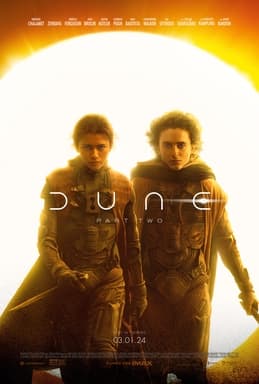
Poster / promotional material via Wikipedia, Dune: Part Two. Used under fair use for criticism and review.
The moment I remember most clearly from my first watch of Dune: Part Two was not a battle or a worm or a prophecy. It was the scene in which Paul Atreides, having fully accepted the Fremen religious framework being offered to him, looks directly into a mirror of his own forthcoming godhood and sees a billion dead people staring back.
Most blockbusters would treat that moment as a triumph. Denis Villeneuve treats it as a horror. Eighteen months later, that distinction is still the point.
The film is not on Paul’s side
This is the thing the enthusiasts of Dune: Part One were not quite prepared for. The first film, by necessity, functioned as a conventional hero’s journey. Paul loses his father, escapes to the desert, begins to find himself. The film’s sympathies were clearly arranged.
Part Two pulls those sympathies out from under the viewer with a specific deliberateness. Paul’s assumption of the Fremen religious mantle is staged not as an achievement but as a surrender. His growing certainty is shot in rooms that are too dark. His final union with Chani is not a romantic resolution but a breaking of trust. The film ends with Chani walking away from the man the audience has been trained to root for, and the camera follows her, not him, as she goes.
This is the move the book makes too, but the film makes it at a studio-blockbuster budget with the audience expectation of catharsis. That is a very specific risk, and Villeneuve takes it cleanly.
What the scale is for
Every review at the time noted the scale. The IMAX footage. The 70mm prints. Hans Zimmer’s score at industrial volume. The sandworm-riding sequence that became, briefly, the signature cinema moment of 2024.
The scale is not decoration. The scale is the argument.
Dune: Part Two is, structurally, a film about the terrifying mathematics of religious war. Paul’s choice to accept the prophecy will unleash a holy war that kills, the film estimates, sixty-one billion people across the imperium. The film cannot communicate the stakes of that number through dialogue. It has to communicate it through scale, through the physical experience of being small inside a room where somebody is about to make the decision that ends civilisations.
The IMAX is the sixty-one billion.
You cannot think about that number in a small film. Villeneuve makes sure you cannot escape it in his.
The casting, twice
I want to isolate two performances. Timothée Chalamet’s Paul has been correctly praised, if slightly in the wrong terms. The praise has been about charisma and physical commitment. Those are real. What is more interesting is what Chalamet does in the back half of the film once the character has begun to consolidate his messianic identity. He stops being charming. He begins to perform Paul as a person conducting himself in public, always aware of being watched, always calculating the rhetorical effect of each gesture. Chalamet plays it without warmth. The film does not allow Paul warmth from the midpoint on. That is the point.
Zendaya’s Chani is the film’s actual moral centre, and it took me two viewings to realise this. Her work is watchful, sometimes quiet, consistently skeptical. She is, among other things, a one-person rebuke to the messianic narrative the rest of the Fremen are being absorbed into. The film gives her the last frame, and the decision to do so restructures the whole film around her perspective on Paul rather than Paul’s perspective on the prophecy.
It is not a performance of resistance, exactly. It is a performance of continued attention, of a person refusing to stop noticing what is happening in front of her. In a film about religious mass delusion, that is a hard thing to render onscreen, and Zendaya does it without a single showy beat.
The Feyd-Rautha question
Austin Butler’s Feyd-Rautha arrived with enormous advance buzz and met almost every expectation. I want to note the one thing the conversation underplayed. Butler’s Feyd is not primarily a villain. He is a mirror. Every physical quality Feyd exhibits, bald, painted, erotically violent, brutally charismatic, is a distorted version of a quality Paul is being asked to embrace in his Fremen form. The film cross-cuts them at key moments not to stage their rivalry but to ask the viewer to compare them.
The comparison is uncomfortable. Paul and Feyd are not opposites. They are two versions of the same authoritarian instinct playing out in different costumes.
Where it sits now
Dune: Part Two made $714 million worldwide on a reported $190 million budget. It was a commercial success at a scale that almost no other film of its year, excepting Wicked and Inside Out 2, achieved. It will almost certainly, given Villeneuve’s stated timeline, be followed by a third film adapting Dune Messiah.
I am both looking forward to that film and slightly worried about it. Messiah is the novel that makes the anti-messianic argument Part Two has set up. The risk is that Villeneuve, having taken his audience this far, will feel pressure to soften the landing.
I hope he does not. The strongest thing about Part Two is precisely that it refuses to soften. It is a $190 million blockbuster whose entire operating mode is to deny the audience the emotional resolution they paid for. That is a rare and valuable thing.
Watch it again, on the biggest screen you can find. Leave the lights off for an hour afterwards.
Lena writes long-form essays on the films that will still be talked about in a decade. Previously at a defunct monthly whose name we do not speak.
MORE BY LENA ASHWORTH →
Furiosa and the Death of Mid-Budget Action
Almost two years on, Furiosa's $175m worldwide gross still looks like the most depressing box-office story of the 2020s. Not because the film is bad, it is not, but because of what its failure reveals about the economics of the action film.

The Substance and the Body Horror Renaissance
Eighteen months after Coralie Fargeat's prosthetic-heavy fable drew both Oscar nominations and walkouts, the strange alchemy of The Substance has only clarified. The film is less about Hollywood than it looks, and more about what we're allowed to say with bodies on screen.

Challengers and the Year Guadagnino Made Sport Sexy
Two years after Challengers arrived in its pastel pressure-cooker, the film's trick is clearer: it is not really about tennis. It is about what love looks like when three people are too competitive to admit they love anything but competition.