The Day of the Jackal: Eddie Redmayne and the Ten-Episode Thriller
Sky and Peacock's Jackal adaptation stretched the Forsyth novel across ten episodes and bet the show on Eddie Redmayne's stillness. The bet paid off, mostly.
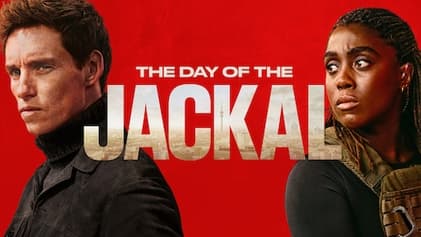
Poster / promotional material via Wikipedia, The Day of the Jackal (TV series). Used under fair use for criticism and review.
Ronan Bennett’s adaptation of The Day of the Jackal premiered on Sky and Peacock in November 2024 and finished its ten-episode run in late December. The show took Frederick Forsyth’s 1971 novel and Fred Zinnemann’s 1973 film and did something that nobody quite expected: it stretched the material into a serialised character study, built the entire show around the kind of internal performance modern thrillers usually skip, and asked Eddie Redmayne to carry the weight mostly in silence.
Nine months on, the bet has clarified. The show is better than I thought it was in December, and it is better for reasons that are specifically about what Bennett and his directors chose not to do.
What the adaptation refused
The Forsyth novel is built on procedural clarity. A professional assassin is contracted to kill Charles de Gaulle in 1963. A French detective is assigned to stop him. The book alternates between the two men, both of them efficient, neither of them especially interior. The Zinnemann film, starring Edward Fox, preserves this clarity. The pleasure of both is watching professionals work.
The temptation for a ten-episode adaptation, especially one setting the story in the 2020s, would have been to deepen the Jackal’s psychology, give him a girlfriend in peril, have him confronted by his past, and so on. Prestige TV has been doing this to thriller protagonists since Killing Eve. Bennett refused the temptation, almost completely. The Jackal has a wife (Úrsula Corberó, very good) and a son in Cádiz. We see his domestic life. But Bennett does not give us access to his interior. The Jackal is a closed object. We watch him.
This is a specific dramaturgical choice and it required a specific actor. Redmayne was the casting coup. He plays the Jackal as a man who has built a working interior life by practising emptiness. There is a scene in episode three, the assassination from a rooftop in Munich, where Redmayne lies prone behind a rifle for something like ninety seconds of screen time without speaking, without visibly breathing, and the camera holds on him long enough that we can feel the specific professional stillness the character has spent a decade cultivating. Redmayne, trained as a theatre actor, understands that stillness is a choice that costs the actor physically. He makes the cost visible without announcing it.
The Lashana Lynch parallel
Lashana Lynch’s Bianca Pullman, the MI6 operative tracking the Jackal, is the show’s compensating centre. Bennett has built her with a fuller domestic life: a husband, a daughter, a marital strain that the work keeps exacerbating. The choice is deliberate. If the Jackal is opaque, Bianca has to be the character the audience can identify with. Lynch is up to the assignment, and then some.
What Lynch does, across ten episodes, is play Bianca as a specifically good professional slowly being corroded by the specific cost of being a good professional. The scenes where Bianca is at home, trying and failing to be fully present with her daughter, are the scenes where the show stakes its emotional claim. The scenes where Bianca is in a Whitehall briefing room, arguing against male superiors who will not listen, are the scenes where the show stakes its procedural claim. Lynch holds both.
The best Lynch scene of the season is in episode seven. Bianca has traced the Jackal to a specific European city. Her superior orders her to stand down because the intelligence is not actionable under current protocols. Lynch plays the entire scene, which is about four minutes of mostly bureaucratic dialogue, as a person realising in real time that the institution she has given her life to is not going to let her do her job. She does not raise her voice. She does not cry. She processes. The processing is the performance.
The structural risk
The risk of stretching a 300-page thriller across ten hours is dilution. The Day of the Jackal mostly avoided it, but not entirely. The middle stretch of the season, episodes five through seven, has moments where the show is clearly stalling to hit its episode count. A subplot about a client network in Eastern Europe, which involves two characters who never quite become fully dimensional, is the weakest element. A second subplot, involving the Jackal’s contact in a Bavarian gun-dealing operation, works better but feels overextended.
These are not fatal flaws. They are the cost of the format. A six-episode season would have been tighter. A ten-episode season lets Bennett stage two sequences that a shorter season could not have afforded: an extended set piece in Budapest in episode six, and a quieter domestic sequence in Cádiz in episode eight, both of which are the season at its best. The episode count is a trade-off. I think Bennett called it mostly right, while acknowledging that a couple of episodes could have been cut without losing the shape.
The direction
The show was directed by Brian Kirk (episodes one, two, nine, ten) and Anthony Philipson (three through eight). Kirk is the more ambitious of the two, and the season’s best direction is his. The opening episode’s assassination sequence, a long tracking shot through a German political rally that ends on the Jackal departing before anyone realises what has happened, is as tightly composed an action sequence as television managed last year.
Philipson’s middle-season work is more functional. It moves the plot. It keeps the pace steady. It does not attempt the kind of set-piece ambition that Kirk brings to the opener and closer. This is, probably, the correct division of labour for a season this length. You cannot direct every episode at the pitch of episode one. Philipson handles the procedural machinery. Kirk handles the flourishes.
The finale
The final two episodes deliver on what the season had been building. I will not spoil the specific mechanics, but the confrontation between Bianca and the Jackal, when it comes, is staged with the discipline the season has been earning. It is not a shootout. It is a conversation in a single location, with real stakes on both sides, and the specific shape of what each character chooses to do tells us what the season had been arguing about.
The show has been renewed for a second season. Quite how a story that was historically a closed narrative extends across another ten episodes is not yet clear. Bennett has said the Jackal character will continue. I have doubts about how that works structurally, but I also had doubts about whether the first season would cohere, and it did, so I am holding my scepticism loosely.
What the season leaves
The Day of the Jackal is the best adaptation of a Cold War-era thriller property the streaming era has managed, and it is the best case anyone has made for Eddie Redmayne as a leading man in a genre register since The Theory of Everything. The patience it asks of the viewer is specific. The reward is specific too.
Watch it slowly, one episode a night, preferably late. The show’s rhythm is internal. It rewards attention.
Priya came to criticism sideways from theatre. She is patient with slow shows, short with bloated ones, and cheerfully vicious about lazy writing.
MORE BY PRIYA NAIR →
Severance Season 2 and the Mythology Problem
Eleven months after Severance returned, the second season's structural gambles are clearer. The show's patience has always been its argument; the real question is whether that argument still scales.

Slow Horses Season 4: The Gary Oldman Show
A year on from Season 4, Slow Horses is still the most consistently-good spy drama on television. An argument for the show that has quietly become one of the best.

Paradise: The Bunker Twist That Reframes the Show
Dan Fogelman's Paradise uses a first-episode reveal as a structural argument. The reveal works; what the show does with it is the interesting part.