Baby Reindeer: What Richard Gadd Actually Wrote
Richard Gadd's seven-episode autobiographical drama was the TV moment of spring 2024 and the legal controversy of summer 2024. A year later, the show itself is still the best argument for why it exists.
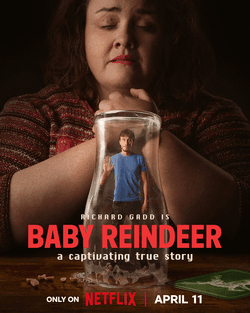
Poster / promotional material via Wikipedia, Baby Reindeer. Used under fair use for criticism and review.
Baby Reindeer arrived on Netflix in April 2024 and did something Netflix shows almost never do anymore: it stopped being about itself and started being about a lawsuit. Within three months of release, a real woman in the UK had publicly identified herself as the person on whom Richard Gadd’s stalker character was based, filed a 170 million dollar defamation suit against Netflix, and turned what had been one of the year’s most acclaimed limited series into one of its most ethically complicated.
A year and a half later, the lawsuit is still in progress. The show is still on Netflix. And the question of what Gadd actually made, as distinct from what the show became a vehicle for, is still worth answering.
What the show is
Seven episodes, each roughly thirty minutes. Richard Gadd plays a fictionalised version of himself, a struggling comedian in London whose act is going nowhere and whose personal life is quietly collapsing. Into his life walks Martha, played by Jessica Gunning, a woman he meets at the pub where he works. Over the course of the show, Martha’s attention to Gadd’s character, Donny Dunn, escalates from conversation to emails to thousands of emails to voicemails to physical pursuit.
The show is autobiographical. Gadd, a real comedian, was stalked. He also, the show tells us in a rupturing fourth episode, was sexually assaulted years earlier by a male mentor in the industry. The stalking and the assault are not unrelated. The show’s central argument, delivered in that fourth episode, is that Gadd’s response to Martha, his inability to walk away, his willingness to keep replying, his occasional encouragement of the contact, is connected to the earlier, separate trauma in ways that he, Gadd the writer, is still working through.
What the fourth episode does
The assault episode, “Episode 4,” is the thing I return to most. It is shot and written with a specific directness that American television almost never manages about male sexual violence. The scene itself is staged without music, in long takes, with the camera mostly close on Gadd’s face. The performance is the episode.
What Gadd does in that episode, as a writer and as the lead actor, is refuse the audience’s traditional consolations. He does not stage the assault as a single unambiguous event; he stages it as a slow, ambiguous, drug-mediated sequence of choices, some coerced, some acquiesced to, whose exact moral line Gadd’s character does not himself fully know how to draw. The episode is honest about the confusion that such events actually produce. It does not offer the viewer a clean story about a victim who always knew he was a victim.
This honesty, I think, is the thing that made Baby Reindeer the cultural event it became. A generation of male viewers, many of whom had never heard their own half-formed experiences of assault articulated on screen, watched that episode and felt seen in a way that was painful and necessary and, for some, career-changing for their willingness to talk about what had happened to them.
The Jessica Gunning performance
Jessica Gunning’s Martha is, at the same time, the more technically extraordinary performance of the two. Gunning is doing something that almost no actor is asked to do in contemporary prestige television: she is playing a person with a diagnosable mental health condition without the show ever diagnosing her. Martha is not explained. She is not reduced to a pathology. She is presented as a fully-dimensional human being whose suffering and whose capacity for harm are not the same thing as each other, and who is, throughout the show, a specific person with specific desires rather than an antagonist-shaped obstacle.
The achievement of the performance is that Martha is never, in any scene, only a threat. She is, in every scene, also a person, and the show’s refusal to let us simplify her is what makes the show formally important and, arguably, what made the real-world legal situation that followed inevitable.
The legal question
I want to address the lawsuit briefly. The woman who sued Netflix has said, publicly, that she is not Martha but that enough details in the show matched her life that she was identified by friends, colleagues, and strangers, and that her life was materially harmed as a consequence. I have read her statements. I have read Gadd’s. I have read Netflix’s public filings.
I do not know how the case will resolve. What I do know, as a matter of craft, is that the show’s opening text, which described the events as “a true story,” was too strong a claim to make about a piece of autobiographical fiction drawn from an identifiable real-world situation. Netflix has since modified the wording. The modification is correct. It was correct to do it earlier.
The deeper question, which the lawsuit cannot resolve but which the industry has to answer, is what obligations an autobiographical artist has to the non-public figures who appear in their work. Gadd’s argument, in interviews, has been that he changed as many identifying details as he could without losing the emotional truth of the piece. His critics have argued that he did not change enough. This is a real disagreement and it does not have a simple resolution.
What survives
Setting the legal controversy aside for a moment, and acknowledging that it cannot fully be set aside, Baby Reindeer is, as a piece of writing and performance, one of the most extraordinary short-form drama series of the decade. It is honest about male victimhood in ways that are still rare. It is honest about complicity in ways that are still rarer. It gives Jessica Gunning a role that will be studied in acting classes for the next twenty years.
Watch it again, slowly, one episode at a time. Do not binge it. The show is about the specific damage of not being able to look away, and it deserves to be watched with breaks between episodes where you let yourself look away, and then come back.
Priya came to criticism sideways from theatre. She is patient with slow shows, short with bloated ones, and cheerfully vicious about lazy writing.
MORE BY PRIYA NAIR →
The Four Seasons: Tina Fey's Middle-Aged Friendship Show
Tina Fey's adaptation of the 1981 Alan Alda film is a show about three couples, four vacations, and what middle-aged friendship sounds like when nobody is performing for an audience.
Ripley: The Slowness Was Always the Point
Steven Zaillian's eight-episode Netflix adaptation of Patricia Highsmith was the quiet prestige show of April 2024. A year later, its patience has only looked smarter.

The Diplomat Season 2: Allison Janney Arrives and the Show Reorganises
Debora Cahn's second season ran six episodes and handed its final scene to Allison Janney. The compression changed what the show is.