Weapons Is a Comedy Structure With the Laughs Taken Out
Zach Cregger spent a decade writing sketch comedy and then applied the sketch runner's structure to a film about seventeen missing children. It made $270 million on $38 million.
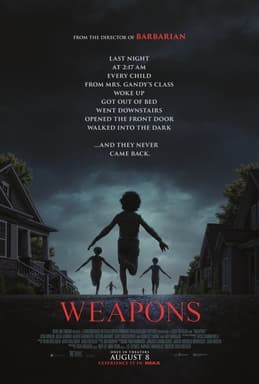
Poster via Wikipedia, Weapons. Used under fair use for criticism and review.
Let me get one thing out of the way. The chapter structure in Weapons is not an homage to Rashomon, it is not Paul Thomas Anderson, and it is definitely not Pulp Fiction, which is what half the reviews reached for in the first week. It is a sketch runner. Zach Cregger spent the better part of a decade writing and performing sketch comedy, and the runner is the sketch writer’s fundamental unit: you plant something, you cut away hard before the audience has finished processing it, you come back later from a different angle and the thing you planted detonates.
That is the entire architecture of this film, and it is the reason a $38 million original horror picture with no IP attached to it took $151.6 million domestically and $270 million worldwide against a market that spent 2025 insisting original films do not open.
The mechanism, stated plainly
Seventeen children leave their homes at 2.17 in the morning, at the same minute, from the same classroom, and run into the dark. One child does not. Cregger tells the aftermath in blocks, each block anchored to a different person: the teacher, a parent, a police officer, a junkie, a principal, the child who stayed.
The blocks overlap. This is where the technique lives. When you re-enter a scene you have already watched from a different vantage, a conventional mystery film gives you new information: here is what was happening off-screen, here is the piece you were missing. Cregger frequently gives you no new information at all. He gives you the same event with a different person’s terror attached to it, and the withholding does not resolve. It compounds.
I have watched the film three times now looking for the cheat and there isn’t one. The perspective blocks are honest. Nothing is shot in a way that lies to you about what is in the room. That matters more than it sounds like it should, because the entire genre has spent fifteen years training audiences to expect the twist that retroactively invalidates what they watched, and Cregger has built something that survives a second viewing intact.
Larkin Seiple is why it is not ugly
Larkin Seiple shot this, and Seiple is a strange hire for a New Line horror picture. His CV runs through music videos, Swiss Army Man, Everything Everywhere All at Once, work that is heavily designed and unafraid of colour. Horror of this budget usually gets photographed in the standard American suburban murk: sodium streetlight, blue-grey interiors, a colour palette apologising for the production design.
Seiple lights Weapons like a comedy. The daytime is bright. The school is bright. The houses have lamps on in them and the lamps are the colour lamps actually are. When the film goes dark it goes properly dark, and the contrast is available to it because it did not spend the first hour in a grey bath. The night-time running sequences work as images, arms straight back, a gait that is wrong in a way you cannot immediately name, because you can see them.
Joe Murphy cut it, and the cutting is the sketch discipline in practice. Blocks end early. Cregger and Murphy repeatedly leave a scene a beat before the beat you want, which is a comedy instinct applied to dread, and it produces the specific sensation of being interrupted that runs through the whole 128 minutes.
The part I am less sold on
Here is the cold layer, and I say this with no pleasure: the final act is the weakest thing in the picture, and it is weakest for the reason these films are always weakest. The withholding has to end. Once the mechanism behind the disappearances is on screen and named, it is a smaller thing than the hole it was filling, and no amount of craft fixes that. Cregger knows it. You can feel him accelerating through the explanation to get to the physical climax, which is well staged and much less interesting than the ninety minutes of not knowing.
What rescues it is Amy Madigan. Aunt Gladys is a part that could have been played as camp by almost anyone, and Madigan plays her as a houseguest. That is the whole trick. She is imposing, she is not sinister, she takes up exactly as much room as a difficult relative takes up, and the horror comes from the fact that nobody in the film is willing to be rude to her. Madigan took the Academy Award and the Screen Actors Guild award for it, and the Oscar in particular is worth marking: the Academy has given a supporting statuette to a genuine horror performance roughly never.
Julia Garner has the least showy job and the most difficult one, playing a woman the town has decided is guilty and who cannot prove otherwise because there is nothing to disprove. Alden Ehrenreich and Benedict Wong are both doing precise, unglamorous work in the middle sections. Cary Christopher, as the child who stayed, holds the last block of the film on his own.
What the number means
Warner Bros. released it on 8 August 2025 through New Line, with BoulderLight and Vertigo attached, on a marketing campaign that told you almost nothing. No plot in the trailer. No monster. A time on a clock and some children running.
That campaign worked because the film could survive it. A studio can only market a picture on withholding if the picture is actually built out of withholding, and this one is, all the way down to its editing rhythm. Every other studio will now take the wrong lesson from the $270 million, which is that audiences want cryptic marketing. The lesson is that Cregger wrote a structure first and a monster second, and the structure came from ten years of learning where to cut a joke.
Marcus believes good criticism is an argument. He is almost always angry about something, usually for good reason. Horror is his first language.
MORE BY MARCUS VELL →
Companion and the Case for the Small Sci-Fi Thriller
Drew Hancock's debut strips its premise to a weekend-house structure and one central idea. The discipline is the film's argument, and the argument lands cleanly.
Wolf Man, Leigh Whannell, and the Universal Monster Problem
Leigh Whannell's January 2025 Wolf Man cost about $25 million and grossed about $36 million globally. The film is not the disaster the numbers suggest. The strategy around it is.
The Substance and the Body Horror Renaissance
Eighteen months after Coralie Fargeat's prosthetic-heavy fable drew both Oscar nominations and walkouts, the strange alchemy of The Substance has only clarified. The film is less about Hollywood than it looks, and more about what we're allowed to say with bodies on screen.