Twin Peaks: The Return Is Eighteen Hours Spent Refusing the Reunion
The revival promised the return of Dale Cooper and then withheld him for most of its running time. That withholding is not a flaw in the structure. It is the structure.
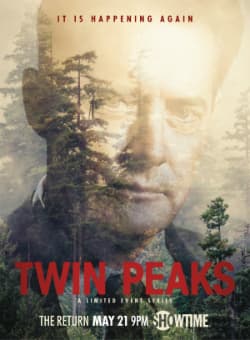
Poster via Wikipedia, Twin Peaks: The Return. Used under fair use for criticism and review.
The most formally interesting piece of television of the last decade is also the one that most openly declined to give its audience what it had come for. Twin Peaks: The Return arrived on Showtime on 21 May 2017, twenty-five years after the original series left Laura Palmer’s promise to see Dale Cooper “in twenty-five years” hanging, and for the first sixteen of its eighteen parts it staged an elaborate, patient, funny, frequently unbearable denial of the reunion everyone had been anticipating.
That denial has a method. David Lynch directed every part and wrote the series with Mark Frost, and the result is closer to a feature film cut into episodes than to a season of television in any previous sense. The question worth asking of it is not whether the reunion was withheld, but what the withholding builds.
A man made of delay
Kyle MacLachlan plays three versions of Cooper in The Return: the malign duplicate, Mr C, who has been walking around in the world for a quarter of a century; the original, trapped; and Dougie Jones, an insurance salesman in Las Vegas whom the original Cooper is dropped into and who is, for most of the season, close to inanimate. The Dougie material is where the viewer’s patience is tested hardest, and it is where the design is clearest.
MacLachlan’s Dougie speaks in echoes. He repeats words back to people. He wanders through a casino as though the world were a language he was in the middle of learning. A conventional prestige drama would treat this as a delay between plot points. Lynch treats it as the plot. The great question of a revival (will the beloved lead come back?) is converted into a slow comedy of near-misses: Cooper standing in a living room, transfixed by an electrical socket, understood by nobody. Every scene of Dougie is also a scene about the audience’s longing to see Cooper, and a refusal to cash it.
Cinematographer Peter Deming shoots Las Vegas in a flat, bright, suburban daylight that has none of the Pacific Northwest gloom of the original. The contrast is deliberate. The place where Cooper has been lost is not mysterious. It is ordinary, and the series is saying that ordinary is where you can lose a person.
The Roadhouse coda and the pause
The Bang Bang Bar is the one place in the series where the plot is allowed to stop and the music is allowed to do the work of a chapter break. It is the series’ reworking of the Roadhouse. Nearly every part closes there with a live performance, and the choices are not decoration. A band plays through an entire song while the camera holds on the stage and the room. It is a structural breath. Having had a part full of dread, Dougie and delay, the viewer is given three minutes with nothing to decipher, and the effect is to make the next part’s dread land harder.
I cannot think of a precedent for this as a formal device. Other programmes have used a musical sting at the end of an episode. This one has used a musical scene, which is a different unit, with duration and presence, and it turns the eighteen parts into something with a recurring rest in it, like a movement.
Part 8 as the argument
Part 8 is the one most often discussed, and it deserves to be, but not only for its audacity. For most of its length it leaves the characters behind altogether. It begins in the desert with Mr C, shifts to a black-and-white sequence set in New Mexico in July 1945, the Trinity test, and follows the explosion’s aftermath through a long, near-wordless passage of abstraction, before arriving in a small-town gas station in 1956 and a radio broadcast that sends ordinary people to sleep. It plays as an origin story for the series’ evil, and it is told with images and sound design rather than dialogue.
What it does for the larger structure is worth noting. After seven parts of ordinary-seeming plot, Part 8 tells the viewer that the series is not going to explain itself in the terms the original did. There is no mystery with a single answer. There is a wound in the world and a history of how it got there. This is the thing the revival was always going to be about, and it announces itself at the exact midpoint of the season.
The ending as a question about time
When the last two parts arrive, the series offers what appears to be the long-awaited resolution, and then retracts it. Cooper, restored, does what he has come to do; and then, in Part 18, he is somewhere else, in Odessa, Texas, with a woman called Carrie Page, asking, “What year is this?” The question is not a trick. It is the one the whole season has been asking about itself. Twin Peaks returned after twenty-five years to find that the thing it was trying to return to had moved.
The finale ends on a scream, and the scream is the argument. The revival was never going to deliver the past, because the past was not on offer. What it delivered, across eighteen hours of deliberately postponed satisfaction, was a serious proposition about what nostalgia costs the person who goes looking for it.
That is the claim I would make for the season, and it is a harder one than the usual verdict that it was strange. It was strange on purpose, and the purpose was to tell us that we could not go home again.
Priya came to criticism sideways from theatre. She is patient with slow shows, short with bloated ones, and cheerfully vicious about lazy writing.
MORE BY PRIYA NAIR →
The White Lotus Season Three Is Built to Refuse Change
The complaint about the Thailand season was that nothing happened for weeks. That was the design. Mike White built a season about people who cannot move, and then made the form hold still with them.
Long Story Short Lights the Same Candle Twice
Raphael Bob-Waksberg's family comedy jumps across six decades in ten half-hours. The jumping is not the design. The design is what gets handed from one pair of hands to the next.
The Four Seasons: Tina Fey's Middle-Aged Friendship Show
Tina Fey's adaptation of the 1981 Alan Alda film is a show about three couples, four vacations, and what middle-aged friendship sounds like when nobody is performing for an audience.