Chernobyl Is a Courtroom Drama That Happens to Contain a Disaster
Craig Mazin and Johan Renck's five hours of television are remembered for the reactor. Their real subject, and their real structure, is a trial, and the audience is seated in the jury box before it knows it.
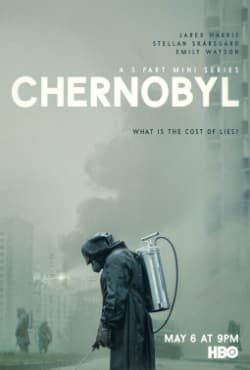
Poster via Wikipedia, Chernobyl (miniseries). Used under fair use for criticism and review.
The first image of Chernobyl is not the reactor. It is a man in a kitchen, at 1:23 in the morning, two years to the minute after the explosion. Valery Legasov (Jared Harris) records a stack of cassettes, puts them where he knows they will be found, and takes his own life. The series then goes back two years and begins again.
That order matters. The usual way of describing Chernobyl is to say that it is a disaster film, with the reactor as its engine and the radiation as its villain. But the show’s architecture says something else. It opens on a death that has already happened and a testimony that has already been given. It is built, from the first frame, as a case.
The structure of a deposition
A disaster film is organised by escalation: the warning, the failure, the cascade, the rescue. Chernobyl has all four, and it keeps rearranging them so the audience cannot enjoy the usual pleasures. Its five episodes, “1:23:45”, “Please Remain Calm”, “Open Wide, O Earth”, “The Happiness of All Mankind” and “Vichnaya Pamyat”, are titled like exhibits, and the last of them is the trial.
Look at where that places the weight. By the fifth episode the viewer has watched four hours of testimony delivered through action: what was said in the control room, what was not said in the council chamber, what was done to the people who were in the wrong place. The trial is the point at which the show stops showing and starts asking you to rule.
It is also, historically, the show’s boldest liberty. Legasov was not present at the trial of Dyatlov, Bryukhanov and Fomin; the series puts him in the room because the argument needs a witness. What he explains is the flaw in the reactor’s design, the fault the show insists the state knew about and left uncorrected. It is an engineering explanation. It is also a closing argument. The reactor explodes in the first episode; the lie that built it is on trial in the last.
A series without a villain’s face
Craig Mazin has said that the lesson of the series “isn’t that modern nuclear power is dangerous” but that “lying, arrogance, and suppression of criticism are dangerous.” You can see that thesis in the way the show refuses to give the disaster a single culprit. Anatoly Dyatlov (Paul Ritter) is easy to hate, and the series lets you, but it spreads the blame along a chain of men who each preferred not to know.
Jakob Ihre’s photography is the sharpest instrument in that argument. He has named Andrei Rublev, Stalker and Come and See as the references, three films that photograph people as part of a landscape that has opinions about them. The Fabijoniškės district of Vilnius stood in for Pripyat because its panel housing kept an authentic Soviet atmosphere; Renck grumbled about the modern windows and dealt with them in post. The series asks you to look at the way the state housed its people before it asks you to look at how it lost them.
The sound of the room
Hildur Guðnadóttir’s score is another piece of testimony. She recorded sounds with Chris Watson at the decommissioned Ignalina plant in Lithuania, the reactor of the same design that stood in for Chernobyl, and built the score out of them. There is no orchestral swell. There is a hum, a rattle, the metallic breathing of a building that is still alive. The effect is not that the music sets a mood. It is that the plant is allowed to give its own evidence.
The one cheat
Every careful courtroom drama has a character it invents. Chernobyl has Ulana Khomyuk (Emily Watson), a physicist from Minsk who investigates the accident, and the epilogue is honest about her: she is a composite, standing in for the many scientists who did the work. The historian Adam Higginbotham, who spent a decade on the subject, has pointed out that there was no need for a scientist to uncover the truth about the RBMK reactor, because many nuclear scientists knew all along that the design had problems.
That is a fair complaint, and it identifies the show’s single structural sleight. It needs someone to go looking so that the audience can follow the investigation. In life, the truth was available and was not acted on, which is a bleaker story and a harder one to dramatise. Mazin chose the more watchable version and said so on screen, which is more than most historical dramas manage.
What the jury is asked
The series won the Emmy for Outstanding Limited Series in 2019, along with Directing and Writing, and went on to take the Golden Globe and the BAFTA. None of that tells you why it still works. What does is that it never lets the audience feel that the story is over. The tapes are made; the testimony is given; the man who gave it is dead before the first scene. The verdict is not delivered. It is left in the room with the viewer.
The first line Legasov speaks is a question: what is the cost of lies? The five hours that follow are the case for the answer, which is that a society pays for its lies in the end, and that the bill arrives all at once.
Priya came to criticism sideways from theatre. She is patient with slow shows, short with bloated ones, and cheerfully vicious about lazy writing.
MORE BY PRIYA NAIR →
The White Lotus Season Three Is Built to Refuse Change
The complaint about the Thailand season was that nothing happened for weeks. That was the design. Mike White built a season about people who cannot move, and then made the form hold still with them.
Industry Season 3: Still the Best Show About Money
A year after Industry's third season brought Kit Harington and a green-energy IPO into the show's London trading floor, the season looks like the moment the show became the best finance drama in TV history.
The Penguin: Colin Farrell's Prosthetic Triumph
A year after The Penguin finished its run on HBO, the show is a strong argument for what the superhero universe can still do on television when nobody makes it wear tights.