True Detective: Night Country and the Anthology Problem
Issa López's anthology season was the most divisive prestige TV of the year. Eighteen months out, the things it got right outweigh the things it did not.
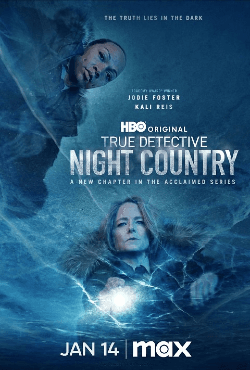
Poster / promotional material via Wikipedia, True Detective season 4. Used under fair use for criticism and review.
True Detective: Night Country, which ran on HBO in early 2024 under Issa López’s showrunning, had the hardest legacy assignment of any prestige TV season in years. The first season of True Detective (2014) was a cultural landmark. The second (2015) was a cultural disaster. The third (2019) was a course correction. The fourth was going to be judged against all three, in every review, from the first week.
López’s season chose to do something I still admire: it did not try to replicate the Nic Pizzolatto original formula. It made a different show inside the same anthology frame. That choice cost the season some of its initial reception. A year and a half on, it is the choice I keep coming back to.
What the season was trying to do
The surface premise: eight men at a remote Alaskan research station disappear in the final days of the polar night. Chief Liz Danvers, played by Jodie Foster, and Trooper Evangeline Navarro, played by Kali Reis, investigate. The case connects to a years-old unsolved murder of an Indigenous activist, to corporate mining interests, to the specific weather of Ennis, Alaska, a town locked in darkness for weeks at a time.
The formal project was to merge the True Detective procedural mood with a register of Indigenous cosmology that the franchise had not previously touched. Ghosts walk. Animals behave strangely. Dreams carry information. The supernatural is not, in the show’s framing, “real or not real,” it is simply a different way of registering what is happening in Ennis.
This was the element critics divided over most sharply at the time. The cosmology-as-evidence move is unfamiliar to the True Detective viewer trained on Cohle’s pessimistic materialism. López’s version asks the viewer to hold a more porous frame. Some viewers did. Some would not.
The Foster-Reis pairing
Jodie Foster’s Danvers was the performance I spent the most time rewatching. Foster, who had not carried a television lead since Money Monster-era studio work, showed up to Night Country with a precise, deliberately unsympathetic register. Danvers is tired, narrow, resentful, unwilling to flatter anyone, resistant to the emotional choreography the show’s police-procedural frame would traditionally demand.
This is the right performance. Night Country is a show about women in law enforcement who have stopped performing the likability their job traditionally required of them. Foster’s Danvers is the senior version of that refusal. Reis’s Navarro, younger, harder, closer to the case’s Indigenous stakes, is the junior version. The two actors work in counterpoint, and the scenes where they are in the truck together, arguing about the case, are the show’s spine.
Reis, a former professional boxer, is not a classically-trained actor. That was visible at the time. She reads, in some scenes, as slightly out of her depth against Foster’s studio fluency. Revisited, the roughness plays differently. Reis is doing a performance of physical presence that the show genuinely needs. Navarro is not supposed to be rhetorically sharp. She is supposed to be the presence that the case’s ghost-stories recognise. Reis brings that presence. The occasional unsteadiness reads, on rewatch, as character texture.
The plot complaints
The season’s most common criticism, in its first run, was that the central mystery did not fully hold together. Specifically, the resolution of the eight-scientist disappearance required a specific chain of coincidences that some viewers found unpersuasive. The conspiracy framing, about a mining corporation poisoning the local water supply, was introduced late. The connection between the cold case and the current case relied on a few too many plot mechanics.
I agreed with these criticisms in March 2024, and I still think the plotting is the season’s weakest element. But a year later, I am less convinced that the plotting is supposed to be the point. Night Country is, structurally, more a tone piece and a character piece than a procedural. The procedural frame is a delivery mechanism for the show’s real interest, which is the specific damage done to a specific Indigenous Alaskan community by extractive industry.
The mystery is solvable. The larger violence is not, and the show is honest about that.
Where the show was doing something new
Night Country was, I would argue, the first time an anthology-prestige drama on this scale, at this budget, made Indigenous women the moral and narrative centre without flattening them into symbols. The Iñupiat characters are specific. The community politics are specific. The protests outside the mine are staged with a documentarian care that the show does not apologise for.
This was a genuine achievement. The show was criticised, in some quarters, for being “political.” The show was political. It was making an argument about resource extraction and Indigenous women’s lives, and the argument was inseparable from the case. This is, if anything, what the original True Detective had done too, in its 2014 staging of Louisiana industrial decay. López was not departing from the franchise’s tradition. She was continuing it with a different geography.
What the season leaves
Night Country won a bunch of Emmys, including acting wins for Foster that were, correctly, considered overdue. HBO renewed the anthology for a fifth season, though as of mid-2025 that season has no announced release date.
The thing I will remember from Night Country, aside from Foster’s face across a precinct desk, is the specific use of weather as a moral climate. The polar night, looming and enveloping, is not a setting. It is a condition under which certain kinds of crimes become possible, and certain kinds of protections fail. The show is about what happens to a community when the light goes out for weeks at a time.
Watch it again, preferably across two nights, preferably in winter. The argument holds.
Priya came to criticism sideways from theatre. She is patient with slow shows, short with bloated ones, and cheerfully vicious about lazy writing.
MORE BY PRIYA NAIR →
Severance Season 2 and the Mythology Problem
Eleven months after Severance returned, the second season's structural gambles are clearer. The show's patience has always been its argument; the real question is whether that argument still scales.
Ripley: The Slowness Was Always the Point
Steven Zaillian's eight-episode Netflix adaptation of Patricia Highsmith was the quiet prestige show of April 2024. A year later, its patience has only looked smarter.
The Penguin: Colin Farrell's Prosthetic Triumph
A year after The Penguin finished its run on HBO, the show is a strong argument for what the superhero universe can still do on television when nobody makes it wear tights.