Kaos: The Netflix Myth Show That Needed a Second Season
Charlie Covell's Greek-myth reworking arrived on Netflix in August 2024 and was cancelled a month later. The show deserved better, and the cancellation revealed something specific about Netflix's renewal math.
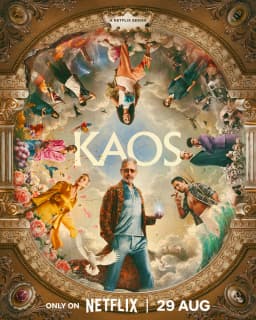
Poster / promotional material via Wikipedia, Kaos (TV series). Used under fair use for criticism and review.
Netflix released Kaos on 29 August 2024, across eight episodes. The show had been in development under Charlie Covell’s showrunning hand for roughly six years, had acquired a cast that included Jeff Goldblum as Zeus, Janet McTeer as Hera, Stanley Townsend as Poseidon, Suzy Eddie Izzard as Lachesis, and Cliff Curtis as Prometheus, and had been produced at a scale that suggested the service was expecting the kind of multi-season investment that genre-ambitious co-productions require. One month after release, on 25 September, Netflix confirmed that the show would not return for a second season.
Six months on, with the cancellation settled into the service’s back catalogue and the show’s specific achievements more visible outside the release-window noise, Kaos looks like one of the more instructive production case studies of the current streaming moment.
What the show was
Covell’s premise is straightforward: the Greek pantheon persists into a specific contemporary moment, occupying a literal mountaintop compound above a Mediterranean city-state called Krete, and has been ruling mortal affairs with roughly the same capriciousness that Hesiod and Homer describe. Zeus, played by Goldblum in full Goldblum register, has been in slow midlife crisis for approximately three thousand years. The show tracks three mortal protagonists (Riddy, a newly dead woman stuck in an Underworld bureaucracy; Caeneus, a young man working in the same bureaucracy; Ari, the heir to the Krete city-state) whose plotlines converge around a prophecy the gods are attempting to suppress.
The show’s tonal register is the specific thing that made it work and the specific thing that, I suspect, made it hard for Netflix to market. Kaos is simultaneously a comedy, a prestige drama, a bureaucratic satire, and a family-saga psychological piece about the specific pathologies of a ruling class that knows it is losing its grip. The tonal range is unusual for contemporary television. It is closer to Tony Kushner’s theatrical register than to anything the prestige-drama streaming ecosystem has produced in the last five years.
The Goldblum question
Jeff Goldblum as Zeus is the casting decision the show’s press coverage kept circling. The casting is exact, and the reason it is exact is that Goldblum’s specific on-screen persona, the mannered hesitation, the precise circling rhythm, the sudden declarative insistence, is a version of ruling-class entitlement that has been gradually converted into a comedy of specific personal inadequacy. The persona, transferred from Goldblum the working actor to Goldblum playing a god, becomes an argument about what power does to someone who has held it for too long.
What Goldblum does, across eight episodes, is play Zeus as a man who has become so thoroughly identified with his own authority that he can no longer distinguish between his specific personal preferences and cosmic moral law. When Zeus is annoyed, weather changes. When Zeus is insecure, continents shift. The show stages the specific self-aggrandisement with a comic lightness that never tips into pure satire, because Goldblum plays the insecurity underneath as real. The scenes between Zeus and Hera, with McTeer giving one of the best performances of her career, are the show’s most layered writing.
The ensemble
The mortal plotline is where the show’s longer-form ambitions were most visible, and where the first-season structure was most obviously promising rather than complete. Georgia Kirkby’s Riddy, a young woman who dies in the opening episode and spends the season inside the Underworld’s processing system, is the performance I most want to signal attention toward. Kirkby plays Riddy as a woman who is, across the season, slowly piecing together the specific bureaucratic machinery her afterlife depends on, and slowly discovering that the machinery is more corrupt than the gods themselves. Her scenes with Misia Butler’s Caeneus are the show’s most grounded emotional work, and the late-season reveal about Riddy’s specific pre-death history pays off because Kirkby has been laying the specific emotional groundwork for seven episodes.
Aurora Perrineau’s Ari, the heir to the Krete city-state, is the character the first season least finishes. Ari is the plotline that most obviously needed a second season to resolve, and the final two episodes leave her on a trajectory that the cancellation has stranded. This is not a performance problem. Perrineau is good. The structural problem is that Covell had written for a multi-season arc and the cancellation meant that the specific Ari-Zeus confrontation the season had been building toward was never going to arrive.
The production
The show was shot primarily in Spain, with Dan McCulloch’s production design creating a specific retro-Mediterranean aesthetic that combined genuinely ancient architectural textures with very specifically contemporary technology (mobile phones, surveillance cameras, administrative office furniture). The visual register the design produces, the sense that the gods have been steadily dragging human infrastructure up to the mountain across the centuries, is one of the show’s specific pleasures.
The costume work by Jo Thompson sits inside the same scheme. The gods wear a specific mix of couture and retro-futurist athleisure. The mortals wear what reads as roughly contemporary Mediterranean middle-class clothing with small period displacements. The decision not to commit to either a fully period or fully contemporary register is the right one for the show’s tonal ambitions, and the execution is consistent.
The cancellation math
The specific reason Kaos was cancelled, to the extent Netflix has publicly spoken about it, was the show’s completion rate. Netflix’s internal metric prioritises the percentage of viewers who start the show and then complete it within the first twenty-eight days. Kaos had a reasonable start-rate, driven by Goldblum’s casting and the show’s marketing push, but a lower completion rate than Netflix’s threshold for renewal at the show’s reported budget level.
I want to flag the specific problem with this metric. Prestige-drama television has never reliably produced high completion rates inside a twenty-eight-day window. Shows that find their audience over multiple seasons (the model that HBO built and that FX has refined) do so because the audience keeps returning to specific characters and specific writing. Netflix’s completion metric penalises precisely the shows that are built for multi-season ambition, and rewards the shows that can be consumed in a weekend and then forgotten.
The cancellation of Kaos, in other words, is not a specific editorial failure on the part of Netflix as much as it is a structural consequence of the metric the company has chosen to optimise. The specific shows that Netflix keeps renewing (Bridgerton, The Crown through its run, Stranger Things, Emily in Paris) all produce high first-pass completion. The specific shows that Netflix cancels in their first season (The Brothers Sun, The Diplomat’s British counterparts, Kaos) are the ones that were asking the audience to come back.
What the cancellation closes off
The second season of Kaos, as Covell has described it in interviews after the cancellation, would have resolved the Ari-Zeus plotline, given Kirkby’s Riddy a specific path out of the Underworld bureaucracy, and escalated the prophecy material into an actual confrontation between the gods and the mortal characters they have been mismanaging. The writing was already on the page. None of it is going to be produced.
This is the thing I keep returning to. Kaos was a show that had been built on a specific contract with the audience, which was that the first season would set up a multi-season argument about the specific corruptibility of divine authority, and that the second and third seasons would deliver on the argument. Netflix’s renewal logic voids the contract. The show as produced is a specific unfinished object, and its unfinishedness is not a writing choice but a commercial one.
What remains
What remains is eight hours of specifically good television, built by a specifically talented writing room, performed by a specifically well-cast ensemble, and stranded before its argument could land. The writing by Covell and the direction by Georgi Banks-Davies, Runyararo Mapfumo, and Michelle Savill is among the most formally inventive British television work of the last several years. The performances by Goldblum, McTeer, Kirkby, and Butler deserve to be widely watched.
Watch it anyway. Start at the beginning. Let the show’s unusual tonal register register. The cancellation does not retroactively unmake what Covell built. It means the thing Covell built is a ruined building rather than a finished one, but the specific architectural ambition of the ruin is still legible.
Kaos is the specific kind of show that the current streaming economics are making harder to produce. That is a problem for everyone who watches television, and worth stating plainly while the show is still fresh enough to be found.
Priya came to criticism sideways from theatre. She is patient with slow shows, short with bloated ones, and cheerfully vicious about lazy writing.
MORE BY PRIYA NAIR →
The Four Seasons: Tina Fey's Middle-Aged Friendship Show
Tina Fey's adaptation of the 1981 Alan Alda film is a show about three couples, four vacations, and what middle-aged friendship sounds like when nobody is performing for an audience.
A Man on the Inside: Mike Schur, Ted Danson, and the Comedy of Late Life
Mike Schur's Netflix show placed Ted Danson inside a retirement community as an amateur investigator. The premise is a disguise for the comedy Schur has been moving toward for a decade.

Your Friends and Neighbors: Jon Hamm and the Middle-Aged Crisis Show
Jonathan Tropper's Apple series gave Jon Hamm a part he has been waiting a decade for. The show itself is a more complicated object.