The Conformist Is a Film About Rooms
Bertolucci's 1970 adaptation of Moravia is usually praised for its colour. The argument it actually makes is architectural: a man is sorted by the spaces he walks through.
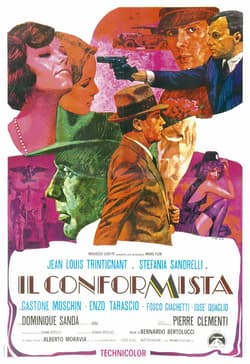
Poster via Wikipedia, The Conformist (1970 film). Used under fair use for criticism and review.
The most quoted thing about The Conformist is its light: the blue-black Paris nights, the amber of a Roman office, the stripes of a venetian blind falling across a face. Vittorio Storaro’s photography is the reason the film has a reputation as a visual object first and a political one second. That ordering is wrong, and the film itself shows why. The light is only ever the second thing to arrive. The first is the room.
Bernardo Bertolucci’s 1970 adaptation of Alberto Moravia’s 1951 novel follows Marcello Clerici (Jean-Louis Trintignant), a cultivated functionary who joins the Fascist secret police because he wants, more than anything, to be normal. In 1938 he is sent to Paris to arrange the death of his former professor, Luca Quadri (Enzo Tarascio), an anti-Fascist in exile. The plot is a spy story with the spying removed. What remains is a man being fitted into place.
The building does the arguing
Consider the scenes in which Marcello is received by Fascist officialdom. The film used the Palazzo dei Congressi in Rome’s EUR district, a quarter Mussolini commissioned as a model city, among its locations, and Bertolucci and his production designer, Ferdinando Scarfiotti, treat the architecture as a set of instructions. The doors are enormous. The floor is a plain, polished expanse. A man crosses it to reach a desk and the distance does the work that a threatening line of dialogue would do in a lesser film.
This is the thesis, stated as plainly as I can manage: The Conformist is a film in which space has an ideology, and Marcello’s tragedy is that he reads it perfectly. Marcello is not forced into the shape the rooms demand. He volunteers for it, and the film keeps showing us the shape before it shows us the person fitting inside.
Set this beside the Roman villa where his mother lives, with her morphine and her decaying grandeur, and the asylum where his father is kept. These are rooms in the other direction: places where the order has already failed. Marcello visits both and leaves both quickly. Storaro lights them differently, softer and more ruinous, and the contrast is the whole of Marcello’s psychology in two cuts. He does not want to become either of his parents. He wants to become an office.
Storaro’s camera as a measuring instrument
Storaro’s celebrated angles, the tilts and the low frames and the long fluid tracking moves, are usually described as expressive. I would call them taxonomic. The camera in the Fascist sequences measures, aligns, squares up. When the film moves to Paris and the Quadri apartment, the geometry loosens: cross-lit stripes, curved furniture, a place where people overlap rather than line up. The dance hall sequence, in which Giulia (Stefania Sandrelli) and Anna (Dominique Sanda) dance together and then pull the room into a line of dancers, is the film’s one scene of genuine social surrender, and it is also the scene in which Marcello is most visibly cornered by it.
(The editor, Franco Arcalli, deserves a share of this. The film’s shuffled chronology, its habit of cutting from the car on the Paris road to a flashback and back, was not in the original script. Bertolucci and Arcalli found it in post-production. The structure is itself a room: the present is a closed car, and the past leaks in through the windows.)
The flaw in the argument, and the best answer to it
Critics at the time who admired the film’s surface often doubted its depths. One American reviewer called it extraordinarily beautiful but said what lay beneath did not stand much analysis, and that the psychology of the central characters was murky. The objection deserves a real answer, because the film does rely on a childhood trauma (a chauffeur named Lino, a pistol, a boy who believes he has killed) to explain a political choice, and that is a neat piece of psychology of the kind we should distrust.
The answer, I think, is in how the film ends. In 1943, on the night Mussolini falls, Marcello walks Rome beside his blind friend Italo and recognises Lino in the street, alive. The childhood murder never happened. Marcello’s whole structure of guilt and conformity was built on a false foundation, and the film does not let him rest on that discovery. He screams, denounces Lino, denounces Italo, and is swept to one side as a crowd takes Italo away. The man who wanted to belong to whoever is in charge is left on the kerb beside a small fire, staring at a room he cannot enter.
The trauma is not the explanation. It is the alibi. Marcello needs a reason for his conformity that is a wound rather than a choice, and the ending takes the wound away and leaves the choice standing. That is a harder idea than the one its detractors credited it with.
What the film cost, and what it bought
The production was modest by the standards of its achievement; one commonly cited figure puts the budget at about $750,000. It was an Italian, French and West German co-production, opened the 1970 Berlin Film Festival (the festival was shut down three days later amid a separate controversy and no prizes were awarded), and went on to an Academy Award nomination for Best Adapted Screenplay. Storaro’s career went international afterwards. Francis Ford Coppola’s Godfather films carry its influence, particularly in the way a room can carry a threat.
There is a 2011 restoration supervised by Storaro himself, and a 4K restoration from the original camera negatives released in 2023 by the Cineteca di Bologna. Both are worth seeking out, not for the colour (though the colour is extraordinary) but for the geometry, which a degraded print flattens first.
The film’s ethics are architectural. It asks you to look at where people stand, how far they must walk, which door they are told to use. Then it asks whether you have ever been grateful for being told. That question has not aged, and the film’s rooms have not either.
Lena writes long-form essays on the films that will still be talked about in a decade. Previously at a defunct monthly whose name we do not speak.
MORE BY LENA ASHWORTH →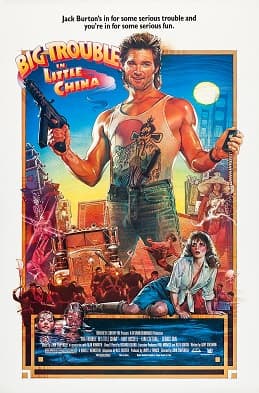
Big Trouble in Little China Was Rushed, Then Buried
Fox rushed Carpenter's kung fu comedy into cinemas to beat Eddie Murphy, then, by Kurt Russell's account, did little to promote it. The film is about a sidekick who has not noticed.
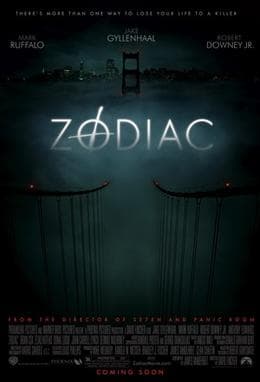
Zodiac Is a Film About Jurisdiction
The Zodiac killer is the least present figure in Zodiac. What the film dramatises instead is how knowledge fails to travel between desks, counties and decades.
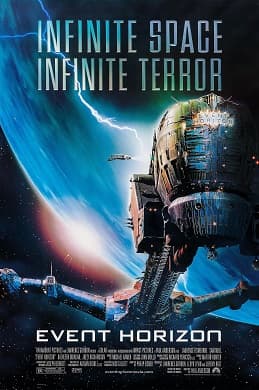
Event Horizon Was Finished by a Calendar, Not a Director
Event Horizon lost money in 1997 and has been defended ever since, usually for the wrong reasons. The film that survived is a haunted house with a gravity drive for a cellar.