Event Horizon Was Finished by a Calendar, Not a Director
Event Horizon lost money in 1997 and has been defended ever since, usually for the wrong reasons. The film that survived is a haunted house with a gravity drive for a cellar.
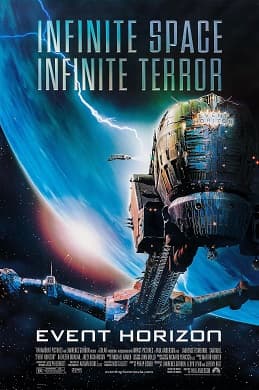
Poster via Wikipedia, Event Horizon (film). Used under fair use for criticism and review.
Let me get one thing out of the way. Event Horizon is not a lost masterpiece, and the people who describe it as one are doing it a disservice. It is a rough, loud, uneven science-fiction horror film that its studio rushed into cinemas, and the reason it matters is that the rushing left scars you can still see.
Paul W. S. Anderson’s film opened in the United States in August 1997 through Paramount, on a reported budget of around US$60 million. It grossed, by most accounts, less than half of that domestically, and the worldwide number did not rescue it. Treat the figures as contested; the verdict was not. It was a flop, and it was written off as one.
The pitch and the problem
Philip Eisner’s screenplay is a very simple idea: a rescue crew goes to find a lost experimental starship, the Event Horizon, which vanished while testing a drive that folds space. The ship has come back from somewhere. Something came back with it. Laurence Fishburne leads the rescue ship’s crew as Miller, and Sam Neill plays Dr Weir, the ship’s designer, who is too attached to his creation to see what it has become.
That is a haunted-house film. The only unusual thing about it is where the house is. Anderson and the production designer Joseph Bennett built the Event Horizon as a Gothic cathedral turned inside out, all spikes, vaults and ribbing, with the gravity drive at its centre like a bell in a tower. It is the best thing in the picture. You do not need to be told the building is wrong; you can see it in the architecture.
What the studio did to it
The reason the film feels like two films is well documented, at least in outline. Paramount fixed a release date early, and the schedule for post-production was punishingly short. Anderson has said that a significant amount of the film’s most extreme violence was cut after test screenings, and that the cut material has never been located in a usable form, which is why the director’s version that fans have asked about for years has not appeared. Treat the details as his account; the broad shape of the story is not in dispute.
The scars show up in the editing. Martin Hunter’s cut moves between its best sequences and its most perfunctory ones with a lurching speed, as if a section had been removed. The film’s second half, in particular, is a series of glimpses: a body, a corridor, a flash of something hellish. The effect is oddly effective, because it makes the film feel like something seen through a keyhole. It is also the effect of footage that is no longer there.
A crew that looks like a workplace
The best decision in the casting is that the rescue crew looks like people who do a job. Fishburne’s Miller is a tired captain whose ship, the Lewis and Clark, has been sent to a place he did not want to go; Kathleen Quinlan, Joely Richardson, Jason Isaacs, Sean Pertwee and Richard T. Jones fill out a team that argues about the work before it argues about the horror. The film spends its first act letting them be professionals, and that is what makes the second act hurt. When the ship starts to take them apart, it is a workplace that is being violated, not a cast of victims.
The marketing sold the wrong film
The campaign sold it as an Alien-style monster picture in space, and in 1997 that was a cheap and obvious comparison to make. The trailers promised a creature. What the film delivers is stranger and less marketable: a ship that has been somewhere, and has come back with nothing in it but intent. The line that reached the poster-board, “Infinite space. Infinite terror.”, is ordinary. The line the film actually trades on is the one Weir says when he explains where the ship went, and why he does not need to see where he is going.
Adrian Biddle, who shot Aliens for James Cameron, lights the interiors in hard blues and sodium oranges, and the contrast between the cold human parts of the ship and the red hell of its core is the film’s visual idea. Michael Kamen’s orchestral score, with Orbital’s electronic work running alongside, is a better pairing than it has any right to be. The crew’s final scenes feel more like a nightmare than an action finale because the music is working against the geometry.
Why it lasted
Event Horizon survived by the usual route for a failed genre film: home video, cable repeats, word of mouth. The people who found it there found a picture that did something the successful science-fiction films of its year did not. It refused to explain. The hell it describes has no name, no mythology and no rules; it simply takes people and does things to them that the film shows in fragments. That refusal made it durable. Films that explain their horrors are finished the moment you understand them; films that do not explain them keep working.
I say this without any wish to be generous. The dialogue is thin in places, the supporting characters are loosely sketched, and a couple of the effects have dated worse than the rest. But the central idea is right, the building is right, and the central performance, Neill’s slow transformation from a grieving engineer to something that is not an engineer, is right. A film with those three things does not need to have been finished on time to be worth defending. It only needs to be the film that was left standing when the calendar ran out.
Marcus believes good criticism is an argument. He is almost always angry about something, usually for good reason. Horror is his first language.
MORE BY MARCUS VELL →
Dredd Was Sold as a Gimmick and Built as a Siege
Dredd lost money in 2012 and has been winning arguments ever since. The film that failed and the film that lasted are the same film, and the reason is one tower block.
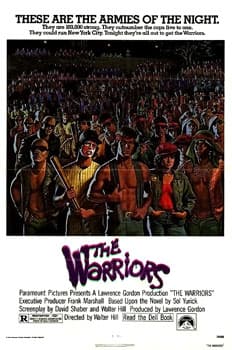
The Warriors Was a Hit That Its Own Studio Treated as a Threat
A $4 million picture grossed about $22.5 million, and Paramount still spent the spring of 1979 pulling its own advertising. The Warriors is a case study in a studio mistaking its audience for the film.
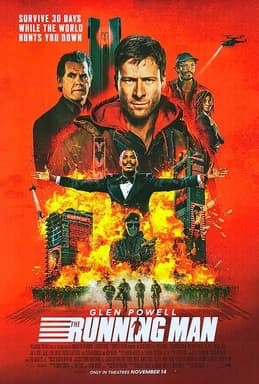
The Running Man Spent Like a Star Vehicle Without a Star
Edgar Wright's Stephen King adaptation took $69 million worldwide on a $110 million budget. The film was fine. The price tag assumed a star Paramount had never actually tested.