Every Plot in Task Is a Custody Dispute
Brad Ingelsby's seven-episode HBO drama looks like a crime series about armed robbery. Its actual subject is who gets to keep which child, and every storyline is a version of that question.
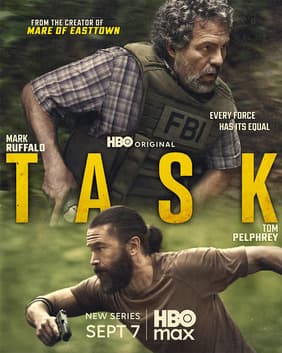
Key art via Wikipedia, Task. Used under fair use for criticism and review.
Count the guardianship problems in Task and you run out of fingers before you run out of episodes. A man is raising two adopted children while his biological son waits to be sentenced. A woman in her early twenties is holding a household together for siblings who are not legally hers to hold. A widower keeps a job that requires him to remove people from houses containing children. A motorcycle club treats its membership as a family with enforceable terms. The federal money at the centre of the season is, in the strictest sense, property in dispute.
Brad Ingelsby has made a crime series in which almost nobody is fighting over the crime.
Task ran seven episodes on HBO between 7 September and 19 October 2025. It arrived pre-labelled as the Mare of Easttown follow-up, same writer, same corner of south-eastern Pennsylvania, and the labelling was accurate enough to be useless. The two shows share a postcode and a register. They do not share a subject. Mare was about grief and the small towns that will not let you have it privately. Task is about legal and moral guardianship, and it keeps testing the gap between the two.
The genre furniture is doing something else
Ingelsby builds the season on a task force assembled to investigate armed robberies of drug houses. That is the premise. It is also, structurally, a pretext: it puts Tom Brandis, an FBI agent played by Mark Ruffalo, and Robbie Prendergrast, a sanitation worker and part-time robber played by Tom Pelphrey, on a collision course that the writing then spends six hours refusing to accelerate.
Watch how rarely the two men occupy the same scene. Ingelsby is not building suspense with the delay; suspense would require us to want the confrontation, and the show works quite hard to make us dread it. The delay is doing structural work. It keeps Tom and Robbie in separate households for long enough that we read them as parallel rather than opposed, and by the time the machinery brings them together the audience has already worked out that they are the same man under different pressure.
Ruffalo’s Brandis is a former priest who left the church for his wife and lost her anyway, which sounds like the kind of biography a writers’ room assembles from spare parts. Ruffalo plays it as a competence problem rather than a wound. He is a man who was trained to absolve people and now works for an agency that exists to charge them, and Ruffalo lets you see him reach for the wrong instrument in almost every interview scene. He listens like a confessor. He is being paid to listen like an investigator. The show never says this out loud and never stops demonstrating it.
Pelphrey and the household as a set
Pelphrey has the harder job and the better material. Robbie is a man robbing drug houses to fund a legal position, and the show is careful that we understand the arithmetic before we are asked to feel anything about it. What Pelphrey adds is a specific physical fact: Robbie is calm at work and jumpy at home. The robberies are executed with the composure of a man who has rehearsed. The kitchen is where he loses his footing.
The direction, split across the season between Jeremiah Zagar and Salli Richardson-Whitfield, honours that inversion in the blocking. The robbery sequences are shot with clean geometry, wide enough to hold every body in the room, everyone where they are supposed to be. The domestic scenes are cluttered, shot by Alex Disenhof and Elie Smolkin with foreground junk in the way, sightlines broken by door frames and countertops. A criminal enterprise is legible. A family is not.
Emilia Jones, as Maeve, is the season’s clearest statement of its actual theme, and she is playing a young woman who has assumed a parental role without any of the standing that would make it enforceable. Jones plays exhaustion without playing martyrdom, which is a narrow line, and she is best in the scenes where she has to be polite to an institution that could take everything from her with a form.
Dan Deacon scores it warm, which is the right mistake
Dan Deacon is an unlikely appointment for this. His body of work is electronic, maximal, frequently joyful, and a bleak crime drama in Delaware County is not the obvious next commission. What he does with it is refuse the genre’s default.
There is very little dread in the score. Deacon writes with sustained tones and a lot of consonance, and he lets cues sit under scenes that a more conventional composer would leave dry. The effect is not reassurance. It is closer to the sound of somebody trying to be kind about something unbearable, which is exactly the register Ingelsby’s dialogue works in, and the two of them together produce a season that is much sadder than its violence would predict.
Thuso Mbedu, Fabien Frankel and Alison Oliver make up the working half of the task force, and the writing gives them a genuine institutional texture: the small territorial frictions, the person who is right and outranked, the meeting that solves nothing. Martha Plimpton, as Brandis’s supervisor, plays the one character in the season who is unambiguously good at her job, and Plimpton makes competence look like a kind of loneliness.
Where it lands
The numbers were modest. The premiere drew 0.214 million on the night, the finale 0.442 million, and the season carried a 96 per cent Rotten Tomatoes score and a 77 on Metacritic into six Emmy nominations. HBO renewed it. The renewal is the one thing about Task that troubles me, and not for the usual reason.
A second season means the task force becomes the format, and the task force was never the point. The point was that a man who used to hear confessions, a man who takes the bins, and a young woman with no legal claim to her own family were all being asked the same question by the same state: prove that you are entitled to the people in your house. Seven episodes was long enough to ask it and short enough not to answer it. That is the shape of the thing. I would rather it kept it.
Priya came to criticism sideways from theatre. She is patient with slow shows, short with bloated ones, and cheerfully vicious about lazy writing.
MORE BY PRIYA NAIR →
The White Lotus Season Three Is Built to Refuse Change
The complaint about the Thailand season was that nothing happened for weeks. That was the design. Mike White built a season about people who cannot move, and then made the form hold still with them.
Industry Season 3: Still the Best Show About Money
A year after Industry's third season brought Kit Harington and a green-energy IPO into the show's London trading floor, the season looks like the moment the show became the best finance drama in TV history.
The Penguin: Colin Farrell's Prosthetic Triumph
A year after The Penguin finished its run on HBO, the show is a strong argument for what the superhero universe can still do on television when nobody makes it wear tights.