Deadwood Is a Play About How Speech Builds a Town
Deadwood's profanity gets the attention. Its structure is the more radical thing: a camp that becomes a polity because people keep talking their way into agreements.
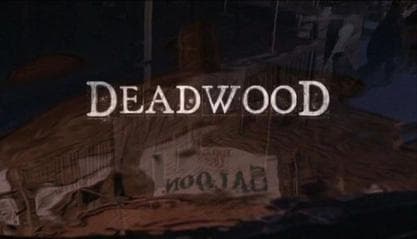
Title image via Wikipedia, Deadwood (TV series). Used under fair use for criticism and review.
The way people talk about Deadwood is a way of not talking about it. The profanity is famous, the language is called Shakespearean, and the show is held up as a landmark of prestige television. All of that is true and none of it is the interesting part. The interesting part is that Deadwood is built the way a play is built: in rooms, on a stage, in the space between two people who want something from one another.
David Milch’s series ran on HBO for three seasons, from March 2004 to August 2006, thirty-six episodes in all, and it was set in the real South Dakota camp of the same name in the mid-1870s. It was filmed on a built set at Melody Ranch in California, and the set is a clue. The camp is a single long street with a handful of interiors that matter: the Gem Saloon, where Ian McShane’s Al Swearengen runs his business from a balcony window; the Bella Union, the rival establishment run by Powers Boothe’s Cy Tolliver; the hardware store of Timothy Olyphant’s Seth Bullock and Jim Beaver’s Sol Star. The balcony window is a proscenium. Swearengen watches the street through it the way a director watches a stage.
A town made out of agreements
The show’s governing idea is that a community forms when people agree on things, and that agreement is mostly made out of talk. Nothing in Deadwood is settled by law, because there is no law. The camp is on Indian land and outside any territory’s jurisdiction, and its characters spend three seasons discovering what that means. Every institution that eventually appears, a postmaster, a newspaper, a telegraph line, arrives because somebody persuades somebody else to pay for it, and the persuasion is the drama.
Milch understood that this makes for a slow, odd show, and he built the episodes accordingly. A scene is usually two or three people, a room and a request. The dialogue is elaborate, euphemistic, circling, and it is elaborate for a reason: the characters cannot say what they mean directly, because saying what they mean would give away their position. Swearengen’s speeches are not decorative. They are negotiations in which every clause is a move.
Two theories of order
The camp’s great opposition is between Swearengen and Bullock, and it is more interesting than the usual hero and villain. Bullock believes in law, in the idea that a place can be run by rules that apply to everyone. Swearengen believes in management: that a place is run by the man who knows who owes what to whom, and that law is a luxury for towns that can afford it. Neither is simply right. The show lets the two men cooperate, resent each other, and then cooperate again, and the cooperation is where the camp actually gets built. Their scenes together are the series’ spine, and they are scenes about method, not about action.
The profanity as grammar
The swearing is the part that dates the show, and it is also the most misunderstood. Nobody in the camp swears in a way that sounds like a modern person swearing. The oaths are structural: a way of marking status, of closing a sentence, of signalling a threat that does not need to be spelled out. The writing is closer to a stylised verse than to realism, and the actors play it as such. McShane’s Swearengen can turn a single obscenity into three kinds of menace in the course of one line; Molly Parker’s Alma Garret, who rarely swears, makes her silence just as pointed.
That is where the theatrical comparison earns its keep. A stage play does not pretend its characters speak the way people actually speak. It lets them speak the way the play needs them to. Deadwood does the same, and it asks the audience to learn the grammar quickly.
Deaths as plot, not shock
A good series should be able to lose a major character and keep going. Deadwood does this early. Wild Bill Hickok, played by Keith Carradine, is shot dead in the first season by Jack McCall, played by Garret Dillahunt, in a historical event that the camp’s founding myth is built around. The show does not stage it as a shock. It stages it as a hole in the structure: the camp loses a man who might have been its law, and has to find out whether it can do without one. (Dillahunt reappears later in the series as a different character, a detail that rewards anyone watching closely, and says something about how the show treats its actors as a company.)
The company is one of the best things about it. The ensemble is large, and the show’s weekly rhythm is the rhythm of repertory: people meeting in different combinations, trading speeches, leaving. It is why the series has a theatrical afterlife in the way it is discussed, and why watching a single episode on its own is so much less rewarding than watching three together.
The ending it did not get
The most painful fact about Deadwood is that it was not finished. HBO and Milch did not reach terms for a fourth season, and the series ended on a plot that was clearly still moving. The reasons reported at the time were commercial. A film, long promised, finally aired in May 2019, thirteen years after the last episode, and it was a graceful, affecting coda, but a coda is not a season.
I come back to the show less for its answers than for its structure: three seasons of people discovering how to live next to each other, spoken in a language made for the purpose. The camp did not become a town because anyone was good. It became a town because enough people, over enough scenes, decided to keep talking. That is a claim about civilisation that most television, built for conflict, has never wanted to make. Deadwood made it for thirty-six hours and earned it.
Priya came to criticism sideways from theatre. She is patient with slow shows, short with bloated ones, and cheerfully vicious about lazy writing.
MORE BY PRIYA NAIR →
The Leftovers and the Discipline of Not Explaining
HBO's The Leftovers began with a mystery and spent three seasons refusing to solve it. That refusal was the argument, and the finale is the only ending it could have had.

Chernobyl Is a Courtroom Drama That Happens to Contain a Disaster
Craig Mazin and Johan Renck's five hours of television are remembered for the reactor. Their real subject, and their real structure, is a trial, and the audience is seated in the jury box before it knows it.

The White Lotus Season Three Is Built to Refuse Change
The complaint about the Thailand season was that nothing happened for weeks. That was the design. Mike White built a season about people who cannot move, and then made the form hold still with them.