Stop Making Sense Is a Film About Building a Band From One Man and a Boombox
Everyone remembers the big suit. What lasts is the order of the songs, which is the order in which a lonely man lets other people into the room.
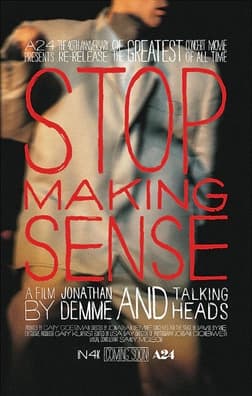
Poster via Wikipedia, Stop Making Sense. Used under fair use for criticism and review.
A man walks out on an empty stage with an acoustic guitar and a tape machine. He says hello. He says he has a tape he would like to play. Then he presses a button, and a drum machine starts up, and he begins to sing “Psycho Killer” at the front of a black stage with nothing behind him.
That is the first four minutes of Stop Making Sense, and I have never watched them without feeling slightly more nervous than the man looks.
It is the nerves that make the film. Everybody remembers the Big Suit, the absurdly wide jacket that David Byrne puts on for “Girlfriend Is Better”, and I will get to it. But the thing that has kept the film alive for forty-odd years is something plainer, which is the shape of the evening. It is a concert in which nobody is there at the start.
The order is the story
Jonathan Demme shot the film at the Pantages Theatre in Hollywood in December 1983, and what he and Byrne chose to put on the screen is not a greatest-hits run. It is a construction. After “Psycho Killer”, Tina Weymouth walks on to join him for “Heaven”, and the bass is the first living sound that is not Byrne’s. Then Chris Frantz arrives behind the drums for “Thank You for Sending Me an Angel”. Then Jerry Harrison, for “Found a Job”. Then the others come on, a few songs apart: the keyboardist Bernie Worrell, the guitarist Alex Weir, the percussionist Steve Scales, the singers Lynn Mabry and Ednah Holt.
You can watch it as a building. The stage, initially a bare black space with a single pool of light, gets fuller by the song. The sound gets thicker. The camera gets looser. It is the opposite of the usual concert-film instinct, which is to open with the loudest thing and spend the next ninety minutes trying to top it.
It is a concert in which nobody is there at the start, and the whole film is the process of everyone arriving. By the time the band is complete and the stage is lit up like a party, the audience has been taught to feel each addition as a small relief.
Jordan Cronenweth, and the courtesy of looking
Demme and the cinematographer Jordan Cronenweth, who had shot Blade Runner two years before, worked with six fixed cameras plus a handheld and a Panaglide for the close work on stage. What strikes me most, though, is what they decline to do. There is almost no flash cutting. The frames are long enough for you to watch people play. You see a hand on a bass neck for as long as it takes to understand what the hand is doing.
The film also keeps the audience largely off screen, which is a strange decision for a concert picture and a deeply good one. It means that you are not being shown a crowd to tell you how to feel. You are being shown the band, and the band is the audience’s surrogate: a group of people pleased to be in a room together.
About the suit
The Big Suit is the best-known image in the film, and I think its reputation has slightly obscured why it works. Byrne has talked about the idea coming from the proportions of Japanese theatre costume: a huge body makes the head look small, and the gesture reads from the back of a hall. The comic effect is real. The emotional effect is better, and subtler. A nervous person who has spent the night building a group of friends around him is now so confident that he is wearing a coat the size of a small tent.
When he runs in place, when he dances with a floor lamp in “This Must Be the Place (Naive Melody)”, when the whole thing breaks open into the closing numbers, you are not watching a performer being eccentric. You are watching someone relax, in public, over the course of eighty-odd minutes. The film’s title comes from a lyric in “Girlfriend Is Better”, and it works as an instruction to the viewer as much as to the band: you can put the explaining down now.
What the restoration let people see
A24’s 4K restoration in 2023 gave the film a new generation of cinema audiences, and what I noticed on the big screen was how much room the picture has left in it. There is air around the figures. The light looks hand-placed. Demme, who died in 2017, left behind a few films that do exactly what this one does, which is to trust warmth over spectacle, and it is hard to name a better memorial.
Mostly I came out thinking about the opening again, the boombox and the guitar and the nervous hello. The film is a kind act. It begins with one man being brave, and it spends the rest of its length making sure he is not alone.
Jules writes the kind of pieces that come from wandering somewhere and overhearing something. On Frame Junkie's masthead since the beginning.
MORE BY JULES OKONKWO →
Only God Was Above Us: Vampire Weekend at Full Power
Vampire Weekend's fifth album, released in April 2024 after a five-year wait, is the record where the band finally stopped being a band about youth. A year on, the shift is the interesting thing.

Short n' Sweet: Sabrina Carpenter's Fully-Funded Year
A year on from Short n' Sweet, Sabrina Carpenter is the first pop star of her generation who has successfully metabolised the Disney-pipeline training into something that is not, finally, Disney.

Brat Summer: What Actually Happened
Charli XCX's Brat was the pop event of 2024. A year on, the question is not whether the record was good. The question is what Brat Summer actually was, who it was for, and why almost everything it inspired was bad.