Short n' Sweet: Sabrina Carpenter's Fully-Funded Year
A year on from Short n' Sweet, Sabrina Carpenter is the first pop star of her generation who has successfully metabolised the Disney-pipeline training into something that is not, finally, Disney.
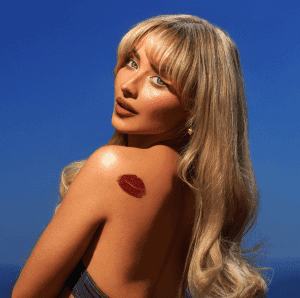
Poster / promotional material via Wikipedia, Short n' Sweet. Used under fair use for criticism and review.
There was a period, sometime around 2016 or 2017, where it became fashionable for music writers to declare the Disney-pipeline pop pipeline dead. The Miley Cyrus, Demi Lovato, Selena Gomez cohort had aged out. The post-Hannah Montana talent pool was thinning. The next generation of young American pop stars, critics agreed, would need to come from somewhere else: social media, Korea, the Nashville machine.
Sabrina Carpenter’s Short n’ Sweet, released in August 2024 and sitting at the top of the global pop conversation twelve months later, was the record that definitively falsified that prediction. Carpenter is, at this point, one of the three or four most commercially and critically successful young pop artists in the English-speaking world. She is also unambiguously a product of the Disney system, having spent her teen years on Girl Meets World before transitioning, across the late 2010s and early 2020s, into a pop-solo career.
Short n’ Sweet is the record where the training finally paid off.
What the album is
Twelve songs, thirty-six minutes, produced primarily by Jack Antonoff and Julian Bunetta. The sonic palette is clean, warm, 1970s-coded in places (the string arrangements on “Don’t Smile”) and specifically contemporary in others (the specific Antonoff-synth register on “Taste”). The writing, from Carpenter in collaboration with her usual co-writers (Amy Allen, Julia Michaels, others), is the album’s single most distinctive element.
Carpenter has a specific lyrical voice that is a genuine contribution to the contemporary pop landscape. She writes short, compressed, relatively joke-forward couplets that work by compression. The lines are quotable. The lines scan. The lines are, in a few instances, genuinely funny in a way that most pop writing has not been since, roughly, the first Taylor Swift album.
“Please Please Please” (released as a single ahead of the album) has a specific chorus that is, by any measure, one of the strongest pop hooks of the decade. “Espresso,” the breakout summer-2024 hit that preceded the full album, is a clinic in how to build a radio-ready pop song out of very specific internal rhymes. “Taste,” the album opener, has a verse-to-chorus structural trick that has been studied by pop writers across the subsequent year.
The Carpenter persona
What Carpenter is doing with her public persona, alongside the album, is worth noting. Her stage iconography, the specific retro-sex-kitten presentation, the innuendo-heavy song intros, the “Juno” choreography, has deliberately invoked a specific kind of early-2000s pop-star performance register that the subsequent “empowerment” era had mostly retired.
The choice is calculated and, for her audience, specifically effective. Carpenter is using the older persona ironically and affectionately at the same time. Her audience (predominantly young women and queer men) is aware that the sex-kitten register is a costume. Carpenter is aware that they are aware. The performance is, in other words, a specific knowing exchange, and it reads as that.
Some critics found the persona regressive. I think this is a misreading of what is happening. Carpenter is not returning to the pre-empowerment era. She is noting, correctly, that the empowerment-era pop persona had calcified into its own specific set of restrictions, and is using an older idiom to open space that the current one had closed.
The live show
Carpenter’s 2024 tour, which I caught at the O2 in November, is the clearest argument for her current stature. The show is structured as a series of comedy-bits interspersed with the songs. The comedy is, genuinely, funny. The performances are committed. The band is tight. The lighting is, specifically, gorgeous.
What Carpenter has figured out, and what very few contemporary pop artists manage, is that the arena-pop show works best when it is structurally closer to a cabaret than to a stadium spectacle. Her show runs ninety minutes, with no filler, no extended dance interludes, no multi-song costume pauses. Every element serves the pop writing. This is, at this scale of touring, surprisingly rare.
Where the album is weakest
I will register one complaint. Short n’ Sweet’s back half (roughly tracks eight through twelve) is weaker than its front half. The ballads, in particular, read as professional but not distinctive. Carpenter has not yet solved the ballad problem that most pop albums of the 2020s have struggled with: the slower tempos expose the genericness of the production choices in a way that the uptempo songs paper over.
This is a first-decade complaint. Carpenter is young. She will solve the ballad problem, or she will learn to sequence her albums so the ballads work as internal breathers rather than as emotional climaxes. Either solution is fine.
What comes next
Carpenter is, as of this writing, working on her next record. She has indicated, in interviews, that it will be shorter, sharper, and more sonically focused than Short n’ Sweet. I am interested.
The broader cultural significance of Short n’ Sweet, a year out, is that it confirmed a specific thing the previous two years of pop music had begun to suggest: that the pop-star-as-auteur model (Swift, Eilish, Lipa, Carpenter) is now the dominant commercial structure of contemporary pop, and that the old industry-factory model (songs placed with artists by committee) is increasingly relegated to the lower tiers of the charts.
This is, on balance, a positive development for the form. Artists who control their own material tend to make more interesting albums. Carpenter, having now demonstrated she can do the job, is joining the top tier.
Put Short n’ Sweet on from track one. Skip nothing. Let the first seven songs do their work. The album is a good argument for what pop still can be.
Jules writes the kind of pieces that come from wandering somewhere and overhearing something. On Frame Junkie's masthead since the beginning.
MORE BY JULES OKONKWO →
Chappell Roan: The Slow-Motion Pop Star
Chappell Roan's album came out in September 2023. Her stardom arrived in summer 2024. The eleven-month gap is the interesting thing.

Brat Summer: What Actually Happened
Charli XCX's Brat was the pop event of 2024. A year on, the question is not whether the record was good. The question is what Brat Summer actually was, who it was for, and why almost everything it inspired was bad.
Hit Me Hard and Soft: Billie Eilish Grown Up
Billie Eilish's third album is a quieter, longer, more patient record than the one she was commercially expected to make. It is also, easily, her best.