The Last Waltz Is an Obituary Written Before the Death
Scorsese filmed The Band's farewell as a eulogy. The group it buried kept arguing about the funeral for decades.
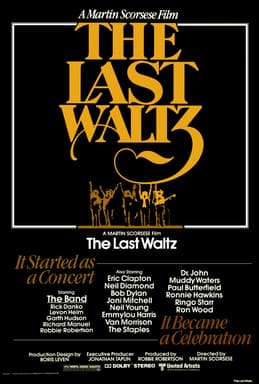
Poster via Wikipedia, The Last Waltz. Used under fair use for criticism and review.
The Last Waltz is a very rehearsed thing. I keep going back to it anyway, and I keep looking for the places where the rehearsal slips, because those are the places where five people stop performing a farewell and simply play.
Martin Scorsese’s concert film documents the farewell show The Band played at Winterland Ballroom in San Francisco on Thanksgiving night, 25 November 1976. Promoter Bill Graham fed the audience turkey. The Band’s members, Robbie Robertson, Levon Helm, Rick Danko, Richard Manuel and Garth Hudson, played with a run of guests that reads like a roll-call of the decade: Muddy Waters, Neil Young, Joni Mitchell, Van Morrison, Bob Dylan, Eric Clapton, Dr. John, Ringo Starr and more. The film came out in April 1978.
The film as a planned thing
This was not a documentary that happened to catch a show. Scorsese planned it. He worked out the camera coverage song by song, marking up lyric sheets with cues, and the film was shot on 35mm by a roster of cinematographers that reads like a hall of fame: Michael Chapman as lead, with Laszlo Kovacs, Vilmos Zsigmond and others on separate cameras. Each operator had instructions. Nobody was meant to improvise.
You can feel the planning, and it is a strange thing to feel at a concert. The camera does not look for the moment; it knows the moment is coming. It tilts to a guitar before the solo begins. It waits on a face. The pleasure of the film is how rarely this looks mechanical, and how rarely you catch the cameras guessing.
The studio sessions are the tell
The most revealing sequences are not on the Winterland stage. Scorsese built a soundstage and filmed some performances there separately, most famously a version of “The Weight” with the Staple Singers. The sequence is lit like a painting and played like a church service, and it does something the concert footage cannot: it lets you watch five musicians listen to each other.
That is the film’s real subject. Not the guests, though the guests are glorious, and not the farewell, though that is the title. It is the way a group of people who have been together for years find each other’s timing without looking. Watch Helm’s drumming against Danko’s bass in any of the performances. They do not seem to be keeping time. They seem to be sharing a pulse.
The guests, and the things left in
The guest list gives the film its range, and the performances give it its heat. Muddy Waters plays “Mannish Boy” with the unhurried authority of a man who has been introduced to a younger audience by the people he taught. Joni Mitchell sings from the side of the stage, almost out of the lights. Dylan closes the show. Neil Young’s appearance carries a piece of film lore: a visible trace of cocaine on his nose during “Helpless” was removed frame by frame in post-production, which is an odd thing to learn about a film so concerned with looking unvarnished. It is a reminder that the film is a made object, shaped to the last frame, and that its sense of spontaneity was a matter of care.
The argument over the funeral
The film’s afterlife has been contested. Robertson produced it and was its central figure, and for years afterwards other members, Helm especially, said that the film and the farewell gave too much of the story to him. Helm said so in print. A group that had once seemed like a brotherhood spent decades quarrelling over who owned the account.
It is a sad coda, and it changes how the film feels. You can see where the seams are: the interview segments are arranged around Robertson, and the others appear in smaller portions. But I would not want to over-read this. The same film also preserves the best of what the five of them did together, in a room, in a night that was not repeated.
What the film is for now
Of The Band’s five members, Manuel died in 1986, Danko in 1999 and Helm in 2012. Robertson died in August 2023. The film has become, in the way that great documents do, something larger than a concert film: a record of five people who were once in the same place at the same time and knew it was ending.
That is what I mean by an obituary written before the death. Scorsese did not know how the story would play out. He only knew that the group was saying goodbye, and he filmed it as though it already were a loss. The first time I watched it I took it for a document of an ending. Now I think it is a document of a presence, one that has had to survive its own farewell.
Put it on and wait for the song where nobody is looking at the cameras. It is still there, and it is the part of the film that does not know it is being filmed.
Jules writes the kind of pieces that come from wandering somewhere and overhearing something. On Frame Junkie's masthead since the beginning.
MORE BY JULES OKONKWO →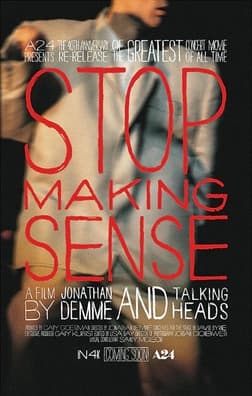
Stop Making Sense Is a Film About Building a Band From One Man and a Boombox
Everyone remembers the big suit. What lasts is the order of the songs, which is the order in which a lonely man lets other people into the room.
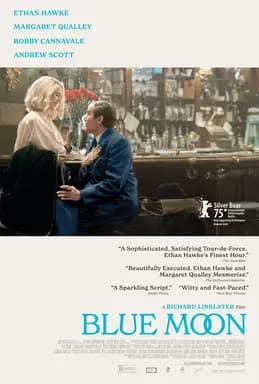
The Fourth Lyric Lorenz Hart Wrote for the Same Tune
Richard Linklater's Blue Moon keeps Lorenz Hart at Sardi's all night on the opening of Oklahoma! and ends on the song he wrote because a publisher asked him to.
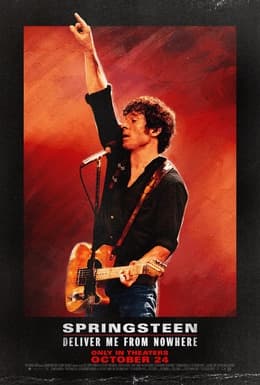
The Record Springsteen Carried Around in His Pocket
A $55 million studio film about a man refusing to let a four-track demo turn into a studio record. The film took $45 million. The cassette had the better argument.