The Record Springsteen Carried Around in His Pocket
A $55 million studio film about a man refusing to let a four-track demo turn into a studio record. The film took $45 million. The cassette had the better argument.
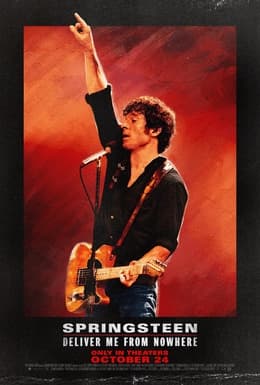
Poster via Wikipedia, Springsteen: Deliver Me from Nowhere. Used under fair use for criticism and review.
The first copy of Nebraska I ever heard was a cassette of a cassette. It lived in the glovebox of my uncle’s Corolla, the label written in biro, and the car had one speaker that worked and one that rattled. We were somewhere on the Hume. I was eleven.
I thought the hiss was part of the song.
It turns out that is close to the right answer.
A bedroom in Colts Neck
Between 17 December 1981 and 3 January 1982, in a bedroom of the house in Colts Neck, New Jersey, Bruce Springsteen recorded the songs that became Nebraska onto a TEAC 144 Portastudio. His guitar technician, Mike Batlan, had got hold of the four-track. Two Shure SM57s on stands. A Gibson J-200. Harmonica, mandolin and glockenspiel, overdubbed after the long tour for The River.
These were meant to be demos. Songs for the band to learn.
Springsteen kept the cassette in his jeans pocket, not sure what to do with it.
That is the whole film, really. A man walking around with the best thing he has made in his pocket, getting it out, looking at it, putting it back.
The film
Scott Cooper wrote and directed Springsteen: Deliver Me from Nowhere from Warren Zanes’ 2023 book. It premiered at Telluride on 29 August 2025 and opened in America on 24 October, the same day the Nebraska ‘82: Expanded Edition box set came out with the full-band recordings that had sat in the vault for forty-three years.
Jeremy Allen White plays Springsteen. Jeremy Strong plays Jon Landau. Paul Walter Hauser plays Batlan, which is the right piece of casting, because the whole picture needs somebody on screen who cares more about the tape machine than about the legend. Stephen Graham plays Douglas Springsteen, the father. Odessa Young plays Faye Romano.
White does the singing. When Springsteen is performing in the film, that is White’s voice, built over singing lessons, guitar lessons, harmonica lessons and time with a movement coach. Springsteen visited the set, and reportedly could not always tell which of the two of them was singing.
The Power Station problem
In April 1982 the E Street Band rehearsed the songs and then spent two weeks at the Power Station in New York trying to turn the demos into band arrangements.
It did not work. Everything got bigger and nothing got better.
The film follows that: the full-band sessions, the songs that would end up on Born in the U.S.A., Springsteen choosing the bedroom tape anyway, Landau holding the only copy of the finished demo on a single cassette.
Then there is the part I wanted more of. Nobody could master the thing. For two months engineers tried noise reduction and whatever else they had, and the cassette kept refusing to become a record. Dennis King at Atlantic Studios was the one who finally cracked it.
Nebraska came out on 30 September 1982. No interviews. No tour. It went to number three in America and number three in Britain.
The film is the band version
Here is my problem with the movie, and it is not a complaint about anybody in it.
A studio film costs what it costs. This one had a reported budget of $55 million. 20th Century Studios got it after a bidding war with A24. Masanobu Takayanagi shot it, Pamela Martin cut it, Jeremiah Fraites of the Lumineers scored it. It is handsome, careful, professional work.
It is the Power Station sessions.
You cannot make a four-track movie for $55 million. The money is audible. Every scene is lit and graded and mixed to the standard of a picture that has to open in multiplexes, and the story it is telling is about a man who looked at that standard and put the tape back in his pocket.
It opened to $9.1 million. It finished on $23 million in America and $45 million worldwide, with a B plus CinemaScore. The people who went liked it well enough. Not enough of them went.
The best moments are the small ones, and most of them are White’s. In the bedroom scenes the voice sits under the level of the room, like someone trying not to wake the house. Strong plays Landau as a man protecting somebody else’s decision, which is a harder thing to act than it sounds, because the decision is commercially mad and he knows it.
Where it ends
The film does not end on the record. It keeps going, into the move to Los Angeles, the breakdown, Landau pushing for therapy, and finally a visit home where Douglas asks his son to sit on his lap, for the first time.
That is Cooper taking Zanes’ point seriously. Nebraska was never the destination. It was what the bottom sounded like, recorded by a man who happened to own a Portastudio when he got there.
My uncle sold the Corolla years ago. I assume the tape went with it, still in the glovebox.
I have the box set now. It sounds wonderful. The hiss is cleaner.
It is not the same record.
Jules writes the kind of pieces that come from wandering somewhere and overhearing something. On Frame Junkie's masthead since the beginning.
MORE BY JULES OKONKWO →
The Demo Singer Who Ended Up With the Number One Record
HUNTR/X are three drawings. Golden went to number one on the Hot 100 and won an Academy Award anyway, because the woman singing it had been doing this job in other people's names for years.
The X-Ray on the Cover of Virgin Is Not a Metaphor
Thirty-four minutes and fifty-one seconds, no cool-down, no exit ramp. Lorde's fourth record is the first one that sounds like a body instead of a report from one.
Pavements and the Joke That Turns Out to Be Sincere
Alex Ross Perry made four films about Pavement at once and braided them together. The braid should not hold. It holds, and somewhere in the middle it stops being funny and starts being true.