The Fourth Lyric Lorenz Hart Wrote for the Same Tune
Richard Linklater's Blue Moon keeps Lorenz Hart at Sardi's all night on the opening of Oklahoma! and ends on the song he wrote because a publisher asked him to.
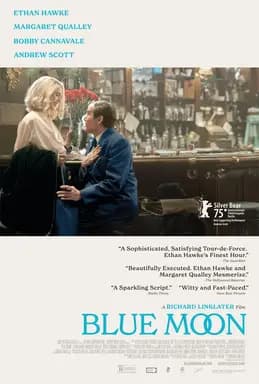
Poster via Wikipedia, Blue Moon. Used under fair use for criticism and review.
The wedding band at my cousin’s reception did “Blue Moon” as the last slow one before the speeches. The bass player took the intro. Bomp-ba-ba-bomp, ba-bomp-ba-bomp-bomp. Half the room sang it with him, which is to say half the room sang the part with no words in it.
Then the singer came in on the actual song and the dance floor thinned out.
I have been thinking about that ever since I watched Richard Linklater’s Blue Moon, because the film is about the man who wrote the words, and the words are the part nobody at a wedding waits for.
One tune, four jobs
The melody came first, and it came to Metro-Goldwyn-Mayer. Rodgers and Hart were under contract there from 1933, and the tune started life as “Prayer”, written for Jean Harlow in Hollywood Party: a girl saying her prayers and asking to be made a movie star. The number was dropped and Harlow was not in the finished film.
Hart wrote a second lyric so the tune could be the title song of Manhattan Melodrama. That one was “It’s Just That Kind of Play”, and it was cut too. The studio then wanted a nightclub number for the same picture, Rodgers still liked the melody, and Hart wrote a third: “The Bad in Every Man”, sung by Shirley Ross.
Then Jack Robbins, who ran MGM’s publishing company, decided the tune could sell on its own if it had more romance in it and a better title. The usual account has Hart reluctant to write yet another set of words for the same melody. He was talked into it.
The fourth lyric was “Blue Moon”. Ted Fio Rito recorded it in October 1934, with Muzzy Marcellino singing.
So the most famous thing Lorenz Hart ever wrote was a rewrite of a rewrite of a rewrite, done on instruction.
Sardi’s, 31 March 1943
Linklater’s film, written by Robert Kaplow, takes one night. Oklahoma! is opening at the St. James, the first show Richard Rodgers has written with Oscar Hammerstein II, and Hart has slipped away from the opening to wait at Sardi’s for the party.
Ethan Hawke plays Hart. He shaved his head so the combover could sit on top of it, and the production used what he has called old stagecraft to take the better part of a foot off his height. Bobby Cannavale is Eddie the barman, who has been told not to serve him. Jonah Lees is Morty, a sergeant on leave playing the piano. Margaret Qualley is Elizabeth Weiland, a twenty-year-old Yale art student Hart has convinced himself will love him back. Andrew Scott is Rodgers, and won the Silver Bear for supporting performance at Berlin for it.
It was shot in fifteen days on a soundstage in Dublin. Shane F. Kelly lit it; Sandra Adair cut it; Graham Reynolds scored it. It is mostly one room and a lot of talking, and the talking is the point.
The man who stayed for the party
Here is the thing Linklater and Kaplow change, and it is the whole film.
On the real night, Hart did turn up at Sardi’s. He told Rodgers it was one of the greatest shows he had ever seen and that it would still be playing in twenty years. Then he left with his mother, saying she was tired.
The film keeps him there. All night. Talking over the piano, pitching Rodgers a musical about Marco Polo, performing a card trick for Elizabeth, telling E.B. White a story about a mouse and naming the mouse Stuart. Hawke plays him as a man who cannot stop producing lines, good ones, one after another, for an audience that is not quite listening.
That is the Hart from the MGM years. The one who kept writing new words for a tune that belonged to somebody else’s plans.
Rodgers had gone off and written a show where, as a rule, the words came first. With Hart it had usually been the tune, then the lyric; with Hammerstein the order flipped, and Oklahoma! is the sound of that arrangement. Hart spends the evening at the bar hearing the reviews come in for a way of working that no longer needs him.
Last call
Near the end, when Rodgers has given Elizabeth his private number and taken her off to his own party, Morty sits down and plays “Blue Moon”. Hart stays for one more drink with Eddie while the staff close up.
It is a gentle choice. It is also a cruel one, if you know the song’s history, because the film ends Hart’s night on the lyric he least wanted to write, and the one that outlived everything else he did.
It kept outliving him. Elvis cut it at Sun in 1954. In 1961 the Marcels took it to number one in America and in Britain, and the Marcels version starts with the bass singer doing a full run of nonsense syllables before anyone gets to “Blue moon, you saw me standing alone”. That is the version the wedding band was playing. That is the intro the room sang. The biggest hit Lorenz Hart ever had is best remembered for the bit with no words in it.
Hart died on 22 November 1943, seven months after the night the film covers, of pneumonia, days after turning up drunk to the opening of the Connecticut Yankee revival he had written new songs for.
The film grossed around $3 million. Hawke and Kaplow were both nominated at the Oscars. It went to Netflix in February.
What the film is
I think Blue Moon is the fourth lyric.
The tune is the night itself, which really happened: the opening, the party, the partnership that was over. Kaplow has written a new set of words over it, with a romance built up out of a bundle of letters and a Hart who stays when the real one went home. It is not the truest version. It is the one that sells the melody.
Hart would have recognised the job.
At the reception the singer finished, and the bass player went back to the bomp-ba-ba-bomp for the outro, and everyone who had sat down got up again.
Nobody stood up for the words.
Jules writes the kind of pieces that come from wandering somewhere and overhearing something. On Frame Junkie's masthead since the beginning.
MORE BY JULES OKONKWO →
The Record Springsteen Carried Around in His Pocket
A $55 million studio film about a man refusing to let a four-track demo turn into a studio record. The film took $45 million. The cassette had the better argument.
The Demo Singer Who Ended Up With the Number One Record
HUNTR/X are three drawings. Golden went to number one on the Hot 100 and won an Academy Award anyway, because the woman singing it had been doing this job in other people's names for years.
The X-Ray on the Cover of Virgin Is Not a Metaphor
Thirty-four minutes and fifty-one seconds, no cool-down, no exit ramp. Lorde's fourth record is the first one that sounds like a body instead of a report from one.