Óliver Laxe Builds a Search and Then Walks Away From It
Sirāt opens as a father's search for a missing daughter and quietly stops being one. What replaces the search is the reason the film won six Goyas for craft.
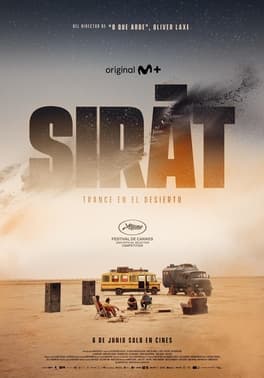
Poster via Wikipedia, Sirāt. Used under fair use for criticism and review.
The most consequential decision in Sirāt is a subtraction. Óliver Laxe opens his film on a premise so legible it could be summarised in a listings entry, a father and his young son looking for a daughter who vanished at a rave, and then, without ceremony, stops pursuing it. There is no scene in which the search is formally abandoned. There is no line of dialogue conceding it. The film simply keeps moving south, further into the Moroccan desert, and at some point you notice that the thing you came in following is no longer the thing you are watching. That noticing is the film’s central event, and it is engineered with a precision that the six Goyas awarded to its craft departments only partly acknowledge.
The picture premiered in competition at Cannes on 15 May 2025 and took the Jury Prize. It opened in Spain on 6 June and in France that September, runs 114 minutes, and was made for a reported €6.5 million, which is a startling figure for what is on screen. (El Deseo, the Almodóvar brothers’ company, sits among the producers, and Esther García’s long experience of squeezing scale out of modest Spanish budgets is visible in every convoy shot.) It went on to nominations at the 98th Academy Awards for International Feature and for Sound.
What a title tells you
Sirāt names the bridge of Islamic eschatology, the crossing over hell that the dead must attempt, described in the tradition as finer than a hair and sharper than a blade. The righteous cross it. The rest do not. It is a useful title precisely because it does not describe the plot. It describes a condition: a passage where the only options are forward and down, and where turning around is not among the things available to you.
Laxe and his co-writer Santiago Fillol construct the film so that the audience arrives at that condition at roughly the same time as the characters, which requires the first act to look like a different film than the one it becomes. The father, played by Sergi López with a stubbornness that reads at first as competence and later as something closer to refusal, behaves throughout as a man executing a plan. He asks after his daughter. He shows a photograph. He attaches himself and the boy to a group of travellers heading to another gathering deeper in the country, on the reasoning that she might be there.
The reasoning is sound. The reasoning also stops being the point.
Mauro Herce and the width of the frame
Mauro Herce’s cinematography took the Goya, and the award is well placed but slightly mis-aimed. What Herce does is not beautiful desert photography, of which cinema has an oversupply. It is the systematic refusal of orientation. The convoy of battered trucks and sound systems crosses terrain that the camera declines to establish. We rarely get a geography shot, the wide that says here is the valley and there is the road. We get the vehicles, the horizon behind them, and no reliable sense of how far anything is.
The desert in this film is not a landscape. It is an absence of information, and the camera guards that absence carefully. Compare the way Herce shoots the rave sequences, where space suddenly becomes legible because it is defined by speaker stacks and bodies and the throw of a light. Inside the party, you know where you are. Outside it, nobody does. That inversion is the whole grammar.
Cristóbal Fernández’s editing, also a Goya winner, works in the same direction. He cuts late into scenes and early out of them, so that events are frequently already underway when we arrive and unresolved when we leave. It is a rhythm that makes the film feel less like a narrative and more like a series of things that happened to be witnessed.
The sound, which is the film’s real argument
Kangding Ray scored it and the sound department won its own Goya, and the Academy nomination for Sound is the recognition that matters most here. The film’s proposition is made almost entirely in the mix.
Electronic music in cinema is usually deployed as texture or as period marker. Here it functions as terrain. The convoy carries its sound system with it, which means the score is diegetic for long stretches and stops being diegetic without announcing the change, and the low end is mixed at a level that produces physical discomfort in a properly equipped room. The bass is not accompanying the journey. It is what the journey is made of. When Laxe cuts the sound, and he does, sparingly, the silence is not peaceful; it is the loss of the only thing that was holding the film’s world together.
There is a broader political weather in the film, transmitted mostly through radio fragments and the behaviour of people at borders, a mobilisation somewhere, a world tightening. Laxe keeps it entirely at the edge of the frame. A lesser film would have cut to a news report. This one lets the information arrive the way it actually arrives when you are far from anywhere, which is late, partial, and impossible to act on.
The thesis, tested
If the argument is that Sirāt replaces its search with a crossing, the test is whether the replacement costs the film anything. It does. The middle stretch asks for a patience that some viewers will not extend, and the ravers who make up the convoy are drawn thinly by design, which means that when the film starts asking us to care about them individually, it is drawing on credit it did not build. Laxe is better on faces than on characters, and there is a version of this film with twenty more minutes of ordinary human specificity that would land harder.
But the trade is deliberate and it buys something rare. By declining to resolve the search, Laxe removes the only structure that would have let the audience keep score. There is no moment where the father succeeds or fails, and so no moment where we are permitted to file the experience away as tragedy or as relief. We are left instead with the condition the title named: a passage taken, no way back, the ground narrowing.
Sergi López carries the last act on almost nothing. Watch his face during the long stretches where he is simply travelling, no objective playable, the plan long since obsolete. He is not grieving and he is not hoping. He is continuing, because continuing is what the bridge permits, and Laxe has built a film in which that turns out to be a complete account of a life.
Lena writes long-form essays on the films that will still be talked about in a decade. Previously at a defunct monthly whose name we do not speak.
MORE BY LENA ASHWORTH →
Dredd Was Sold as a Gimmick and Built as a Siege
Dredd lost money in 2012 and has been winning arguments ever since. The film that failed and the film that lasted are the same film, and the reason is one tower block.
The Thing Was Not Rejected in 1982. It Was Mis-Sold.
John Carpenter's The Thing earned back its budget and was savaged anyway. The record says the film was not the problem. The poster, the tagline and the weekend it opened were.
In the Mood for Love and the Architecture of Not Touching
Wong Kar-wai's 2000 film is remembered as a romance of restraint. It is better understood as a film about frames: doorways, corridors and apertures that do the work the lovers will not.