In the Mood for Love and the Architecture of Not Touching
Wong Kar-wai's 2000 film is remembered as a romance of restraint. It is better understood as a film about frames: doorways, corridors and apertures that do the work the lovers will not.
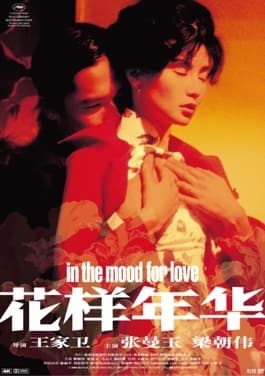
Poster via Wikipedia, In the Mood for Love. Used under fair use for criticism and review.
The most discussed thing in In the Mood for Love is something that never happens. Su Li-zhen (Maggie Cheung) and Chow Mo-wan (Tony Leung) discover that their spouses are having an affair with each other, move through a Hong Kong of shared stairwells and rented rooms in 1962, and spend ninety minutes arriving at a closeness they decline to complete. Wong Kar-wai’s film is filed under restraint, and the filing is correct as far as it goes. It does not go far enough. Restraint is a quality of people. The film’s real subject is a quality of space.
Watch where the camera is. Very little of the picture is shot square on. We look at the lovers through doorframes, through the slats of a window, past the edge of a wall, along the length of a corridor so narrow that two people must turn their shoulders to pass. The cinematography is credited to Christopher Doyle and Mark Lee Ping-bin (Doyle had been Wong’s house eye for a decade; Lee’s name on the picture is a reminder that the look was a collaboration, not a signature). The result is a film in which the apartment block is a character with opinions. Every encounter is witnessed by an architecture that squeezes, interrupts and overhears.
The spouses we never see
Wong’s best structural decision is also his cruellest: the unfaithful husband and wife are never shown full face. Mr Chan and Mrs Chow are a back of the head, a hand, a voice off. The effect is to make the betrayal a rumour the film cannot confirm, and to transfer all its visible energy to the two people who are behaving well.
It also does something subtler to the audience. We are placed where Su and Chow are placed: obliged to reconstruct a marriage from partial evidence, rehearsing how the affair might have started by rehearsing it themselves. The two stage-manage scenes in which one plays the other’s spouse, and the film lets these scenes run long enough that the pretence curdles into the real thing. Nothing in the picture is more erotic than a woman telling a man how she would have been approached, and nothing is staged with less contact.
What the costume is doing
William Chang Suk-ping, who is credited with production design and editing as well as costume (a combination that explains how coherent the film’s surface is), dressed Cheung in a long run of qipaos, reported at more than twenty over the course of the picture. The standard reading is that they are a calendar: each dress marks the passing of a day or a week without a word of dialogue. That is true, and it undersells them. The high, stiff collar is the film’s second corridor. It holds the head up and the body in, and it gives Cheung the carriage of a woman who is always about to be observed by a neighbour.
Against this, the colour is generous. Reds, greens and an almost edible yellow flood the interiors, so that the narrowness of the frame and the lushness of what fills it pull against each other. A film about suppression has been shot as if the suppressed material were leaking into the wallpaper.
Music as the only touch
Shigeru Umebayashi’s “Yumeji’s Theme”, lifted from Seijun Suzuki’s 1991 film Yumeji, returns so often that it becomes less a motif than a weather system. Wong pairs it with slow motion, and the pairing is the nearest the picture allows to physical contact: two people carrying noodles down a lane at a speed that turns an errand into a ritual. The Spanish-language recordings by Nat King Cole that drift from a radio fill the same function from the other side, a foreign love song in a city that has no idiom for what these two are doing.
This is why the needle-drops work as structure rather than decoration. The characters do not touch, so the music touches for them, and it does so in the film’s shared spaces, where the neighbours can hear it too.
The production behind the stillness
The film took a long time and, by Wong’s habit, was found rather than fully scripted in advance. It was reported to have grown out of a different, more broken-up project, with the shoot extending well past its first plan and some of it taking place in Bangkok to stand in for a Hong Kong that was by then too changed to film. That history is worth keeping in mind, because it explains something about the picture’s rhythm: scenes that feel inevitable were often discovered late. The repeated corridors, the repeated stairs and the repeated exchanges are not the product of a locked design so much as a director circling a situation until its geometry showed itself.
Where the thesis lands
The film ends on a cut from the lovers’ last unconsummated meeting to Angkor Wat, where Chow whispers a secret into a hole in an ancient wall. It is routinely read as a gesture of closure: the secret is buried, the story sealed. Read against the rest of the picture, it is the same device as everything else in it. Chow has again found an aperture, and again he speaks into the space rather than to a person.
In the Mood for Love is not a film about love held back by manners. It is a film about how little room a city gives to two people who want one another, and how a camera, a costume and a piece of music can make that lack of room as palpable as a hand. The restraint belongs to the characters. The architecture is what makes it unbearable.
Lena writes long-form essays on the films that will still be talked about in a decade. Previously at a defunct monthly whose name we do not speak.
MORE BY LENA ASHWORTH →
Dredd Was Sold as a Gimmick and Built as a Siege
Dredd lost money in 2012 and has been winning arguments ever since. The film that failed and the film that lasted are the same film, and the reason is one tower block.
The Thing Was Not Rejected in 1982. It Was Mis-Sold.
John Carpenter's The Thing earned back its budget and was savaged anyway. The record says the film was not the problem. The poster, the tagline and the weekend it opened were.
Drive My Car and the Business of Letting Someone Else Take the Wheel
Ryusuke Hamaguchi's three-hour adaptation is usually described as a film about grief. It is closer to a film about who is permitted to drive, and what a man gives up when he finally hands over the keys.