Frankenstein Cost $120 Million and Played Like a Secret
Del Toro's Frankenstein is built in two halves that only work if you sit through both in one go. Netflix released it as something you can pause.
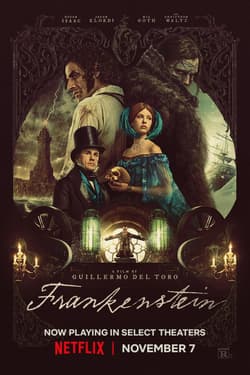
Poster via Wikipedia, Frankenstein. Used under fair use for criticism and review.
Let me stake my position before the arguing starts. Frankenstein is the best thing Guillermo del Toro has made in years, and the way it reached us was a category error so large that it now looks like part of the text. A film about a man who builds something magnificent and then cannot bear to be in the room with it was financed for a reported $120 million, given a limited American theatrical run from 17 October 2025, and posted a theatrical gross of $655,147 before landing worldwide on Netflix on 7 November. I say this with no pleasure. Those two numbers sit next to each other like a punchline nobody wrote on purpose.
The film that took twenty years to not get made
The prehistory matters, because it explains the shape of what we got. Del Toro had been circling a faithful Shelley adaptation for most of his career. It sat at Universal for years, with Doug Jones lined up for the Creature, before the studio parked it during the Dark Universe experiment, that brief and expensive period when Universal decided its monsters needed a shared continuity more than they needed films. Netflix picked the project up in 2023. Jacob Elordi took the Creature. Shooting ran from March to September 2024 across Toronto, Edinburgh and Lincolnshire, and the design language leans hard on Bernie Wrightson’s illustrated edition of the novel, which del Toro has cited for decades and which Wrightson, who died in 2017, never saw put on screen.
So this is the version that exists because a streamer said yes when a studio said not yet. That is the deal del Toro took, and he was clear-eyed about taking it. It is still worth naming what the deal cost, because the cost is structural rather than cosmetic.
Two halves, one sitting
The film runs 150 minutes and is built in a shape borrowed straight from the novel: a frame on an icebound ship in 1857, then Victor’s account, then the Creature’s account of the same events. Oscar Isaac gets the first half. Elordi gets the second. The whole design depends on the audience believing Victor for an hour and then having that hour dismantled by the thing Victor made.
That is a theatrical structure. Not because theatres are holy, but because the mechanism only fires if you have sat still through part one without the option of stopping. The second half is an act of revision, and revision needs the first version intact in your head, uninterrupted, with no gap in which you went to bed and came back on Tuesday. Del Toro has made a film whose central effect is a rug-pull, and Netflix put it on a platform whose defining feature is that you can put the rug down whenever you like.
What Laustsen and Desplat actually do
Dan Laustsen shoots this like a man who has decided that gothic means saturated rather than murky, which is the right call and the harder one. Victor’s tower is lit in cold greens and a sick electrical blue; the farm sequences in the Creature’s half go warm, low and close, and the shift is the argument. Victor’s world is a laboratory and it photographs like one. The Creature’s world is a kitchen, a mill, a blind man’s hearth, and it photographs like somewhere a person could live. Nobody says this out loud in the script. Laustsen says it in the grade.
Evan Schiff’s cutting is unfashionably patient. Scenes are allowed to end on the wrong beat and sit there. Alexandre Desplat scores the Creature’s education with a restraint that borders on refusal, holding back the full orchestra until the point where the film has earned it, which is late. The Academy handed the film awards for costume design, makeup and hairstyling and production design out of nine nominations at the 98th ceremony, including Best Picture, and that distribution of prizes tells you exactly how the industry read it: a triumph of surfaces. It is not. The surfaces are the least interesting thing about it.
Where it slips
The first half is the weaker one and I do not think that is entirely deliberate. Christoph Waltz’s Harlander, the arms dealer bankrolling the tower, is a del Toro invention rather than a Shelley one, and he functions mostly as a plot engine with an accent. Mia Goth’s Elizabeth is written with more curiosity than the film has time to spend on her; she is the only character who treats the Creature as a person before the plot requires it, and the film keeps parking her offscreen. Victor’s father is cruelty as backstory delivery. There are stretches in the first hour where the film is filling in a psychology it will spend the second hour proving unreliable, and knowing that in advance does not make the filling-in move faster.
Then Elordi arrives properly and the picture becomes something else. He plays the Creature as neither pitiable nor terrifying but curious, a body learning what it is for, and the performance is built almost entirely out of timing. Watch how long he takes to react to being spoken to kindly. That delay is the whole character.
The release is the reading
Here is the part that will annoy people. The $655,147 is not a flop. It cannot be a flop, because Netflix was never selling tickets. The theatrical run existed to satisfy awards eligibility and to give critics a screen, and it did both. But a company that spends $120 million on a two-part gothic and then treats the exhibition of it as paperwork has made a decision about what the film is for, and the decision is that it is for the library.
Del Toro made a film about the difference between creating something and taking responsibility for it. He then released it through a machine that funds creation lavishly and takes responsibility for exhibition not at all. Victor lights the tower and walks away. Netflix wrote the cheque, collected the statuettes, and moved the thing into a menu.
The film survives it. That is the good news, and it is real: Frankenstein is going to be watched for a long time, and the format it was released in guarantees the watching more reliably than a three-week run in forty cinemas ever would. But something was traded, and it was the one hour of uninterrupted attention that the film’s own architecture was built to demand. Del Toro got his Creature. He did not get the room.
Marcus believes good criticism is an argument. He is almost always angry about something, usually for good reason. Horror is his first language.
MORE BY MARCUS VELL →
The Electric State and What $320 Million Cannot Buy
Netflix reportedly spent around $320 million on The Electric State. The film that came out the other end is the clearest argument yet against frictionless money.

Maria and Pablo Larraín's Closing Argument
Pablo Larraín's third and probably final entry in his trilogy of distressed-woman biopics is the most formally certain of the three, and the one least willing to flatter its subject.

Hit Man: Richard Linklater's Star Vehicle for a Non-Star
A year on from Hit Man's Netflix release, the film is a quieter argument than it first appeared. Richard Linklater made a star-launcher for someone he knew would not, in the end, need launching.