The Running Man Spent Like a Star Vehicle Without a Star
Edgar Wright's Stephen King adaptation took $69 million worldwide on a $110 million budget. The film was fine. The price tag assumed a star Paramount had never actually tested.
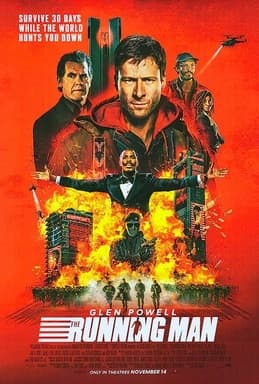
Poster via Wikipedia, The Running Man. Used under fair use for criticism and review.
Let me get one thing out of the way. The Running Man is not a bad film. It earned a B plus CinemaScore, the same grade audiences gave the Schwarzenegger version in 1987, and 61 per cent on Rotten Tomatoes, which is a shrug rather than a verdict. Nobody walked out of Edgar Wright’s picture furious.
Nobody hated The Running Man. Almost nobody went to find out whether they would.
Paramount released it in the United States on 14 November 2025, 133 minutes long, on a reported budget of $110 million. It opened to $16.5 million, under projections of around $20 million, and came second to Now You See Me: Now You Don’t, which is not a sentence anybody at Paramount planned to read. The second weekend was about $5 million, a drop of roughly 70 per cent. It finished on $38 million domestic and $32 million international for $69 million worldwide, and went to Paramount+ on 13 January 2026.
Those numbers do not describe a film audiences rejected. They describe a film audiences never priced in. That is a different problem, and it has a different culprit.
A 2025 novel, released in 2025
The source is Stephen King’s novel, published in 1982 under the Richard Bachman name and set in an economically ruined 2025, where a totalitarian government keeps the public distracted with a televised game show in which contestants are hunted for money. Wright and co-writer Michael Bacall stayed much closer to the book than Paul Michael Glaser’s 1987 film, which kept the title and the game show and discarded most of the rest. King called the new one a “bipartisan thrill ride.”
Think about what that hands a marketing department. A book set in 2025, arriving in cinemas in 2025, with the author publicly on side. That is a campaign that half-writes itself, and it barely registered. What got sold instead was Glen Powell, running.
The Glen Powell question
I say this with no pleasure, because I like Glen Powell and so does everybody else. But the film was priced on an assumption nobody had checked.
Look at the hits. Top Gun: Maverick, in which Powell is part of the supporting cast of a Tom Cruise film. Anyone But You, a romantic comedy that made a reported $220 million on word of mouth and a budget that was a fraction of this one. Twisters, where the brand was the weather. Hit Man, which went to Netflix. Every one of those is good evidence that audiences enjoy watching Powell. None of them is evidence that Powell alone can open a $110 million action picture on a November weekend.
The Running Man needed that to be true, because Ben Richards is not a superhero and the film does not pretend he is. He is a broke man who signs up to be hunted on television because his family needs the money. That is an everyman part, and an everyman part is a fine thing to build a film around. The problem is the number attached to it. A $110 million film about a man with nothing is a contradiction that only a star can paper over, and Paramount spent the money before it checked whether it had one.
Wright’s price range
The awkward pattern here is Wright’s own. Baby Driver cost a reported $34 million and took $226.9 million worldwide. Last Night in Soho cost a reported $43 million and took a little over $20 million. Scott Pilgrim vs. the World, the last time a studio gave Wright a genuinely big budget, took under $50 million worldwide against a reported cost of at least $60 million.
Wright’s films make money when they are cheap and specific. The cheap and specific version of The Running Man is a better business idea than the one Paramount paid for, and I suspect it is a better film too.
What the money bought
To be fair to the money, it is on screen. Chung Chung-hoon, who shot Oldboy and The Handmaiden for Park Chan-wook and Last Night in Soho for Wright, gives the picture genuine scale. Paul Machliss, Oscar-nominated for cutting Baby Driver, keeps the chases legible, which in a studio action film of this size is not a given. Steven Price, who won an Oscar for Gravity, scored it. Principal photography ran from November 2024 to March 2025 across London, Glasgow and Bulgaria, with Glasgow’s SEC Armadillo and OVO Hydro among the locations.
The cast is stacked. Josh Brolin plays Dan Killian, the producer. Colman Domingo plays Bobby T, the host, and is having more fun than anybody. Lee Pace plays McCone, the lead hunter. Michael Cera, William H. Macy and Emilia Jones turn up along the way, and Schwarzenegger has an uncredited cameo, which reads as either a blessing or a hostage photograph depending on how you feel about 1987.
None of that is the problem. It is where the $110 million went, which is the problem restated.
It is worth noting the corporate weather. Paramount’s merger with Skydance closed in August 2025, three months before release, so The Running Man went out as an inherited project, shot and budgeted under the old regime. I would not pin the result on the new owners. The spend was locked long before they arrived. But nobody in that transition appears to have asked whether a November slot against a franchise sequel was the right home for an expensive film with an untested lead.
The lesson available
The lesson Hollywood will take is that Glen Powell cannot open an action film. That is not proven either. What is proven is narrower and more useful: an everyman premise, a director whose record is strongest under $40 million, and a leading man nobody had tested alone add up to a mid-budget film, and it should have been made as one.
Give Wright $35 million and a King novel. Then leave the picture alone.
Marcus believes good criticism is an argument. He is almost always angry about something, usually for good reason. Horror is his first language.
MORE BY MARCUS VELL →
Madame Web and the Universe That Never Had a Spider-Man
Madame Web is a genuinely bad film. It is more interesting as the public death certificate of Sony's plan to build a Spider-Man universe without Spider-Man in it.
The Alto Knights: De Niro Twice, and Nobody Once
Barry Levinson's mob drama had a Goodfellas screenwriter, a great cinematographer, and Robert De Niro playing both leads. It grossed 9.6 million dollars. Here is why.

Borderlands and the Three Years Lionsgate Sat On It
Eli Roth's Borderlands cost a reported $110 million and grossed about $33 million worldwide. The film is bad. The thing that made it a disaster happened in the edit room, three years before release.