Madame Web and the Universe That Never Had a Spider-Man
Madame Web is a genuinely bad film. It is more interesting as the public death certificate of Sony's plan to build a Spider-Man universe without Spider-Man in it.
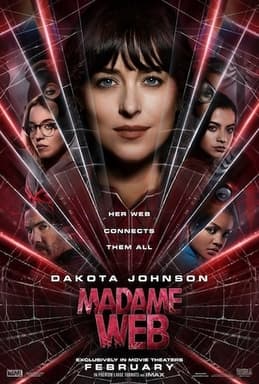
Poster via Wikipedia, Madame Web. Used under fair use for criticism and review.
Let me get one thing out of the way. Madame Web is a bad film, and saying so is neither brave nor interesting, because everyone already knows. It scored 10 per cent on Rotten Tomatoes. It made $100.5 million worldwide against a budget reported at $80 million net and possibly north of $100 million all in, which for a comic-book movie is a polite way of saying it lost a fortune. Dakota Johnson went on her own press tour and dismantled it in real time, with a cheerful contempt that became more entertaining than anything in the film. The badness is settled. What I want to look at is what the badness was a symptom of, because Madame Web is the clearest case study we have of a strategy collapsing in public.
The strategy was Sony’s, and it was insane on its face. Sony owns the film rights to Spider-Man and several hundred characters connected to him, but Spider-Man himself has, by a separate arrangement, been busy over in the Marvel Cinematic Universe. So Sony set about building a cinematic universe out of the characters around the hole where Spider-Man should be. Villains, mostly. Supporting players. People defined entirely by their relationship to a character the films were contractually unable to show you.
The films nobody asked for
It started with Venom in 2018, which worked, sort of, because Tom Hardy committed to a bit about a man and his symbiote that nobody had storyboarded. Then Venom: Let There Be Carnage. Then Morbius in 2022, a film whose only cultural footprint was an ironic meme campaign so persistent that Sony briefly re-released it to capitalise on the joke and discovered the joke did not buy tickets. Then Madame Web. Then two more Venom-adjacent releases to close out 2024.
Look at that list as a portfolio rather than a series of individual misfires and the problem snaps into focus. None of these films had a reason to exist except the rights. Each one was an asset being sweated. Madame Web is the purest example because Cassandra Webb is, in the comics, an elderly blind clairvoyant, which is not a premise anyone walks into a multiplex craving. The film reworks her into a paramedic, played by Johnson, who starts having premonitions and ends up protecting three teenage girls from a man who will, in some unmade future film, become important. That is the whole engine: protect these characters because of who they might be in a sequel that, it turned out, was never going to get made.
The tell in the dialogue
S.J. Clarkson directed it, the first woman to direct a film in this universe, brought over from prestige television, and you can feel her trying to make the human scenes work while the machinery groans around her. The supporting cast is full of people who went on to bigger things the same year: Sydney Sweeney, Isabela Merced, Celeste O’Connor. The villain, Ezekiel Sims, is played by Tahar Rahim, a genuinely fine actor, and the most quietly damning fact about the production is that his dialogue is almost entirely re-recorded in post, dubbed over so heavily that the menace never lands in sync with the mouth. When a studio has to ADR its antagonist into incoherence, the film was in trouble long before anyone bought a ticket.
And then the marketing, which I treat as a separate target because it was its own disaster. The trailer included the line “He was in the Amazon with my mom when she was researching spiders right before she died,” a sentence so strangely constructed it became a meme, and which was not even in the finished film. A studio cannot sell a story it cannot describe, and the campaign’s central problem was that it could not describe the story, because there was not really a story, there was a rights position wearing the costume of one. The posters promised four women in spider suits the film barely delivers; the suits turn up, briefly, in a premonition, which is its own kind of bait and switch.
The cold layer
Here is the part I will defend, because a take with no cold layer is worthless. There is something almost honest about how naked the cynicism got. Most bad blockbusters at least pretend to believe in themselves. The Sony Spider-Man Universe stopped pretending somewhere around Morbius, and Madame Web is what total creative indifference looks like when it is still expensive. Johnson understood this better than anyone and said so, and her refusal to play the game on the press tour was the most alive thing attached to the project. She knew she was in a contractual obligation, not a film, and she declined to lie about it.
By the end of 2024, after Kraven the Last Hunter arrived in December and sank as well, the universe was effectively over. Sony had spent six years and a great deal of money proving a thing that should not have needed proving: that you cannot build a franchise around the absence of your main character. The audience can tell when a film exists because someone owns a name. Madame Web did not fail because it was badly made, though it was. It failed because it was the visible edge of a plan that never had a centre, and the centre it was missing was the one character everyone had actually come to see.
Marcus believes good criticism is an argument. He is almost always angry about something, usually for good reason. Horror is his first language.
MORE BY MARCUS VELL →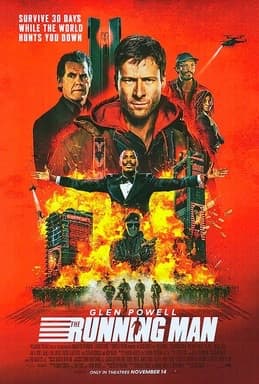
The Running Man Spent Like a Star Vehicle Without a Star
Edgar Wright's Stephen King adaptation took $69 million worldwide on a $110 million budget. The film was fine. The price tag assumed a star Paramount had never actually tested.
The Thing Was Not Rejected in 1982. It Was Mis-Sold.
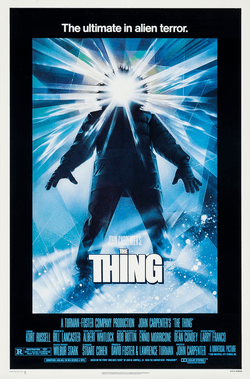
John Carpenter's The Thing earned back its budget and was savaged anyway. The record says the film was not the problem. The poster, the tagline and the weekend it opened were.
Superman Had to Launch a Universe and Be a Film at Once
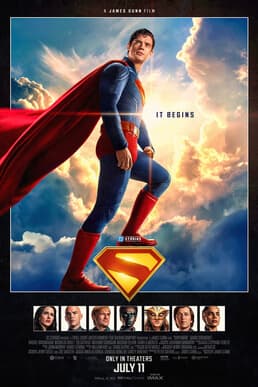
James Gunn's Superman was carrying a whole rebuilt DC on its back and still had to be a movie for two hours. It managed both, and the strain shows in exactly one place.