Purple Rain Needed One More Song
The film is a bumpy vehicle, and everyone involved knew the engine was elsewhere. The best evidence is what happened when the director asked for one more song and got one by the next day.
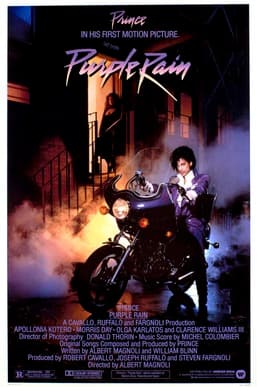
Poster via Wikipedia, Purple Rain (film). Used under fair use for criticism and review.
Somewhere in the middle of shooting, the director asked for one more song.
Albert Magnoli had a film that was mostly built. He had a plot (a young Minneapolis bandleader, a rival, a girlfriend, a father with a gun), a cast of musicians who had been sent to acting classes at Prince’s insistence, and a sense that the thing lacked a centre. So he asked Prince to write something that spoke to the film’s themes. By the following day, according to the production history, Prince had the song fully produced. It was “When Doves Cry.”
I keep coming back to that story because it is the most honest account of what Purple Rain is. A film that needs one more song, and gets the best one it has, is a film in which the music is solving problems the movie cannot.
The movie, and the movie it sits inside
Let me be fair to the picture. Purple Rain (released 27 July 1984 by Warner Bros.) was a long shot from the start. After the success of 1999, Prince told his manager, Robert Cavallo, he would not renew with him unless he got to star in a studio film. Every studio they met rejected a musician-led picture. David Geffen and Richard Pryor passed. Cavallo ended up producing it himself, with a darker script by William Blinn that Magnoli, an editor handed the job when Reckless director James Foley turned it down, did not much like for lacking “truth.” The studio, allegedly, asked in an early meeting whether John Travolta could play the lead instead.
You can hear all of that in the finished film if you listen for it. The acting is variable. The story is the oldest one there is: the kid who will not share the stage learns to share it. Critics at the time were mixed, with praise for the score and soundtrack and criticism of how the film treats its women, and the second criticism is fair. Apollonia (Apollonia Kotero, then nearly unknown, who had no singing background and was doubled in the vocals on “Take Me With U” by Lisa Coleman) is given little to do but be fought over.
But there is a room in it. First Avenue, the Minneapolis nightclub that is the film’s real set, was paid $100,000 and closed for 25 days to be used. The crew shot there, and in the IDS Center’s Crystal Court, and along a country road north of Henderson Station for the motorcycle rides, over just 42 days beginning on 31 October 1983. It is a film made in a hurry, and it shows in a good way: a city that feels like a stage lit from the wings.
What the songs do that the scenes cannot
Here is the thing the film understands. The plot’s emotional hinge is that the Kid refuses to play compositions by the women in his band, Wendy and Lisa, until the night he does. He drives himself to a breakdown, finds a box of his father’s songs in a trashed basement, picks up a cassette of a rhythm track the band’s keyboardist and guitarist wrote, and begins to compose. At First Avenue he announces a song the girls in the band wrote. Then he plays “Purple Rain.”
That scene is the pivot of the film, and it works because of the performance, which is long and unhurried and has nothing to do with acting. The camera stays on a man playing a guitar solo until the solo does the arguing. I think the film knows it is a delivery system for six or seven of these moments, and it arranges the story around them the way you would arrange a house around a good fireplace.
“When Doves Cry” is the proof. The single has no bass line, which was strange to the radio of 1984 and is stranger now: a drum machine, a guitar, a keyboard figure and a voice, with a hole in the middle where the low end should be. Critics noticed it at the time as experimental. It reached number one on the Billboard Hot 100, as did “Let’s Go Crazy”; “Purple Rain” itself peaked at number two. The album spent 24 consecutive weeks at the top of the Billboard 200 and has been certified 13 times platinum in the United States.
The numbers, for the record
The film cost about $7.2 million. It made $68.4 million in the United States and about $70.3 million worldwide. It won the Academy Award for Best Original Song Score. The soundtrack sold over 15 million copies in the United States and about 25 million worldwide. In 2019 the Library of Congress selected the film for the National Film Registry.
Those are the numbers. What I would add is smaller. On a shoot where the lead and Morris Day were in a feud so real that days of filming were shifted around it, the thing that held was the stage. The rivals (the Revolution, the Time, Apollonia 6) appear in the same room, and the film’s best material is when they play to each other across it. Whatever they were to each other in life, the camera caught them as a bill: three acts, one venue, a Saturday night.
A film that remembers it is a gig
That is where I land. Purple Rain is a film about a gig, and its most truthful quality is that it keeps remembering. It is not particularly good at being a drama. It is superb at being a night out. When it forgets and tries to be a tragedy, the plot gets loud. When it remembers, the lights drop, the first chord goes through the floor, and the story takes care of itself.
Magnoli asked for one more song. The right reading of that request is not about the song. It is the filmmaker admitting where the film lives.
Jules writes the kind of pieces that come from wandering somewhere and overhearing something. On Frame Junkie's masthead since the beginning.
MORE BY JULES OKONKWO →
One to One Finds John Lennon on the Couch
Kevin Macdonald built a John Lennon film out of the television the man was watching in a small New York apartment, and then let him stand up once, to sing.
Big Trouble in Little China Was Rushed, Then Buried
Fox rushed Carpenter's kung fu comedy into cinemas to beat Eddie Murphy, then, by Kurt Russell's account, did little to promote it. The film is about a sidekick who has not noticed.
The Conformist Is a Film About Rooms
Bertolucci's 1970 adaptation of Moravia is usually praised for its colour. The argument it actually makes is architectural: a man is sorted by the spaces he walks through.