Predator: Badlands Bet the Franchise on a PG-13
Everybody wrote about the Predator becoming the protagonist. The genuinely dangerous decision was the rating, and it returned $184.6 million on a $105 million budget.
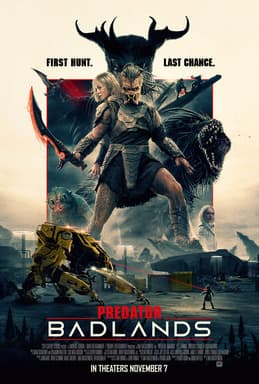
Poster via Wikipedia, Predator: Badlands. Used under fair use for criticism and review.
Let me get one thing out of the way. The interesting decision in Predator: Badlands is not that Dan Trachtenberg made a Yautja the hero. That was the headline in every piece written in the release week of 7 November 2025, and it is the least surprising thing the film does. Franchises flip to the monster’s point of view all the time, usually around the fifth entry, usually when the human protagonists have stopped working.
The interesting decision is the PG-13. Trachtenberg and 20th Century Studios took a property whose entire brand equity is built on a man’s spine being pulled out through his back, spent a reported $105 million on it, and released it with a rating that meant they could not show you that. It is the first Predator picture to carry a PG-13 since Alien vs. Predator in 2004, and Alien vs. Predator is the film the franchise has spent twenty years apologising for.
It worked. $40 million domestic on the opening weekend, a franchise record. $91.1 million domestic and $93.5 million international for $184.6 million worldwide. An A minus CinemaScore, also a franchise record, in a series where audiences have historically walked out somewhere between a B and a C plus.
Why the rating is the real risk
I say this with no pleasure, because I would rather watch the hard-R version. But the argument for the rating is structural, not commercial, and that is what makes it worth writing about.
A Predator film rated R has to keep proving the Predator is dangerous, and the way it proves that is by killing somebody memorably every fifteen minutes. That is a metronome. It is also a cage, because it means the creature can never be the audience’s point of identification for long: the moment you spend real time inside its perspective, the kills stop being frightening and start being cheering, and the film has to keep resetting.
Take the gore away and the film has to generate danger some other way. Badlands generates it through physical vulnerability. Dek, played by Dimitrius Schuster-Koloamatangi, is a runt cast out by his own clan. He is not the apex thing on the planet. He is roughly middle of the food chain on Genna, and the film is structured as a survival picture in which the audience’s monster keeps nearly dying to other monsters.
That is not a compromise forced by the ratings board. That is a story that could only be told at this rating, and Trachtenberg and screenwriter Patrick Aison clearly knew it going in.
Elle Fanning is carrying two films
Fanning plays Thia and Tessa, two Weyland-Yutani synthetics, and the doubling is where the film gets its comedy and most of its narrative engine. Thia spends a large portion of the runtime as a torso. Not a wound, a design: she is a damaged synthetic who has been severed from her legs and has to be carried, which means Fanning is playing much of her performance with almost no body available to her at all.
She is very good at it. The timing is comic without the film being a comedy, and she is doing the thing good actors do with an artificial character, which is to build the artificiality out of specific choices rather than a general flatness. Tessa is the harder role and the less successful one, mostly because the script needs her to be a plot function in the last act and Fanning cannot fix that from inside.
Alison Wright voices MU/TH/UR, which is the film’s most direct handshake with the Alien side of the house, and it is done with restraint. Two lines that connect the universes and no lore dump. After Alien vs. Predator and Requiem that restraint should be recognised as a deliberate act of repair.
The craft, which nobody wrote about
Jeff Cutter shot it. Cutter’s CV runs through 10 Cloverfield Lane, which is Trachtenberg’s first feature and a film made almost entirely in one basement, and you can see the same instinct here scaled up: hold the frame, let the creature move through it, do not cut to tell the audience that something is scary.
The New Zealand locations, shot from August to October 2024 under the working title “Backpack,” are photographed as an actual place rather than as a colour-graded alien mush. There is weather in this film. There is depth of field. The flora is designed to be dangerous in daylight, which spares the picture the standard third-act night sequence where you cannot see what is happening to whom.
Stefan Grube and David Trachtenberg cut it at 107 minutes, which for a studio science-fiction release in 2025 is close to an act of restraint. Sarah Schachner and Benjamin Wallfisch share the score, and it is the least distinctive element in the picture: competent, percussive, and largely indistinguishable from four other studio genre scores from the same year.
What the studios will take from this
Trachtenberg has now made three Predator films in three years: Prey in 2022, which Disney dumped straight onto Hulu and which was better than the two theatrical entries that preceded it combined, the animated Killer of Killers in 2025, and this. He is the only person who has worked out what the franchise is for since 1987.
The lesson available to other studios is the wrong one, and they will take it: rate your horror franchise PG-13 and the box office goes up. That is not what happened. What happened is that a director identified the one story in the property that a lower rating actively enables, wrote toward it, and then hired a cinematographer who could make a creature legible in daylight.
The gore was never the franchise. The hunt was. It took four decades and a director who started in a basement to notice the difference.
Marcus believes good criticism is an argument. He is almost always angry about something, usually for good reason. Horror is his first language.
MORE BY MARCUS VELL →
Mickey 17 and the Expensive Satire Bong Joon-ho Made
Bong Joon-ho's first film after Parasite is a $118 million science fiction satire that Warner Bros marketed badly and audiences did not know how to process. A year on, the failure is the studio's, not the director's.
A Quiet Place: Day One, and the Discipline of a Small Apocalypse
Michael Sarnoski's Quiet Place prequel is a studio horror release built to break the franchise's scale rules, and the smaller it stays, the better it works.
Dredd Was Sold as a Gimmick and Built as a Siege
Dredd lost money in 2012 and has been winning arguments ever since. The film that failed and the film that lasted are the same film, and the reason is one tower block.